
Elgato’s first wireless microphone is a $99.99 kit called the Wave Go: a 7-gram clip-on transmitter, a USB-C receiver, and a battery-carrying “Smart Handle” the transmitter docks into when you want a handheld. It went on sale in October 2026 through Elgato’s own store, which quoted delivery by October 26, and Amazon lists it at the same price, sold by Amazon, temporarily out of stock as of October 20. The spec sheet reads like a phone kit: 2.4 GHz to a USB-C receiver, about 30 meters of range, 24-bit audio, no onboard recording. Elgato says it isn’t made for direct use with a DSLR or mirrorless camera.
Last updated: October 2026. Some links below are affiliate links. Buy through them and it helps keep the site running, at no extra cost to you. Wave Go prices and specs were read on elgato.com and the live Amazon listing on October 20, 2026. Rival prices are from our October 12 Amazon read unless a date says otherwise.
How the convertible part works
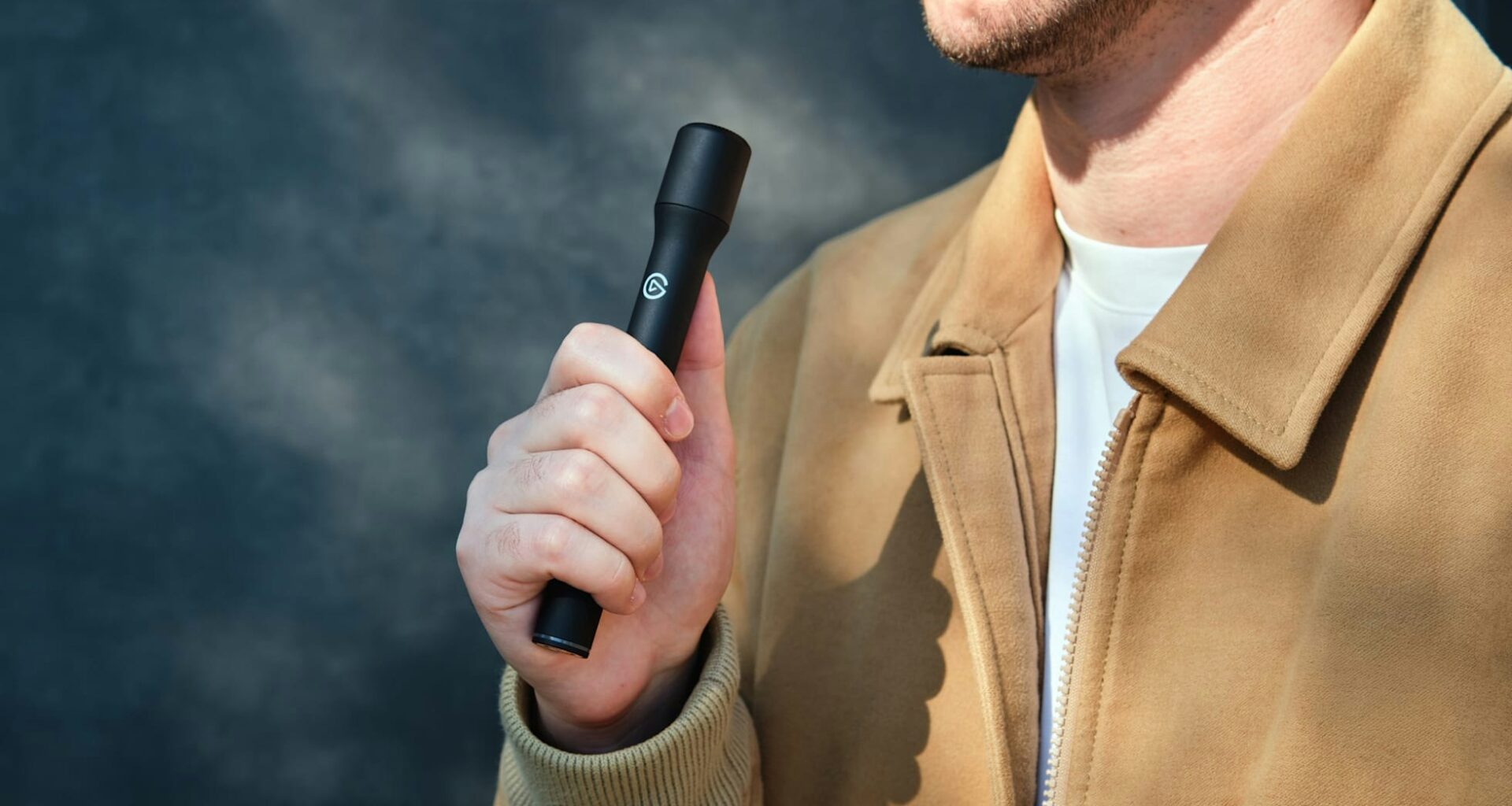
The transmitter is the microphone. On a shirt it sits on a magnetic plate or a clip, an omnidirectional electret capsule in a 7 g body that Elgato rates at about eight hours per charge. Twist it into the Smart Handle and it becomes an interview mic: the handle carries its own battery, charges the transmitter while it’s docked and recording, and puts power, record and mute buttons under your thumb. Elgato’s spec table gives the handle about 40 hours; PetaPixel’s launch piece puts the combined runtime at 48 hours, with ten minutes on the charger good for another hour. The carrying case charges both.
The system knows which mode it’s in and adjusts the processing to match, so a capsule tuned for a lapel doesn’t sound thin six inches from a mouth. No other kit at this price does that. The receiver takes a second transmitter, which Elgato sells for $14.99 at launch against a $29.99 list price, and the spare stores inside the handle.

The spec that decides it: USB-C only
The receiver is a USB-C plug and nothing else. There’s no 3.5 mm output, no camera-shoe receiver, and no Lightning version, so an iPhone 14 or older is out. Bluetooth is on the transmitter for the companion app, not for audio; the audio path is Elgato’s own 2.4 GHz link at a quoted latency of 24 ms or less. Plug the receiver into a phone or a computer and it’s a USB microphone that happens to be wireless. A camera has nowhere to take it.
The second omission matters more for anyone who films for a living. The Wave Go has no onboard recording. Every current DJI and Rode kit above $150 keeps its own copy of the take on the transmitter, so a radio dropout costs you a few seconds of the live feed and nothing else. On the Wave Go a dropout is a hole in the take. Elgato’s answer is the 30-meter range and the low latency of a dedicated 2.4 GHz link, which is fine for a phone at arm’s length and less reassuring with a subject walking away from you across a parking lot.
Against the kits it’s priced with
Nothing else at $100 converts to a handheld. On price and features the Wave Go has plenty of company, most of it from DJI and Rode. The wireless mic guide covers the full field; the four kits below are the ones a phone creator is choosing between at this price, plus the one other clip-on that becomes a handheld.
| Kit | Price (date read) | Transmitters | Handheld mode | Onboard recording | Camera output |
|---|---|---|---|---|---|
| Elgato Wave Go | $99.99 (Oct 20) | 1, second $14.99 | Yes, Smart Handle | No | No, USB-C only |
| DJI Mic Mini | $79 (Oct 12) | 1 | No | No | Only with DJI’s separate camera receiver |
| Rode Wireless Micro | $86 (Oct 12) | 2 | No | No | No, phone receiver only |
| Rode Wireless GO Gen 3 | $169.99 (Oct 12) | 2 | No | Yes, 32-bit float, 32 GB | Yes |
| DJI Mic 3 (2 TX + case) | $259 (Oct 12) | 2 | No | Yes, 32-bit float, 32 GB | Yes |
| Sennheiser Profile Wireless (2-channel) | $329 (Oct 20) | 2 | Yes, charging bar doubles as the handle | Yes, 16 GB per mic | Yes |
Read down the handheld column and the comparison narrows to one kit. The Profile Wireless was the first clip-on to turn into an interview mic, by sliding a transmitter into the end of its charging bar, and it brings two transmitters, internal recording and a receiver that plugs into a camera as well as a phone. It also costs $329, sold by Amazon on October 20. The Wave Go takes the one trick people noticed on the Sennheiser and sells it for $100 with the camera and the backup recording left out. Read across the price row instead and the Mic Mini and the Wireless Micro are cheaper, the Rode brings two transmitters, and DJI sells a camera receiver for the Mini; Mic Mini vs Wireless Micro is that decision on its own page.
Who it is for
Elgato’s own list is the accurate one: story times, street interviews, hour-long lives, and then the desk, where the handle stands in for a USB mic on calls, dictation and a podcast. That is a phone-first creator who records straight into the device and publishes from it, and who sometimes needs to hand the mic to a stranger. For that person one kit covers the lapel, the interview and the desk, and the second transmitter for $14.99 covers a guest.
It is not for anyone whose audio ends up in a camera. A mirrorless shooter, a documentary crew, or a creator who records a backup on the transmitter as a habit has nothing to use here, and the money is better spent on the Wireless GO Gen 3 at $169.99 or the Mic 3 at $259, both of which record 32-bit float on the transmitter and plug into anything. If the handheld is the draw and the camera matters, the Profile Wireless is the kit, at three times the price.
Podcasters already on an Elgato desk mic get a travel mic out of the handle, and that’s all. The Wave:3 MK.2 and the rest of the podcast mic picks are condensers and dynamics built around a fixed position and a boom arm; the Wave Go’s capsule is an omni lav that happens to have a handle.
Where to buy it
Amazon has the Wave Go at $99.99, sold and shipped by Amazon, and on October 20 the listing read “temporarily out of stock” with orders accepted for the next batch. Elgato’s own store had it in stock the same day at the same price with delivery quoted for October 26, and it is the only place selling the second transmitter at the $14.99 launch price. The black version is the one on sale in the US; PetaPixel reports a sky blue as well. Black Friday pricing for the whole category, including the kits in the table, is tracked on Black Friday wireless mic deals for creators.
FAQ
Does the Wave Go work with an iPhone? With a USB-C iPhone, yes: the receiver plugs straight in and the phone sees a USB microphone. Lightning iPhones are not supported, and there is no Lightning receiver.
Can I plug it into my camera? No. The receiver is USB-C only, with no 3.5 mm output, and Elgato says the kit isn’t made for direct use with a DSLR or mirrorless camera.
Does it record on its own? No. There is no internal storage on the transmitter or the handle; audio goes to the phone or computer in real time.
How many mics can one receiver take? Two. The second transmitter pairs to the same receiver and stores inside the Smart Handle.
How long does it run? About eight hours on the transmitter alone and about 40 hours with the handle topping it up, per Elgato’s spec table; the case recharges both.
In conclusion
For $99.99 the Wave Go is a clip-on, an interview mic and a desk mic for a creator who records into a USB-C phone or a computer and nothing else. The camera crowd and anyone who wants a backup take should stay with the DJI and Rode kits in the table. We’ll update this page when Amazon’s stock settles and when the first long-session reports on the handle come in.