


A podcast kit is four things: a microphone, a way to hear yourself, something to hold the mic at mouth height, and a way to get the signal into the computer. Longer equipment lists are selling accessories. The three kits below are built from those four parts at $150, $400 and $1,000. Every part carries its Amazon price, so each table adds up to the cent.
The $150 kit is for one person at a desk recording into a laptop. At $400 there are two people in the same room and nothing between the mics and the computer. At $1,000 a console goes in between, so each host has their own preamp, headphone jack and track. None of the three needs a mixer, and nothing in the cheaper kits is wasted when you move up.
All three kits put each voice on its own track, one per device or per channel. Two voices on one track cannot be leveled, de-noised or trimmed independently, and that is the difference between a ten-minute edit and an evening. The recording and publishing steps are in how to start a podcast, and what follows here is the shopping list.
Last updated: November 2026. Some links below are affiliate links. Buy through them and it helps keep the site running, at no extra cost to you.
TLDR
For one person, buy a Samson Q2U and a pair of Audio-Technica ATH-M20x for $138.99, or $160.06 with a Neewer boom arm. Two hosts double that on USB for $320.12, and swapping the Q2Us for a pair of Shure MV6 Gen 2, which set their own levels, brings it to $456.00. The console kit is a RØDECaster Duo with two Rode PodMic USB on XLR for $1,077.14. Swap the console for the new Zoom PodTrak P4next and the recorder build lands at $1,023.97 with better headphones and arms. If the mic is the only decision you want to make, best podcast microphone covers that on its own.
The $150 solo kit
The Samson Q2U is a dynamic microphone with both a USB port and an XLR output, and for $79.99 the box includes a desk stand, a foam windscreen and both cables. The kit uses the USB side today. The XLR side is the reason to pick it over the other USB mics at this price, because when a console or recorder arrives later, the same mic plugs into it. A dynamic capsule also picks up less of the room than a condenser at the same distance, which is the right trade for an untreated bedroom.
Headphones for recording have to be closed-back, because open or semi-open pairs leak playback and the other voice back into the mic. The ATH-M20x is a closed-back pair with 40mm drivers and a fixed 3m cable for $59.00. The cable does not detach and the cups do not fold, which is fine for a pair that lives on a desk. Wired earbuds you already own do the monitoring job for $0, so this is the first line to cut if the budget is tight, but the M20x seal better and they are the pair you will edit on.
The weak point of the kit is the Q2U’s desk stand. That stand puts the capsule at desk height, so you lean toward it for an hour and the level drifts every time you sit back. A Neewer suspension boom arm fixes that for $21.07, and if that listing is out of stock, Neewer’s MS006 is the same arm under a newer name. It clamps to the desk edge, carries up to 3.3 lb, and takes the kit to $160.06. If the Neewer is the only part of the kit you want to upgrade, the boom arm guide covers the step up to the Elgato Wave Mic Arm LP and the Rode PSA1+. The software costs nothing: Audacity runs on either platform and GarageBand on a Mac.
| Part | Pick | Price |
|---|---|---|
| Microphone | Samson Q2U (USB and XLR, desk stand in the box) | $79.99 |
| Headphones | Audio-Technica ATH-M20x | $59.00 |
| Mic mount | The Q2U’s included desk stand (boom arm, $21.07, optional) | $0.00 |
| Interface | None, the mic connects over USB | $0.00 |
| Software | Audacity or GarageBand | $0.00 |
| Total | $138.99 |


The $400 two-host kit
Two hosts in one room need two of everything in the solo kit and one decision: how two microphones reach one computer. The cheapest answer is two USB mics, and the parts are the solo kit twice over. Two Q2U come to $159.98, two ATH-M20x to $118.00 and two Neewer arms to $42.14, for a total of $320.12. The arms are part of this kit from the start, because with two people the lean-in problem doubles.
Before you buy, check how your recording software handles two USB devices. On a Mac, Audio MIDI Setup combines both Q2Us into one Aggregate Device, which records as a two-channel file with one voice per channel. Split it into two mono tracks and each host can be leveled alone. On Windows the application has to open both devices itself, and Audacity records from one device at a time, so plan on software that takes two inputs or on the console kit below. If the laptop has one free USB port, a powered USB hub covers the second mic. Any generic hub does, so it is not counted in the table.
That total leaves $80 under the headline, and the better use of it is one upgrade. The Shure MV6 Gen 2 is a dynamic USB-C mic with auto level, which means it sets the gain and holds it, the job a new host gets wrong most often. A pair costs $338.00, so with the two M20x the kit comes to $456.00. That puts it $56 over the $400 line, and it is the version to buy for a show where nobody wants to think about levels. The trade is that the MV6 has no XLR output, so it does not grow into the console kit the way the Q2U does. The MV6 ships with its own stand and cable, so the arms become optional.
| Part | Pick | Price |
|---|---|---|
| Microphones | 2× Samson Q2U | $159.98 |
| Headphones | 2× Audio-Technica ATH-M20x | $118.00 |
| Arms | 2× Neewer suspension boom arm | $42.14 |
| Interface | None, both mics on USB (a powered hub only if the laptop has one free port) | $0.00 |
| Software | Audacity or GarageBand, with an Aggregate Device on a Mac | $0.00 |
| Total | $320.12 |

The $1,000 two-host kit with a console
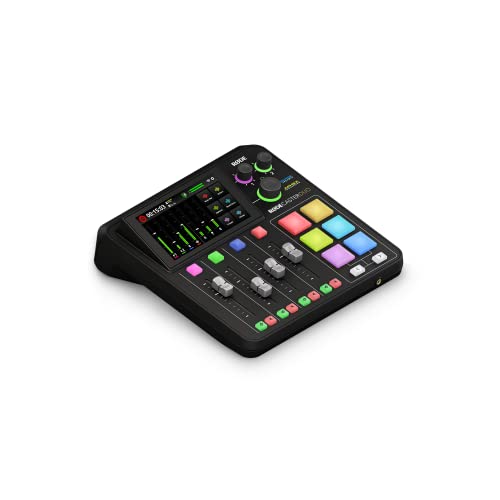
The console accounts for $499.00 of this kit. The RØDECaster Duo gives each host a preamp, a jack and a track with no software routing, because it has two combo XLR inputs on its own preamps, two headphone outputs and USB-C multitrack to the computer. There are six pads as well. One box replaces the Aggregate Device, the hub and the levels question from the $400 kit.
With a console on the desk, the microphones move to XLR. Two Rode PodMic USB at $418.00 run on their XLR outputs into the console and keep the USB-C port as a fallback for recording into a laptop on the road. The headphones are still the $118.00 pair of ATH-M20x and the arms are still the $42.14 pair of Neewer arms. The table comes to $1,077.14, which is $77 over the headline, and two generic XLR cables are extra. To get back under it, run two Q2U on XLR instead of the PodMics. That version lands at $819.12, and the console still gives you the monitoring and the separate tracks.
The Shure step-ups do not fit this budget for two hosts. The Shure MV7+ is a hybrid USB-C and XLR mic at $299.00, so a pair adds $180.00 to the table. The Shure SM7dB is the broadcast mic with its preamp built in. At $549.00 each, two of them cost $1,098.00 before anything else, which is why it belongs on a solo desk at this budget. The headphone upgrades are the Sony MDR-7506 at $113.00 and the Audio-Technica ATH-M50x at $159.00, and MDR-7506 vs ATH-M50x settles which.
The console is the luxury in this kit, and a recorder does the core job for $179.99. The Zoom PodTrak P4next is new this fall, and it is here because it has four headphone outputs, so two hosts monitor with no splitter and there is room for a third and fourth voice. It also has four XLR inputs, SD recording, a phone input, USB audio to the computer, battery power and AI noise reduction. The original PodTrak P4 still turns up at $149.99, but it is the older model and the P4next is the one to buy. The recorder build keeps the same two PodMics and adds two MDR-7506 at $226.00 and two Elgato Wave Mic Arm LP at $199.98. It comes to $1,023.97, which is less than the console table, with better headphones and low-profile arms. What the console adds on top of that is the pads, the screen and Rode’s preamps.
The third route is an audio interface. The Focusrite Scarlett 2i2 4th Gen is $224.99 with two combo inputs, 48V, Air mode and auto gain. What it lacks is a second headphone output. Two hosts on a 2i2 would share a splitter and a single volume setting, so it suits one host plus a remote guest better than two people in the room.
| Part | Pick | Price |
|---|---|---|
| Console | RØDE RØDECaster Duo | $499.00 |
| Microphones | 2× Rode PodMic USB (on XLR) | $418.00 |
| Headphones | 2× Audio-Technica ATH-M20x | $118.00 |
| Arms | 2× Neewer suspension boom arm | $42.14 |
| Software | Audacity or GarageBand, taking the Duo’s multitrack over USB-C | $0.00 |
| Total | $1,077.14 |


What to skip
Skip the analog mixer. The small mixers that show up in beginner lists sum both voices to one stereo mix before the computer sees them, so both hosts land on one track and one person’s cough gets cut out of both voices. The USB mics in the first two kits do without one, and the console and recorder in the third are multitrack.
If $1,000 is a stretch, the $499 console can wait. The recorder build above covers the same per-host preamp, jack and track for $319.01 less, and it records to an SD card without a computer in the room. The pads and the screen are worth having once the show is a habit.
The Rode PSA1+ at $137 is the arm every list names, and you can skip it. The Elgato Wave Mic Arm LP holds the same mics for $99.99 and stays out of the frame on camera, and the Neewer does the job for $21.07. The only Amazon listing we found for the PSA1+ was a resale unit, so it is not linked. The Sennheiser HD 280 Pro is in the same position. At $89.99 it sits between the ATH-M20x at $59.00 and the MDR-7506 at $113.00 and does the same closed-back job. Its listing was a resale unit too, so either end of that range is the cleaner buy.
Pop filters and cables are generic. The Q2U ships with a foam windscreen, the PodMic USB has its pop filter built in, and a foam cover from any brand handles anything else. The two XLR cables for the console kit are whichever 10-foot cables are cheapest with a brand name on them; an expensive pair does not show up in spoken word. Acoustic panels wait until you have recorded in the room and heard what it does.
Remote guests
A remote guest needs none of this hardware. Riverside, Zencastr and Descript record the guest’s side locally in their browser and upload it afterward, so each track is whatever mic was on that end. One host plus a remote guest is the solo kit plus one of those services; the two-host kit covers one in-room host plus a remote guest with a mic to spare. Ask the guest to wear earbuds, or your voice comes back through their laptop speakers into their mic. The PodTrak P4next‘s phone input takes a guest on a call as its own channel, no browser needed.
FAQ
Do I need an audio interface to start a podcast?
No, for one or two hosts on USB mics. The Q2U and the MV6 Gen 2 have the converter built in. An interface, console or recorder comes in with XLR mics or a hardware headphone jack per host. If you buy one, count the headphone outputs: the Scarlett 2i2 4th Gen has one, the RØDECaster Duo has two, the PodTrak P4next has four. Audio recorders and interfaces goes deeper on the hardware.
USB or XLR microphone for a podcast?
Buy USB for one voice into a laptop, and XLR once there is a console or recorder to plug into. The Q2U and the PodMic USB have both connectors, which is why they anchor two of the three kits. The field inside each type is in best USB microphone and best XLR microphone.
Can two people share one microphone?
Not well. A dynamic podcast mic is built to reject sound from the sides, so the second voice comes through quieter, roomier and on the same track as the first, and nothing in the edit separates them. One mic per voice is the rule, and the Q2U at $79.99 keeps the cost of following it low.
Can I start with my camera mic or a gaming headset?
For a test episode, yes. A camera’s built-in mic sits a meter from your mouth and records the room as loudly as the voice; a headset mic is close enough but tuned for voice chat. The $138.99 solo kit is the smallest step that fixes both, and its Q2U is still the mic in the $819.12 version of the console kit.
Where the kit goes from here
Once the parts are on the desk, how to start a podcast covers the recording, editing and publishing side. The mic decision on its own is in best podcast microphone, with the field split into best USB microphone and best XLR microphone. For the box between the mic and the computer, audio recorders and interfaces for video work goes deeper, and Sony MDR-7506 vs Audio-Technica ATH-M50x is the headphone upgrade question answered.


