


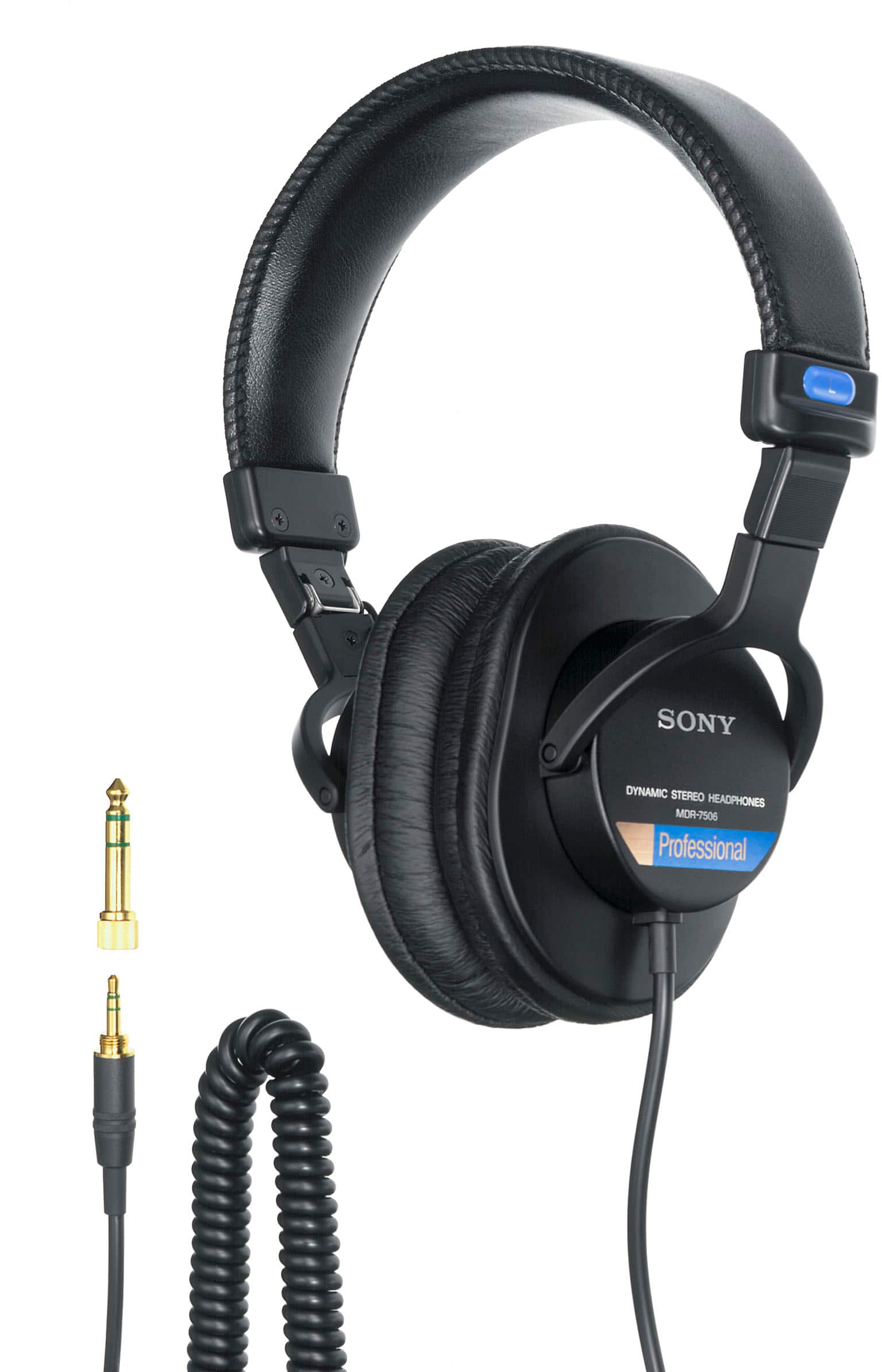
Walk into any edit bay, mix room, broadcast truck or podcast closet and one of two headphones is hanging on the hook. The Sony MDR-7506 has been in production since 1991 and costs $113. The Audio-Technica ATH-M50x arrived in 2014 and costs $159. I own both, I’ve had both for years, and they are not interchangeable. One of them is a tool for finding problems in dialogue. The other is a nice pair of headphones that a lot of people bought for editing because the internet told them to.
Our editing headphones guide ranks the whole shelf. This page is the head-to-head for the two everyone already has an opinion about, written for the person who is going to buy one of them this week and wants to know which.
Last updated: October 2026. Some links below are affiliate links. Buy through them and it helps keep the site running, at no extra cost to you. Prices were read on the live Amazon listings on September 29, 2026, both sold by Amazon itself. Best Buy had both listed and neither in stock.
TLDR
For editing video, buy the MDR-7506. It is $46 cheaper, it is lighter, and its bright, forward tuning is the reason it became the standard: it shows you the sibilance, the mouth clicks and the room tone that a flattering headphone hides, and it is what the mixer who gets your timeline is probably wearing. Buy the ATH-M50x if you also track music, want a detachable cable, or want one pair that is pleasant to listen to when the work is done. Its tuning smooths over the same dialogue problems the 7506 shows you.
The tuning decides it
Put the 7506 on and the first thing you notice is that it is bright. It is also the pair I put on my gift list for editors, for the same reason. There is a lift through the upper mids and lower treble, roughly 2.5 to 5 kHz, and a slight dip in the low mids under it. Sony has left it that way for thirty-five years because it works. Every consonant, every lip smack and the air-conditioner hum sit right where the 7506 is loudest, so a dialogue problem announces itself before you go looking for it. When I’m cutting an interview and something sounds slightly off in the room, the 7506 tells me what it is in one pass, whether that is a de-esser mistake or a noisy edit point.
The M50x is tuned to be liked. The bass is lifted a little, the treble is pulled back a little, and the whole thing sits in a gentle scoop that makes music sound expensive. The “bass cannon” reputation is overstated for the current x revision, which rolls off under 40 Hz and is more conservative than the forum lore, but the lift is still there and it does the thing a lift always does in an edit: it fills in the low end so a thin voice sounds fuller than it is, and it rounds off the top so a harsh voice sounds smoother than it is, right up until the client plays the cut on a laptop and hears what you didn’t.
The M50x is accurate enough that plenty of music has been tracked and mixed on it. It is the wrong shape for the specific job of judging speech, and speech is most of what a video editor judges.
Comfort, clamp and heat
Neither of these is a headphone you forget you’re wearing, and the two fail in opposite directions. The 7506 weighs about 230 grams without its cable and sits lightly, but the pads are thin and shallow, so on bigger ears it behaves like an on-ear. After two hours the pad edges are pressing on cartilage. Glasses make it worse. It does breathe, though, which matters in a warm room.
The M50x is 285 grams and clamps harder out of the box, with a headband that finds one spot on top of your skull and stays there. The pads are deeper and softer, so ears sit inside them, which is the better design. The pleather traps heat, and by the second hour of a summer session my ears are damp. The clamp eases after a few weeks; the heat never does. Over a full day I’d call it even, which is a polite way of saying I take both of them off at the same points in the afternoon.
If the comfort question is the one that matters most to you, neither of these is the answer. The Sony MDR-M1 is what the 7506 becomes when someone finally deals with the pads and the treble, and the Beyerdynamic DT 770 Pro in the 80 ohm version is the all-day pick in the headphones guide, and both cost more than either of these.
The cable and the pads
Here the M50x wins outright, and it isn’t close. Its cable detaches with a quarter-turn lock at the cup, and the box has three of them: a coiled one that stretches to about three meters, a three-meter straight, and a short 1.2-meter straight for a laptop or a phone dongle. When a cable dies, you buy a cable. The lock is proprietary, so third-party cables have to be the right kind, but they exist and they are cheap.
The 7506’s cable is a fixed coil, about 1.2 meters relaxed and three meters stretched, and it is the most common reason a pair dies. The coil is heavy enough to tug on the left cup all day, and when it fails the fix is a soldering iron or a detachable-jack mod that people have been doing since the nineties. I’ve owned three pairs. Two of them ended because of the cable.
Pads are a wear item on both. The 7506’s pleather flakes within a year or two of daily use, and the little black confetti on your desk is the sign. Genuine Sony pads are around $16, and the aftermarket has deeper, better pads for a few dollars more, which fixes the comfort complaint above at the same time. The M50x pads harden and peel too, more slowly, and Audio-Technica’s own replacement pair is about $27, so budget for pads on either one rather than counting them as a defect.

What I use each one for
The 7506 lives at the edit desk and goes in the bag for set days. It is the headphone I check dialogue on, the one I hand to a producer who wants to hear a take back, and the one I don’t mind losing because there are four more in the building. On a location it is the crew standard, so when the sound mixer says “listen to this,” what they hand you is a 7506 and you already know its sound, which is worth more than any spec on the sheet.
The M50x lives at the other desk. It is what I put on to listen to a music bed before it goes in a cut, to track a voiceover when I want the talent to enjoy the playback, and to listen to music when the day is over. It isolates a little better than the Sony above 1 kHz, the cups swivel flat for one-ear monitoring, and the detachable cable means it survives being thrown in a drawer. It is a fine general-purpose closed-back headphone. It is just not the one I judge a mix on, and when I catch myself doing it I switch.
If you can only own one and you cut video for a living, the 7506 is the one. If you can only own one and you are a musician who also edits, the M50x is a fair compromise as long as you check dialogue on a second source before delivery, which you should be doing anyway, and the studio monitors guide covers what that second source should be.
Side by side
| Headphone | Amazon, Sept 29 | Tuning | Weight (no cable) | Impedance | Cable | Pads | Warranty |
|---|---|---|---|---|---|---|---|
| Sony MDR-7506 | $113 | Bright, forward upper mids; exposes speech problems | ~230 g | 63 ohm | Fixed coil, 1.2 to 3 m | Thin pleather, ~$16 to replace | 1 year |
| Audio-Technica ATH-M50x | $159 | Gentle scoop, mild bass lift; flatters speech | 285 g | 38 ohm | Detachable, three included | Deeper pleather, ~$27 to replace | 2 years |
Both are closed-back with passive isolation only, both fold, both drive fine from a laptop or a camera without an amp, and both have been in production long enough that pads and repair guides are everywhere.
In conclusion
Which would I buy today if I owned neither? The MDR-7506, with a $20 set of aftermarket pads in the same order, and I’d put the $46 I saved toward the day the cable goes. It is the sharper tool for the work, and it is the sound the rest of the industry is checking against. The ATH-M50x is the one I’d buy second, for everything that isn’t judging a voice.
And that’s it! As always, what you see here is what works for me, my clients, and my crew. Your ears, your room, and your delivery spec get the final vote. The full shelf, including the M1 and the DT 770 Pro, is in the best headphones for video editing guide. Cutting on something else entirely? Leave a comment.


