Every guide to studio monitors is written for someone making music. Flat response for mixing beats, punchy low end, DJ-adjacent vibes. You’re not doing that. You’re an editor: you spend your day setting dialogue against music and ambience, in a spare bedroom or an office corner that has never seen a bass trap, and the question that matters is whether you can trust what the voice sounds like. That’s a different job, and it gets a different answer.
Here’s the thesis of this whole guide, learned the hard way in my own room: in an untreated space, room correction beats cabinet size. A modest speaker that gets calibrated to your room will tell you the truth about a dialogue mix; a bigger, prettier speaker firing blind into drywall will lie to you in the low mids all day. So the picks below are weighted hard toward monitors that can measure or correct for your room, and toward front-ported designs that tolerate sitting a foot from a wall, because that’s where your desk is.
Last updated: July 2026. Some links below are affiliate links; buying through them supports the site at no cost to you. Speaker prices caught the same 2026 supply weirdness as everything else, so every price here is a late-July snapshot. Check the listing.
TLDR
If you just want the answer: the IK Multimedia iLoud MTM MKII is the best monitor purchase for most editors, because the pair ships with a measurement mic and calibrates itself to your room in ten minutes. On a tighter budget, the Kali LP-6 V2 is the best-measuring speaker under $500 a pair. And if you want the endgame, the ADAM A7V is what I’d buy again: I’ve run its predecessor, the A7X, for years.
The picks
Best for most editors: IK Multimedia iLoud MTM MKII
The MTM MKII pair is $799.99 with the ARC measurement microphone in the box, and that mic is the entire point. You set the speakers on your desk, run ARC calibration, and the DSP corrects the response for the actual room you edit in: the wall behind the desk, the bare floor, the window on one side. Ten minutes, no acoustics degree. The result measures absurdly well for the size (independent Klippel testing has the corrected response within about ±2.2dB through the range that matters, with real output down to the low 50s Hz), and the symmetric mid-tweeter-mid layout keeps the voice band stable whether you’re sitting up straight or slouched at hour six. Dialogue against a music bed on these is just… settled, and you stop second-guessing.
They’re compact, so they won’t fill a big room or flatter a client demo, and ARC only fixes the response at your listening position, not the whole space. If your suite doubles as a client screening room, look at the A7V below instead. For one editor at one desk, this is the calmest money in the guide.

Worth cross-shopping at this tier: the ADAM A4V (about $600 each, so ~$1,200 a pair at July street prices) brings ADAM’s X-ART tweeter and in-speaker DSP to a 4″ cabinet, and the Kali IN-5 ($449 each) puts the entire voice band through one coaxial driver, which is a clever way to get a stable midrange without DSP. Both are excellent; neither ships with a mic at this price, which is why the MTM MKII holds the slot.
Best on a budget: Kali Audio LP-6 V2
Kali’s LP-6 V2 is the speaker that made cheap monitors respectable. Independent measurements put it within ±2.5dB through the critical range with honest bass into the low 40s Hz, which embarrasses some monitors at twice the price. The two features editors should care about: it’s front-ported, so shoving it against the wall behind your desk doesn’t turn the low end to mud the way it does on rear-ported boxes, and the back panel has boundary-EQ dip switches with settings for exactly that placement. It’s a speaker designed by people who know you don’t have a treated room.
Price and stock were the problem at the July 2026 check: list is $199 each, but listings were running about $249 each from marketplace sellers with single-digit stock. At $400 a pair it’s the easy call; at $500, check the alternatives below before you click.

Two very good runner-ups here. The JBL 305P MkII pair was $299 at the July check, from a healthy listing, and its waveguide gives it a wide, forgiving sweet spot; it’s rear-ported, so it wants a few inches of breathing room behind it. And the Yamaha HS5 pair ($339.98) is the white-coned classic you’ve seen in a thousand studio photos. It is consistent and brutally revealing in the mids, and its one limit for our work is the 5″ cabinet, which rolls off steeply below about 74Hz, so you’re guessing about the bottom octave of a music bed. Fine for dialogue-first work, or pair it with its bigger sibling the HS7 in a larger room. Yamaha is always a safe buy; it just doesn’t correct for your room, and this guide’s whole argument is that your room is the problem.
Best endgame: ADAM Audio A7V
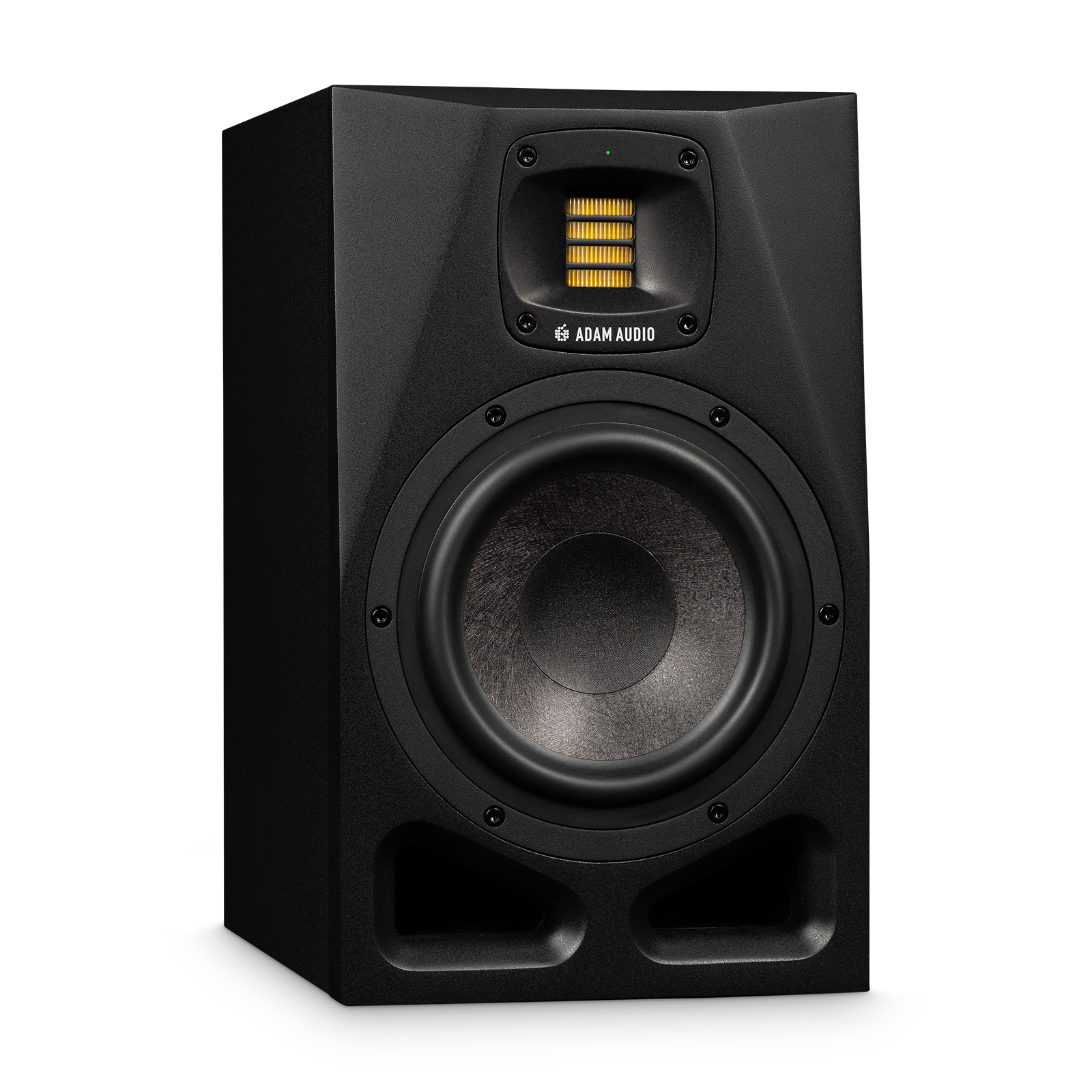
This pick is personal. I’ve run ADAM A7X monitors on my PC for years with Sonarworks SoundID Reference doing the room correction in software, calibration mic and all. It’s the sound I trust. The A7V is that speaker’s successor with the correction moved into the hardware: the A-series has a DSP platform inside the cabinet that hosts your SoundID Reference calibration profile directly. You measure the room once, push the profile to the speakers over A Control, and from then on the correction runs in the monitors themselves. No plugin, no CPU hit, no software running. Works the same whether the source is your NLE, a browser, or a client’s laptop plugged into your interface.
The speaker under all that DSP is proper: 7″ woofer, ADAM’s X-ART ribbon tweeter (the top end is detailed without the sizzle that makes long sessions fatiguing), and enough output to run a real suite and a client couch. Price is about $899.99 per speaker, so ~$1,800 a pair, and at the July check the healthiest listing was a special order from Adorama. Budget another $249 for the SoundID Reference kit with the measurement mic if you don’t already own it; without it the DSP still gives you voicings and room EQ presets, but the measured calibration is the reason to buy in.
The measurement-nerd alternative is the Neumann KH 120 II ($949 each), the best-measuring 5.25″ monitor made, with Neumann’s MA 1 mic (about $250 extra) doing automatic room alignment. It’s a phenomenal speaker and the right pick for a small desk at this budget. Genelec’s 8030C sits in the same conversation and is built like lab equipment, but at this price rung it’s analog only: Genelec’s GLM calibration needs the step-up SAM series at roughly $3,200 a pair, which is a lot to pay for a calibration the MTM MKII ships with in the box.
Best for a shallow desk: IK Multimedia iLoud Micro Monitor Pro
If your “edit suite” is a desk against the bedroom wall and every centimeter counts, these are the answer. The Micro Monitor Pro pair is $599.99 including the ARC mic, and the calibration story is the same as the MTM MKII’s: measured correction for your actual space, in speakers the size of a coffee mug stack. Physics still exists, so don’t expect real low bass from 3″ woofers, but the corrected midrange is shockingly trustworthy for dialogue work, and they fit where literally nothing else in this guide does.

The cheaper desk option is the ADAM D3V at $349.99 a pair: USB-C straight from your machine, a flat ±2dB tuning, and three room presets in its DSP. Presets aren’t measured calibration, which is the gap between it and the IK, but as a first pair of real monitors for a laptop editor it’s a lovely little product.
The accessories that matter
Three cheap things move the needle more than a speaker upgrade. First, get the monitors off the desk surface: the IsoAcoustics ISO-155 stands (about $135 a pair) decouple the cabinets so your desk stops acting as a resonator, and their tilt puts the tweeters at ear height, which matters more than any EQ switch. Skip the foam-wedge route if you can; the rigid stands measurably outperform them.
Second, the Mackie Big Knob Passive ($69.99) puts a volume knob and, crucially, a mono button on your desk. One press collapses your mix to mono, which is the fastest dialogue QC that exists: if the voice stays clear in mono, it survives a phone speaker, a laptop, and a TV soundbar. Editors mixing for social should be hitting that button on every export.
Third, if you go the ADAM route (or want to fix the monitors you already own), the Sonarworks SoundID Reference kit with the measurement mic is $249 and calibrates any speaker in software. It’s the exact setup I’ve run for years on the A7X pair.
And the accessory you don’t need: a subwoofer. Dialogue intelligibility lives roughly between 100Hz and 8kHz; the three main picks here (the MTM MKII, the LP-6 V2 and the A7V) reach the low 50s Hz, and the Micro Monitor Pro is the one that gives up that bottom end, in exchange for the footprint. An uncalibrated sub in an untreated room adds boom you can’t trust, and you’ll start ducking music under dialogue to compensate for a problem that only exists in your room. The exception is trailer-style, music-forward work with calibration in the loop (ARC and SoundID can both manage a sub). Everyone else: spend the sub money on the stands and the mic, and pocket the rest.
The picks side by side
| Monitor | Size | Price/pair | Port | Room correction | Best for |
|---|---|---|---|---|---|
| iLoud MTM MKII | Dual 3.5″ MTM | $799.99 (mic incl.) | Front | ARC, measured, built in | Most editors |
| Kali LP-6 V2 | 6.5″ | $400 to $500 | Front | Boundary EQ switches | Budget, near-wall desks |
| JBL 305P MkII | 5″ | $299 | Rear | Two trim switches | Cheapest solid pair |
| Yamaha HS5 | 5″ | $339.98 | Rear | Two switches | The mid-forward classic |
| ADAM A7V | 7″ | ~$1,800 | Front | SoundID profile in-speaker | The endgame suite |
| Neumann KH 120 II | 5.25″ | ~$1,898 + MA 1 mic | Rear | MA 1 auto-alignment | Small-desk reference |
| iLoud Micro Pro | 3″ | $599.99 (mic incl.) | Front | ARC, measured, built in | Tiny desks |
| ADAM D3V | 3.5″ | $349.99 | Passive radiators | 3 presets | USB-C starter pair |
How to choose (what matters for edit work)
Room correction comes first. Your untreated room imposes ±10dB swings on whatever speaker you put in it, which swamps every difference between these products on a spec sheet. Anything that measures your room and corrects for it (ARC, SoundID, MA 1) is solving the biggest problem you have, which is why the pick order above looks the way it does.
Front ports beat rear ports on a desk. A rear-ported speaker jammed against a wall reinforces its own bass and smears the low mids where chest tones and room rumble live. If your monitors will sit within a foot of a wall, front-ported (Kali, ADAM A7V, the iLouds) or sealed-ish designs should get priority, or use the rear-ported speaker’s boundary trims and mind the gap.
Size the woofer to the room. A 5″ to 6.5″ woofer is right for a normal bedroom-office suite. Eight-inch monitors in a small untreated room excite room modes you can’t hear around; they make things worse, at higher cost. The volume you edit dialogue at (quiet, conversational, hours at a time) doesn’t need the output anyway.
Fatigue is a spec, because you listen for six hours, not thirty minutes. Harsh top ends make you tired, and tired ears mix badly. The ribbon tweeters on the ADAMs and the corrected response on the calibrated picks are specifically good at not wearing you down. If a speaker impresses you in the first ten seconds of a demo, be suspicious; impressive is usually hyped, and hyped is exhausting.
FAQ
Can’t I just edit on headphones?
You can, and a good pair of cans is the other half of a trustworthy setup; I check every mix on both. But headphones hide how dialogue and music interact in air, and they lie about stereo width. The combination is the answer: monitors for balance decisions, headphones for detail work and noise checks. The headphone side of that setup is in our audio-on-a-budget guide.
Do I need acoustic treatment too?
Treatment helps, and even two panels at the first reflection points are worth more than a speaker upgrade. But calibration gets you most of the way to trustworthy dialogue decisions in a normal room, and it’s a ten-minute job instead of a construction project. Do calibration now, treatment when you’re ready.
Is the Yamaha HS5 bad? Everyone recommends it.
Not bad at all; it’s a workhorse with a famously revealing midrange, and Yamaha build quality is real. It’s just uncorrected and light on bass below ~74Hz, which for editors in untreated rooms means more guessing than the calibrated picks require. If you already own HS5s: keep them, add the $249 SoundID kit, and you’ve built a better system than most of this list.
Mono button… seriously?
Seriously. A huge share of your audience hears your work on a single phone speaker. Summing to mono exposes phase problems and buried dialogue instantly, before your client’s phone does it for you.
In conclusion
Buy the iLoud MTM MKII if you want the best dialogue-truth per dollar, the Kali LP-6 V2 if the budget is real, and the ADAM A7V when you’re building the room you’ll grade and mix in for the next decade. Whatever you buy, put it on stands, calibrate it, and learn the mono button. That’s the system, and it’s cheaper than the sub you were about to order.
And that’s it. The full answer is monitors plus headphones plus a little treatment, and the audio mixing on a budget guide, the headphones guide and the acoustic treatment guide pick up where the speakers leave off. For the headphone half of that answer, start with Sony MDR-7506 vs ATH-M50x. What you see here is what works for me and the rooms I’ve mixed in; if your space is doing something stranger, describe it in the comments and I’ll point you at a pick.