


A camera bag is the piece of kit most people buy twice. The first is whatever was cheap the week the camera arrived. The second gets bought after a lens cap rolls out of an unpadded pocket, or a cage with the monitor still on the arm refuses to go in at all. I’d like you to skip to the second purchase, and I’d like it to cost less than the lens it protects.
This is a guide for a video kit, which changes the bag more than the bag companies let on. A photo kit is a body and three lenses, and it packs flat. A video kit is a caged body, a monitor on an arm, a shotgun mic, a wireless receiver, a stack of batteries and a laptop, and none of it packs flat. So the picks are organized by job: the everyday backpack, the travel backpack, the two-body backpack, the one-body sling, the hard case for flights, and the roller for a cinema kit.
I go from set to the suite with the footage as often as I go the other way with a camera, so there’s also a section on the offload bag: where the readers, cables and SSDs ride, and what never goes in checked luggage.
Last updated: November 2026. Some links below are affiliate links. Buy through them and it helps keep the site running, at no extra cost to you. Prices were checked at Amazon and Best Buy in late October 2026 and will drift.
TLDR
If you just want the answer: the Peak Design Everyday Backpack V2 30L is the bag I’d point most video shooters at, and it’s $239.96 at Amazon from Peak Design’s own storefront. The value pick is the Peak Design Everyday Sling 10L at $169.95 if you run one body and leave the laptop at home. If the body is a cinema camera and it’s going on a plane, skip the fabric and buy the Pelican Air 1535 at $314.95. The rest of this guide is which job each bag does, and which ones you can skip.
The picks
Best everyday backpack: Peak Design Everyday Backpack V2 30L
The case for the Everyday Backpack V2 30L is one motion: the bag stays on one shoulder, a side zip opens, the body comes out. Both sides open, so one holds the camera and the other the mic and monitor, and the MagLatch top closes one-handed over the batteries. Thirty liters covers a mirrorless body, two lenses, a shotgun mic, a 5-inch monitor and a day of batteries, with a 16-inch laptop in its own sleeve against your back. It’s $239.96 at Amazon from Peak Design’s own storefront; Best Buy had it at $209.99 when I checked, if you’d rather buy there.
The FlexFold dividers are designed around lenses, so a caged body with the monitor still mounted takes more of the interior than the layout expects; pull the monitor and it packs fine. Don’t be tempted by the older 30L V1, which Amazon still listed at $299.95 when I looked, more than the current bag. If you’d rather carry something that looks like a camera bag and costs less, the Lowepro ProTactic 350 AW III is the one-body version of the two-body pick below.

Best travel backpack: WANDRD PRVKE 31L
The WANDRD PRVKE 31L solves the problem a day bag can’t: a shoot with a night somewhere in it. The camera gear lives in the bottom, the roll-top expands the bag from 31 to 35 liters for a change of clothes and a jacket, and a quick-draw side hatch gets the body out without unrolling anything. There’s a sleeve for a 16-inch laptop and the materials are weather-resistant, which matters on a bag that waits on train platforms. It’s $344.00 from WANDRD’s Amazon storefront.
That’s a lot of money for a backpack, and the roll-top is a two-step close when you’re in a hurry. The side hatch gives you one body and the lens beside it; anything deeper means opening the back panel. The other bag in this class is the Nomatic McKinnon 35L V2, the one you see on a lot of YouTubers, which expands from 35 to 42 liters, takes the same 16-inch laptop, and costs $419.99. Buy the Nomatic if you pack more clothes than camera; otherwise the WANDRD saves you $75. If you travel light, the Peak Design 30L above handles two nights for $134 less.

Best for a two-body kit: Lowepro ProTactic BP 450 AW III
Once there’s an A-cam and a B-cam, the question is whether either comes out without unpacking the other. The Lowepro ProTactic BP 450 AW III opens four ways, the top, both sides and the full back panel, so each body gets its own door. Its 28 liters are all padded camera space with no lifestyle compartment, which is why it holds more camera than the Peak Design despite the smaller number. A 16-inch laptop fits, and the AW is Lowepro’s rain cover, stowed in the base. AW III is the current generation; the AW II in older roundups is the one it replaced. It’s $292.99, sold by a third party at list price.
It looks like a camera bag, and a tactical one, which is a consideration in some cities and none at all on a set. The exterior webbing is for strapping on a tripod or a bottle, and it adds bulk whether or not you use it. For one body, the smaller ProTactic 350 AW III has the same access layout for less money.

Best one-body sling: Peak Design Everyday Sling 10L
For a b-roll afternoon, a backpack is a commitment you re-open on the ground every time. The Everyday Sling 10L swings around to the front and the body is in your hands. Ten liters is one body with a lens mounted, a second lens, a small on-camera mic and a few batteries, held apart by the same FlexFold dividers as the backpack. It carries crossbody or on the waist, and at $169.95 it’s the cheapest bag in this guide.
Its limit is the cage. A caged body with a monitor on top does not go in a 10-liter sling; a bare mirrorless body with a top handle is the most it wants. It isn’t a laptop bag either, so it’s the second bag you own rather than the only one. Peak Design also makes a 6L version; that’s the one if your body is small and you never carry a second lens, and the 10L is the one for anything with a mic on top.

Best hard case for flights: Pelican Air 1535
Once the body is a cinema camera in a cage, a backpack’s padding isn’t enough for a baggage belt. The Pelican Air 1535 is the carry-on-sized case from Pelican’s lighter Air line, with Pick N Pluck foam you cut once to the shape of your kit: body, cage, two lenses, monitor and batteries in the holes you choose. It fits the overhead bin, it survives being checked when a gate agent decides that for you, and it’s $314.95 sold by Amazon.
Pluck the foam and that layout is permanent; change cameras and you’re buying a new foam set or a divider insert. There’s no laptop sleeve, so the computer rides in a separate bag, which is how it should be anyway (more on that below). And it takes a hand rather than a shoulder, so it’s the wrong tool for a day of walking. It’s the same case in our on-set VFX data kit, because the kit inside costs more than the case. If your gear never gets checked, a padded backpack is the cheaper answer.

Best roller for a cinema kit: Think Tank Airport Advantage
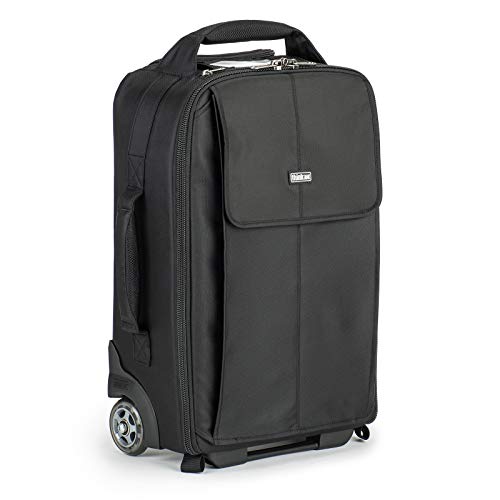
A roller is for the kit that’s too heavy to wear: cinema body, cage, two or three cine lenses, monitor, a brick of batteries, and a shoulder that has to still work tomorrow. The Think Tank Airport Advantage is Think Tank’s carry-on-sized roller, $319.75 from Think Tank’s own Amazon storefront. Stock was thin when I checked, so check back if the listing is empty rather than paying a reseller’s markup.
Think Tank sells bigger versions of the same bag: the Airport Advantage XT at $349.75, the Airport Security V3 at $469.75, and the Roller Derby V2 at $429.75. Lowepro’s Pro Trekker RLX 450 AW II, $499.95, is a roller that converts to a backpack. None of them is cheaper than the Advantage, so start there. Every roller shares two weaknesses: wheels are useless on gravel and stairs, and a soft shell is carry-on protection, not checked-bag protection. The Pelican above is a few dollars less and takes the checked-bag beating; buy the roller when you’re wheeling it through terminals every month and never letting go of it.
The offload bag: where the footage rides
The bag I think about most isn’t the one with the camera in it. Between set and the suite, the things that can’t be replaced are the cards, the drives they get copied to, and the laptop that did the copying. My rule: media, drives, laptop and spare batteries fly in the cabin with me, never in a checked bag. The batteries because the FAA requires spare lithium batteries in carry-on. The media because no insurance payout brings back a shoot day.
Inside whichever bag I’m carrying that day, the offload kit lives in a Peak Design Tech Pouch, $59.95. It’s an organizer with accordion pockets: reader in one, cables in the next, two SSDs standing up in the back, and the whole thing lifts out of the backpack and drops into the roller or the Pelican. The two drives I’d put in it are the OWC Envoy Ultra 2TB as the fast working copy and a Samsung T9 2TB as the cheaper second copy, which goes in a different pocket, or a different bag, than the first. The two-copies-before-you-format routine is written up in our travel offload and backup workflow, and the full-size version of this kit, with a cart instead of a pouch, is the portable DIT kit under $6K.
How the picks compare
| Bag | Price (Nov 2026) | Form | Capacity | Access | Best for |
|---|---|---|---|---|---|
| Peak Design Everyday Backpack V2 30L | $239.96 (Amazon) | Backpack | 30L, 16-in laptop | MagLatch top, both sides | Everyday video kit |
| WANDRD PRVKE 31L | $344.00 | Backpack, roll-top | 31 to 35L, 16-in laptop | Roll-top, quick-draw side, back panel | Travel with an overnight |
| Lowepro ProTactic BP 450 AW III | $292.99 | Backpack | 28L, 16-in laptop | Top, both sides, back panel | Two bodies |
| Peak Design Everyday Sling 10L | $169.95 | Sling | 10L, no laptop | Top zip, swings to front | One body, no cage |
| Pelican Air 1535 | $314.95 | Hard case | Carry-on size, Pick N Pluck foam | Hinged lid | Cinema body on a plane |
| Think Tank Airport Advantage | $319.75 | Roller | Carry-on size | Lid | Cinema kit through terminals |
Read the capacity column loosely. Liters measure the whole bag, so the 28-liter Lowepro, padded all the way down, carries two bodies while the 30-liter Peak Design carries one comfortably.
What matters
Access decides whether you still like a bag a year from now. Side access means the bag stays on your shoulder while the body comes out; a top-loader goes on the ground, open, in whatever the ground is. Every backpack in this guide has side access, and that was the first filter.
Dividers are built for lenses, and you’re packing a cage. Decide what comes off the rig for transport (usually the monitor, sometimes the handle) and size the bag to the body as it travels. If nothing comes off, you’re in hard-case territory however you feel about backpacks.
The laptop sleeve has to take a 16-inch machine and sit against your back; three of the backpacks here do that. A laptop in an outer compartment is the first thing to take a hit when the bag gets set down, and the drives you offloaded to are usually in the same pocket. Keep the computer against your spine and the drives in the pouch.
Weather protection comes two ways. A rain cover (Lowepro’s AW) is a stowed shell you pull out when it starts; weather-resistant fabric and zips (WANDRD, Peak Design) handle a drizzle but not a downpour. If the forecast is the job, the Pelican is the answer.
Pocket counts and tripod-carry straps matter less than the spec sheets suggest. A tripod on the outside of a backpack is heavy and swings; on most shoots it travels in its own bag (ours are in the best tripod for video guide). Buy for the body, the laptop and the way the camera comes out.
FAQ
What size camera bag do I need for a mirrorless video kit?
For one body, two lenses, a mic, a small monitor, batteries and a laptop, a 28 to 30 liter backpack is the right class; that’s the Peak Design 30L or the Lowepro 450. For one body and a lens with no laptop, a 10-liter sling. If you keep thinking about 40 liters or more, you’re describing a two-bag problem: a camera bag and a clothes bag, or a camera bag and a roller.
Can I take a camera bag as a carry-on?
Yes. A 30-liter backpack fits the overhead bin on mainline aircraft, and the Pelican Air 1535 and Airport Advantage are built to the carry-on size. Carry-on is a request, though: on a full regional flight you may be told to gate-check, and the hard case survives that where a roller might not. Keep the cards, drives, laptop and spare batteries in the bag under the seat, so a surprise gate-check risks a camera and not a shoot.
Backpack or roller for a cinema camera?
Roller if the kit weighs more than you want on your back for a terminal walk and you’re on smooth floors from the car to the gate. Hard case if the kit might get checked or ride in a truck bed. Backpack only if the cinema body is small enough to travel with the monitor and handle off; a two-body backpack like the ProTactic 450 will take a compact cinema body with the cage stripped, and nothing in this guide takes one fully built.
Pack for the handoff
The camera this bag carries is probably in our best camera for YouTube guide, and the legs that travel beside it are in best tripod for video. If your work is VFX, the VFX supervisor’s tool kit is what I’d pack next to the camera, and the on-set VFX data kit is the Pelican version of it. For what happens to the cards once the bag is open on the hotel desk, start with the travel offload and backup workflow.
And that’s it. Buy the bag for the way the camera comes out and the way the drives stay in, and spend what you saved on a second SSD. As always, your kit and your budget get the final vote. Running a bag I should have covered? Leave a comment.


