


A travel tripod has to fit in a carry-on and hold the camera still with the lens that is on it, and no other spec counts until it does both. The five picks here all have ball heads and run from $49.99 to $395.95, so they suit stills and hybrid shooters who sometimes roll video. If you need a fluid head, those kits live in best tripod for video, and none of its boxed picks is repeated here.
Some links below are affiliate links. Buy through them and it helps keep the site running, at no extra cost to you.
TLDR
Buy the Peak Design Travel Tripod in aluminium at $395.95 if you fly with a camera more than a few times a year. You get a 20 lb rating and the packed shape the category is named for, and you pay $200 less than the carbon version of the same tripod costs. For half the money, the Manfrotto Befree Advanced is the value pick at $199.95, and it folds to 40 cm. When weight matters most, the SmallRig ultra-light carbon travel tripod is carbon, costs $149.99 and weighs 1.52 lb, which makes it the lightest tripod here by 0.86 lb. Hybrid shooters who want taller carbon legs should get the Ulanzi F38 at $189.00. The K&F Concept 63-inch at $49.99 is fine until the wind picks up.
What matters in a travel tripod
Read the folded length first, because it decides whether the tripod travels inside the bag. A domestic carry-on is 22 by 14 by 9 inches at most US airlines, and the inside of a camera backpack is shorter than that. Anything that folds past about 17 inches rides outside on a strap. Every tripod here with a published folded length sits between 40 and 42.8 cm, with one exception. The K&F Concept is 40 cm for the legs alone but 48 cm (18.9 inches) with its ball head on, which is past that mark. The Peak Design’s case rests on how it packs: the legs close around the centre column with no air between them, so the same length takes less room in the bag than a tripod with splayed legs.
Weight decides whether the tripod comes along on day three, and the listed figures run from 1.52 lb for the SmallRig to 3.96 lb for the Befree Advanced. The light end pays for it in wind, though. Lighter legs move more, so the lightest picks lean on the hook under the centre column for a hung bag.
Compare the load rating with the weight of the body and the lens together. A full-frame mirrorless body is 1.3 to 1.8 lb and a 24-70mm f/2.8 adds 1.5 to 2 lb. Together they make a working stills kit of 3 to 4 lb before an L-bracket. Then use half the rating as the working rule, because a head near its limit creeps after the lock is set and legs near their limit flex on every touch. By that rule an 8 lb rating is the floor for that kit, and the SmallRig’s 11 lb covers it with room.
Leg sections and locks trade stiffness for folded length. Five thin sections fold shorter than four thick ones and flex more at full extension, and since the bottom section is the thinnest, a tripod set up with the bottom section left in is stiffer than the spec suggests. Lever locks are faster and show their state at a glance, while twist locks are lighter and pack tighter, but a quarter turn too few leaves a leg that slides under load. The Befree Advanced comes both ways.
The ball head and its plate decide how the camera moves between tripod, L-bracket and gimbal. An Arca-type dovetail is the standard worth having, since most L-brackets and many gimbal plates use it. The Peak Design, the Befree Advanced AS, the K&F Concept and the HEIPI below all state it. A head with its own plate design means one more plate to carry and one more thing to leave behind.
The centre column supplies the last inches of height and is the first thing to blame for blur. Raised all the way, it puts the camera on a thin single post above the legs, so the max height figures in the table are best read as the ceiling, with the working height a few inches lower.
Choosing between carbon and aluminium is a weight decision first and a price decision second. Carbon of the same stiffness is lighter and settles vibration faster, and it does not go cold in the hand in winter, while aluminium is cheaper for the same load and dents instead of cracking. Between $150 and $200, carbon is now the normal material, which is why two of the five picks are carbon. At $400 the aluminium Peak Design is the same design as the carbon one, with $200 left over.
How the picks compare
| Tripod | Folded | Max height | Weight | Load rating | Material | Head | Price | Seller |
|---|---|---|---|---|---|---|---|---|
| Peak Design Travel Tripod, aluminium | not listed | not listed | not listed | 20 lb | Aluminium | Ball, Arca-type plate | $395.95 | Smash It |
| Manfrotto Befree Advanced | 40 cm | 151 cm (59.4 in) | 3.96 lb | Manfrotto’s figures disagree | Aluminium | Ball, lever locks | $199.95 | Amazon |
| SmallRig ultra-light carbon | 42.8 cm (16.9 in) | 53.5 in | 1.52 lb | 5 kg (11 lb) | Carbon | Ball | $149.99 | SmallRig |
| SmallRig AP-20 (inline) | 40 cm | 158 cm (62.2 in) | 2.75 lb | 12 kg (26.4 lb) | Carbon | Ball, monopod leg | $149.00 | SmallRig |
| Ulanzi F38 | not listed | 61.4 in | 2.38 lb | 22 lb (10 kg) | Carbon | Quick-release plate | $189.00 | Ulanzi Official US Store |
| K&F Concept 63-inch | 40 cm (15.7 in); 48 cm (18.9 in) with the ball head | 63 in | 2.6 lb | 22 lb (seller’s figure) | Aluminium | Ball, Arca-compatible | $49.99 | DLS US |
“Not listed” means the Amazon listing does not publish the figure.
The picks
Best overall: Peak Design Travel Tripod, aluminium, at $395.95
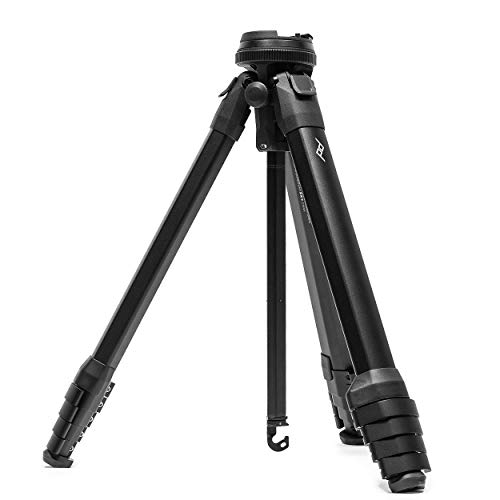
The Peak Design Travel Tripod is the one to buy when the tripod has to live inside the bag and still hold a heavy lens. Its legs pack tight around the centre column and close into a cylinder with no gaps, so it drops into the side pocket of a camera bag instead of strapping to the outside. The 20 lb rating is the other half of the case. By the half-the-rating rule it covers a full-frame body with a 70-200mm f/2.8. The ball head takes an Arca-type plate, so the plate stays on the camera between shoots, and a phone mount stores inside the centre column. Amazon has it at $395.95, and Peak Design’s own store lists it at $399.95.
You pay for that. The Peak Design costs twice what the Manfrotto does, and the premium goes to the packed shape and the head rather than to more load or height. The carbon version is the same design for $599.95, sold direct and at Adorama, and it only makes sense for a buyer who counts ounces ahead of $200, because otherwise the aluminium is the same tripod. If the pocket fit doesn’t matter to you, save the money and buy the Befree Advanced below.
Best value: Manfrotto Befree Advanced, lever lock, at $199.95
The Manfrotto Befree Advanced is the tripod for a first-time buyer who wants a fast setup at half the Peak Design’s price. It folds to 40 cm and stands 151 cm (59.4 inches) tall for $199.95. Manfrotto’s plates and heads are in every rental house. The pick is the lever-lock version, with a ball head and aluminium legs. Lever locks open and close in one motion each, so a beginner sets up faster than with twist locks and can see which leg is still loose.
The load rating is the open question, because Manfrotto’s own page disagrees with itself, with one figure in the details and a higher one on the product badge. No number is printed here for that reason, and a mirrorless body with a mid-size zoom sits inside either. Weight is the other cost. At 3.96 lb the Befree Advanced has the heaviest listed weight of the picks, 2.4 lb more than the SmallRig below. If twist locks don’t bother you, you can spend less on the Befree Advanced AS at $159.95, the twist-lock version that Manfrotto labels Arca-Swiss compatible.

Best light carbon: SmallRig ultra-light carbon travel tripod at $149.99
Buy the SmallRig ultra-light carbon travel tripod if the tripod has to be light enough that it still comes along on day three. At 1.52 lb it weighs less than half the Befree Advanced, and it folds to 42.8 cm (16.9 inches). Its ball head is rated for 5 kg (11 lb), enough for a mirrorless body with a 24-70mm f/2.8 with headroom. SmallRig sells it from its own Amazon storefront at $149.99.
You give up height and some steadiness in wind. The listing’s spec table gives 53.5 inches of height (the title rounds up to 54.9). That puts the camera at chest height for a standing adult. A tripod this light also moves in wind that heavier legs ignore, so the bag goes on the hook. If either of those would bother you, the sturdier SmallRig is the SmallRig AP-20 at $149.00. The AP-20 is rated for more, 12 kg (26.4 lb), and stands taller, at 158 cm (62.2 inches). It also folds to 40 cm and converts to a monopod, though it weighs 2.75 lb. To spend less than either, look at the K&F below.

Best carbon for hybrid shooters: Ulanzi F38 at $189.00
The Ulanzi F38 suits the shooter who frames stills one day and a locked-off interview the next, because Ulanzi builds it as a video travel tripod with a quick-release plate system. Height is what it adds over the SmallRig. At 61.4 inches it is the tallest boxed carbon tripod here. Ulanzi’s official US store sells it on Amazon at $189.00.
The extra height costs weight. The listing gives the F38 a 22 lb maximum load and a weight of 2.38 lb. That is 0.86 lb heavier than the 1.52 lb SmallRig. The folded length is not on the Amazon page, so it reads “not listed” in the table. If you want that figure before you pay, or you would rather carry less, the carbon tripod to buy instead is the SmallRig ultra-light at $149.99, which publishes it.

Budget: K&F Concept 63-inch aluminium at $49.99
For a camera on a calm beach at sunset, a group shot on a timer or a tabletop, the K&F Concept 63-inch does the job. You get aluminium legs, a ball head and 63 inches of height at 2.6 lb for $49.99.
Wind is where it stops, because light aluminium legs flex when a gust hits a camera with a zoom on it, and a long exposure shows the blur. The 22 lb rating on the title is the seller’s figure, and on 2.6 lb legs the wind sets the limit long before the rating does. Nothing that costs less is still a full-height tripod. For phones, best iPhone tripod covers the smaller stands.

Fluid head or ball head
A ball head locks a frame and a fluid head moves one. For stills, and for video that is framed and left alone, every ball head here is right. Pan or tilt during the take, though, and the pan judders because a ball head has no drag, so what you want is a small fluid head on travel legs. Manfrotto’s version is the Befree Live at $299.93. It weighs 3.6 lb, folds to 40 cm and is rated for 4 kg (8.8 lb). You’ll find it as the travel pick in best tripod for video, which also covers counterbalance, 75mm bowls and why the full-size kits there do not fit in a carry-on. A hybrid shooter who moves the camera during the take should start with that guide.
Alternatives that were passed over
The Benro Rhino One carbon with the VX20 head at $309.95 is a tripod and monopod in one. The HEIPI 3-in-1 carbon at $378.99 is the Peak Design-shaped alternative with an Arca-Swiss plate, but a saving of $17 is not enough to displace the Peak Design aluminium. Peak Design’s Pro Tall Tripod, at 40 lb and $999.95, is a studio tripod and not a travel one.
FAQ
Is a carbon fibre travel tripod worth the extra money?
Below $200 carbon costs nothing extra. The SmallRig ultra-light is carbon at $149.99 and the aluminium Befree Advanced is $199.95, so carbon is now the cheaper way to a light tripod. The question only costs money at the top, where the Peak Design carbon is $200 over the aluminium for the same design.
What size tripod fits in a carry-on?
Anything that folds under about 17 inches (43 cm) fits a carry-on and most camera backpacks. The Befree Advanced, both SmallRig tripods and the Befree Live all fold inside that length. The K&F Concept folds to 15.7 inches for the legs alone and 18.9 inches with its ball head on, which is over it. The TSA allows tripods in carry-on bags, with the airline having the final say on size, and a tripod in checked luggage is more likely to arrive with a bent leg.
How much load capacity does a mirrorless camera need?
Take the weight of the body plus the lens and double it. A full-frame mirrorless body with a 24-70mm f/2.8 is 3 to 4 lb, which makes an 8 lb rating the floor. A 70-200mm f/2.8 pushes it toward 10 lb. Treat a rating over 20 lb on a 2.6 lb aluminium tripod as a seller’s number, because wind limits that tripod long before the rating does.
Can a travel tripod be used for video?
For a locked-off frame, yes. Any ball head here will hold it. Pans and tilts are the problem, because a ball head has no drag and the motion stutters. If you move the camera during the take, get the Befree Live or one of the kits in best tripod for video, and accept the extra weight.
Is the Peak Design Travel Tripod worth $400?
For a photographer who flies with a camera more than a few times a year, yes. The packed shape fits a bag pocket that the other tripods here do not, and the 20 lb rating covers a full-frame body with a 70-200mm. For a tripod that leaves the house twice a year, the Befree Advanced at $199.95 does the job for half the price.
Where this fits in the kit
The video side of the same decision is best tripod for video, and phones get their own guide in best iPhone tripod. When a monopod is enough or a gimbal is the right tool, tripods, gimbals and support for solo shooters makes that call, and a monopod guide of its own follows this one. The documentary bag a travel tripod rides in is in the run-and-gun documentary kit.


