Handheld footage costs nothing on the shoot day. The bill shows up in the edit: Warp Stabilizer grinding through an analysis pass on every interview clip, a 4K frame punched in to hide the crop, and the wall behind your subject doing a slow jello wobble every time the camera drifts past it. Shaky footage is a loan, and post is where the interest gets collected.
This guide is for the shooter who is also the crew. One person, no assistant, and usually the same person cutting the footage next week. For you, the choice between tripod, monopod and gimbal follows the shot. Our Run-and-Gun Documentary Kit already made this call once, and made it for the monopod. This post generalizes that logic across the four situations a solo shooter faces: the locked-off interview, the interview with real camera moves, the run-and-gun day, and the walking shot.
I haven’t run every unit below through a shoot week, so treat these as research plus what I keep seeing from the post side. The picks are where the spec sheets and the published testing agree.
Last updated: July 2026. Some links below are affiliate links. Buy through them and it helps keep the site running, at no extra cost to you. Prices were verified on July 17, 2026, and in the current shortage era they will drift, so read every number as “around this much at the time of writing.”
TLDR
If your work is seated interviews and product tables, the SmallRig AD-01 at around $136 is the whole answer, and the value pick of this entire post. If you shoot documentary or events on the move, the iFootage Cobra 3 Strike monopod at around $299 is the best single piece of support a solo shooter can own. And the DJI RS 5 at around $569 is for one specific job: walking shots you choreograph on purpose.
Pick by the shot, not the spec sheet
Locked-off interviews and talking heads: SmallRig AD-01
A locked-off frame needs zero stabilization in post. No analysis pass, no crop, no render queue ticking through an interview day clip by clip. That makes the SmallRig AD-01 at around $136 (list $168.99) the best deal in this category: a one-time fee that takes Warp Stabilizer out of your interview work entirely. It’s also the support slot in our Talking-Head Studio Kit, and nothing since has changed that call.
The numbers hold up. A 17.6-pound payload rating means an FX30-class body with a zoom, a wireless receiver, and a small monitor doesn’t get near the limit. The aluminum legs run 33 to 73 inches, the 75mm bowl levels the horizon without re-splaying the legs, the head pans a full 360 degrees on fluid drag, and the quick-release plate takes both DJI RS and Manfrotto-style plates, which matters if a gimbal joins the kit later. A bag is included. The flaws are livable: the pan drag is basically locked or free with little useful range between, there’s no counterbalance (a front-heavy rig will nose-dive if you let go mid-tilt), and the leg screws want a re-tightening pass every few months. For a frame that never moves, none of that costs you a shot.

Interviews with real camera moves: Benro A2573F with the S6PRO head
The moment your coverage includes repeated pans and tilts (panel coverage, product moves, anything where the move itself is the shot), counterbalance stops being jargon. The Benro A2573F with the S6PRO head is the cheapest kit I’d trust for that job, at around $315 from a third-party seller when I checked in July 2026 (seven units left; other sellers hovered near $290, so shop the buy box before you click).
The S6PRO head is the reason to buy the kit: 13.2-pound payload, five-step counterbalance, and independent, continuously adjustable pan and tilt drag. In editing terms, counterbalance means the head holds the camera at any tilt angle instead of flopping, and real drag means a pan starts and stops without a visible bump. Together they get you the clean pan on take one instead of shooting six and picking the least bad in the edit. The 65mm flat base also moves to a slider or better legs later, so the money isn’t married to this kit. The legs hold up their end: a leveling center column, 29.5 to 63 inches of range, flip locks, and a mid-level spreader. Some units arrive with weak tilt drag, so test yours inside the return window. And if you’d rather have the name brand, Manfrotto 502AH heads on 055 legs show up around $250 on sale at the big camera retailers a few times a year and are worth watching for; the $499 one-left listing on Amazon is not the way to buy one.

Run-and-gun documentary and events: iFootage Cobra 3 Strike
A documentary scene does not wait for leg locks. Our run-and-gun kit made the monopod argument in full, and it’s held up: a solo doc shooter needs a footprint the size of a shoe and a setup time near zero, and a tripod delivers neither while the moment walks away. The Cobra 3 Strike is still the best version of the idea at around $299, the same price as when that kit shipped.
What you get: an 11-pound payload, a one-press pneumatic column that changes height from 33 to 59 inches with one hand mid-shot, a pedal-lock fluid base for controlled pans and little push-ins, and detachable tri-feet that hold a locked-ish frame while you fix audio. That fluid base is the difference between a controlled pan and a handheld one you feed to Warp Stabilizer and pay for in crop, and it’s the fastest setup of anything in this guide. At about 3.6 pounds it’s roughly double a plain stick, and the fluid base is not a drag-adjustable head. The Amazon listing rolled to the A150SIII revision at the same price, so don’t let the model string throw you. In July 2026 iFootage’s own store was sold out and Adorama showed backorders, so Amazon (sold by iFootage’s official storefront) was the healthy channel.

The simpler monopod: Manfrotto XPRO+ 500
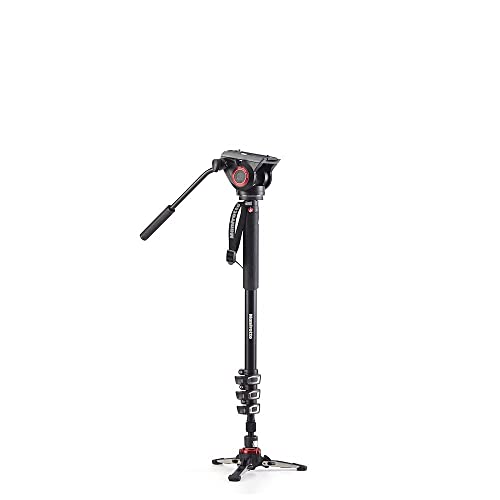
If the Cobra’s party tricks read as tricks to you, the Manfrotto XPRO+ 500 video monopod does the same core job for around $250, sold by Amazon directly. It’s a 4-section aluminum stick with Manfrotto’s FLUIDTECH fluid base, an included 500-series fluid head, an 11-pound rating with the head on, and more height than the Cobra: 79.9 inches at full extension, which you’ll use shooting over crowds at events. What you give up is the one-hand pneumatic lift and the pedal lock; every height change means working four leg locks, the kind of friction that makes you stop adjusting by hour six. The weak point is the plastic leg-brace key. A fair trade if the $50 matters more than the speed.
Walking B-roll and choreographed moves: DJI RS 5
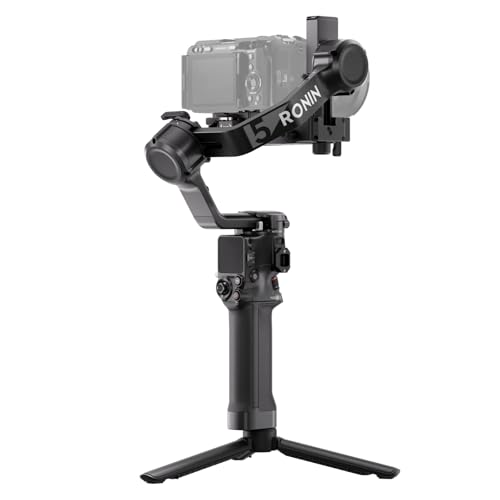
The gimbal is the most oversold item in this post and still belongs here, because it’s the only tool here that makes a walking shot look intentional instead of tolerated. The DJI RS 5 launched in January 2026 at $569 (the Combo with the tracking module and briefcase handle runs around $719), and the spec that matters is the ratio: a 3 kg tested payload from a 1.46 kg gimbal. DJI’s fifth-generation stabilization adds 50 percent more peak torque, which means the motors don’t lose the fight on fast direction changes or longer glass. Second-generation automatic axis locks drop setup and teardown to seconds, per-axis fine-tuning knobs let you balance without loosening a whole arm, and status lives on a 1.8-inch OLED.
For the cameras this site keeps recommending: a Sony FX30 with the Sigma 18-50mm f/2.8 weighs about 1.2 kg, and a Nikon Z6 III with a 24-120 lands near 1.6 kg. Both sit comfortably inside 3 kg with margin left for a mic and a filter. When I checked in July 2026 the buy box was third-party, with all eight sellers at the $569 launch price. That’s normal for a launch-window DJI product, but check the seller name before checkout. If your camera writes gyro data (current Sony bodies do), Gyroflow covers casual walking B-roll for free; the gimbal is for choreographed moves, orbits, and long lenses.
The lighter gimbal: DJI RS 4 Mini
The DJI RS 4 Mini is the compact case: around $309 standalone or $369 for the Combo against a $459 list, and both dipped to $269 and $319 after Prime Day in July 2026, so treat the price as a snapshot. It carries 2 kg from an 890-gram body and runs about 13 hours on a charge, a full shoot day without a spare battery. In practice, an FX30 with the Sigma 18-50 fits. A Z6 III with an f/2.8 zoom is at the edge, and an FX30 with the heavier Tamron 17-70 runs into the roll axis’s balance limit. If your rig will grow, buy the RS 5 and skip the resale trip. In the same class, the Hohem iSteady MT3 Pro at around $450 is the one to watch: a 2.5 kg payload and built-in AI tracking, but it launched in March 2026 and Amazon stock is thin and third-party only. We’ll revisit it once availability settles.

The ceiling, for the record
Above everything here sits the broadcast tier, and its entry point is the Sachtler Ace XL, a full system at around $1,349. It’s a better head than anything above, and the time to buy it is when support becomes a line item on someone else’s invoice, not before. Nothing in this post embarrasses itself next to it for solo work.
The six picks, side by side
| Pick | Type | Payload | Weight | Height range | The post-production story | Price (July 17, 2026) |
|---|---|---|---|---|---|---|
| SmallRig AD-01 | Fluid-head tripod | 17.6 lb | Full-size kit (drives, doesn’t hike) | 33 to 73 in | Locked-off frame, zero stabilization ever | Around $136 |
| Benro A2573F + S6PRO | Counterbalanced fluid-head tripod | 13.2 lb (head) | Full-size kit (drives, doesn’t hike) | 29.5 to 63 in | Clean pans on take one, no re-shoots | Around $315 (others near $290) |
| iFootage Cobra 3 Strike | Pneumatic fluid-base monopod | 11 lb | About 3.6 lb | 33 to 59 in | Controlled pans, no Warp Stabilizer crop | Around $299 |
| Manfrotto XPRO+ 500 | Fluid-base monopod + head | 11 lb (with head) | About 4.3 lb | Up to 79.9 in | Same story, slower height changes | Around $250 |
| DJI RS 5 | 3-axis gimbal | 3 kg tested | 1.46 kg | n/a (handheld) | Walking shots that never touch a stabilizer plugin | Around $569 ($719 Combo) |
| DJI RS 4 Mini | Compact 3-axis gimbal | 2 kg | 890 g | n/a (handheld) | Same story, lighter rigs only | Around $309 ($369 Combo) |
What matters when you’re alone
Setup time is the spec nobody prints. A tripod you won’t set up is a monopod you overpaid for. When you’re solo, every leg lock competes with the light changing and the subject cooling off, so count seconds from bag to first usable frame: the Cobra is a few, the AD-01 is a minute or two, and a spread-and-leveled Benro is longer than that.
The weight that matters is the weight you’ll carry at hour eight. A 17.6-pound payload rating means nothing if the legs stay in the car. Solo shooters carry the camera, the audio, the media, and the support, all at once, so a 3.6-pound monopod that’s always in hand beats a better tripod that’s back at the vehicle.
Counterbalance and drag are what the step-up money gets you. Counterbalance is a spring that offsets the camera’s tilt torque, so the head holds any angle instead of nose-diving the moment you let go. Drag is adjustable resistance, so a pan starts and stops without a bump. The AD-01 has neither, which a locked-off frame never notices. The S6PRO’s five-step counterbalance and continuous drag are exactly what the extra $180 is for, and if your shots move, that money shows up on screen in take one.
Payload ratings are ceilings, so run any support at about half its rating. A gimbal at 95 percent of payload hunts, vibrates on direction changes, and eats its battery; a fluid head near its limit can’t counterbalance properly. That’s why the RS 5’s 3 kg rating matters even for a 1.2 kg rig: the headroom is what you’re paying for.
The bill for fixing it in post
Software stabilization works, and it charges for the service three ways. Crop: Warp Stabilizer buys its smoothness by punching into the frame, so your 4K master ships as a softened, cropped 4K or gets downscaled to a 1080 delivery. Artifacts: on parallax-heavy shots (walking past a wall, anything with strong foreground-background separation) the warp itself becomes visible and the wall goes to jello. Time: an analysis pass plus a render hit on every clip, multiplied by an interview day, on every project, against a $136 fluid head you pay for once.
Gyro-based stabilization changes the math, on the right camera. Gyroflow is free, open source, GPU-accelerated, and current at stable 1.6.x. Instead of guessing motion from pixels the way Warp Stabilizer does, it reads the motion the camera’s own gyro recorded, so there’s no jello and the result looks like a lens, not a filter. It reads gyro data from GoPro, DJI, Insta360, Sony, and Blackmagic cameras, plus some Panasonic, Fujifilm, and Canon bodies.
The Sony column matters most here: the FX30, FX3, a7 IV, a7S III, ZV-E1, and a6700 all write usable gyro data, with caveats worth knowing before you build a workflow on it. Some modes don’t record gyro at all (the a7S III drops it in 4K/120), and clips shot with Dynamic Active SteadyShot aren’t supported. Sony’s own Catalyst Browse is still alive and free (2026.1) if you’d rather stabilize Sony-native. Nikon consumer bodies don’t write usable gyro data, so a Z6 III leans on its IBIS or on Warp Stabilizer. That’s a real input to the decision: a Sony shooter can push the monopod-plus-Gyroflow combo through a lot of moving work, while a Nikon shooter should weight the tripod and gimbal branches harder. The support you choose upstream decides how much of this section you ever need.
FAQ
Is a monopod good enough for video interviews?
When you’re solo, mostly yes. The Cobra 3’s tri-feet hold a stable-enough frame for a short sit-down while you run audio and light, and the footage cuts fine. Where it stops being enough: interviews that run past twenty or thirty minutes (self-standing drifts, and you can’t babysit it), two-camera coverage where the B cam sits unattended, and any frame you plan to walk away from with a $2,000 body on top. Those are tripod jobs.
Do I need a gimbal or is a tripod enough?
List your last twenty shots. If they were seated subjects, product tables, and pans, a tripod covers all of it and the gimbal would live in a drawer. A gimbal pays off only when the camera itself travels: walking B-roll, orbits, follow shots, moves you choreograph. If that’s under ten percent of your work and you shoot a gyro-writing Sony body, free software covers the gap before hardware does.
Can you fix shaky footage in post?
Yes, at a price: Warp Stabilizer takes crop from your frame, adds jello on parallax-heavy shots, and bills analysis plus render time on every clip. Gyro tools rewrite that trade on supported cameras; Gyroflow reads the camera’s recorded motion data and stabilizes without the guesswork, free, on bodies that write gyro (most current Sony, GoPro, DJI, Insta360, Blackmagic).
What tripod head do I need for video?
A fluid head, always; a photo ball head can’t pan smoothly at video speeds. Past that, the spec that separates a $136 head from a $315 kit is counterbalance: a spring that holds your camera’s tilt angle so the frame doesn’t nose-dive when you let go, plus adjustable drag for smooth starts and stops. Locked-off work doesn’t need it; repeated pans and tilts do.
Tripod, monopod, or gimbal first?
If most of your work sits still, buy the AD-01 first. If most of your work moves through the day with you, buy the Cobra 3 first. Buy the gimbal last, after a specific shot you keep failing to get proves you need it.
Buy the shot, not the shelf
And that’s the whole decision: one person, four situations, and a different right answer for each. You don’t need all of it at once. Buy the tool for the shot you keep taking, let the render queue you’re not running pay for the next one, and remember that stabilization also depends on the glass; our first lenses for hybrid shooters guide covers that half of the equation.
As always, this is what the research and a lot of arriving footage point at; your shots get the final vote. Disagree with a branch, or shooting a situation I didn’t cover? Leave a comment. The rest of our buyer’s guides live on the Gear Guides page.