


Every home portrait setup I have walked into has the same problem: a window on one side, a ceiling light on the other, and a bedsheet pinned to the wall with the fold lines still in it. The subject looks fine in the viewfinder and wrong on the laptop, and the fix in Lightroom takes longer than the shoot did.
This is the kit I’d put together to end that: seamless paper on a stand that holds it flat, one flash through a softbox, and a reflector doing the job of a second light. Two tiers. The first is a single-light build on 53-inch paper for head-and-shoulders work. The second adds a 200 Ws strobe as the key, a second flash for separation, and 107-inch paper wide enough for a full-length frame or two people. Strobe is the stills choice, and the reasons are in the next section; if you shoot video in the same room, the continuous version of this receipt is the creator lighting kit under $500.
Some links below are affiliate links. Buy through them and it helps keep the site running, at no extra cost to you.
TLDR
- Tier 1, the under-$500 build: a Godox TT685II speedlight ($129) fired by a Godox X3 trigger ($89), a speedlight softbox, a Neewer 43-inch 5-in-1 reflector for fill, a Neewer 7.2 ft stand ($51.29), and Savage Widetone Super White 53-inch paper ($66.99) on a Neewer T-stand ($41.49). The five priced items come to $377.77; the softbox and reflector are not in that total.
- Tier 2, about $1,000: a Godox AD200Pro II ($349) as the key in an Amaran Light Dome 60 ($89), the TT685II as the second light, two stands, and Savage Super White 107-inch paper ($109.99) on a Neewer 8.5 x 10 ft backdrop stand ($79.99). Priced items: $948.56, plus a Bowens bracket, the reflector and sandbags.
- Shooting video in the same room? Build the continuous kit instead: same paper, same stands, a COB light in place of the flash.
Why strobe for stills, and when the continuous kit wins
A speedlight is the size of a soda can and still out-muscles any LED you would put in a home room. A flash dumps its whole output in a fraction of a second, so the exposure comes from the burst rather than from how long the shutter stays open. That gets you base ISO and f/5.6 to f/8 on a portrait lens, where eyes and ears are both sharp, with no tripod. The same burst freezes a laugh, a kid, and hair that moved. It also takes the room out of the picture. Shoot at the sync speed, usually 1/200 or 1/250. Add ISO 100 and f/8 and a daytime window barely registers; the flash sets the look. A 60 W LED through a softbox cannot do that; it is the right amount of light for a seated subject at three to four feet, which is how the continuous kit uses it.
The trade is that you cannot see a flash until you fire it, so you learn by test frame, and a flash is useless for video. If the same room has to shoot video, flip the build to continuous and read the creator lighting kit under $500. That one is a Godox SL60IID at $139 through a Light Dome 60, plus a reflector. It keeps the same Savage paper on the same T-stand. The step up for a room that does both is the amaran 200d S at $239, which has the output to key a standing subject through the same dome. For stills alone, strobe wins on every number above.
Tier 1: one flash, a reflector and 53-inch paper, under $500
Seven lines. The five priced items add up to $377.77; the softbox and the reflector have about $122 under the ceiling to fit into.
| Item | Role | Price |
|---|---|---|
| Godox TT685II (your mount) | Key light | $129.00 |
| Godox X3 (your mount) | Trigger | $89.00 |
| Speedlight softbox, 24-inch class | Modifier | not priced |
| Neewer 43-inch 5-in-1 reflector | Fill | not priced |
| Neewer 7.2 ft stainless stand | Light stand | $51.29 |
| Savage Widetone #1 Super White, 53 in x 36 ft | Backdrop | $66.99 |
| Neewer T-shape backdrop stand | Backdrop stand | $41.49 |
| Subtotal | plus 2 items not priced | $377.77 |
The key light: Godox TT685II, $129
The Godox TT685II is the cheapest flash that speaks Godox’s 2.4 GHz X radio, and that is the point. The trigger you buy with it also fires the AD200Pro II in Tier 2, so nothing on this receipt gets replaced when you move up. It does TTL when you want the camera to meter the flash, manual when you want to set it once, and high-speed sync for the day you want f/2 in a park. It runs on AA batteries, which is the downside: at full power the recycle slows as the cells drain, so shoot at a quarter power with the softbox close and keep a second set charged.
Buy it in your camera’s mount. The link above is the Sony version. The Canon and Nikon SKUs are in the best flash for Sony, Canon and Nikon guide. The V860III and V1, the step up from it, are in there too. Every mount is $129.

The trigger, the softbox and the fill
The Godox X3 sits in the hot shoe and sets the power of every Godox flash in this post from the camera; buy it in your mount, same as the flash. The softbox is a speedlight softbox in the 24-inch class, the kind that folds flat and takes the flash on a bracket with a cold shoe. A 43-inch shoot-through umbrella is the cheaper version of the same idea and spills everywhere, fine against white paper and a problem against anything darker. Skip the $189.99 all-in-one kits with a stand, three muslins, umbrellas and a pair of 50 W bulbs: the bulbs are too dim to close the lens down and the muslin wrinkles the moment it leaves the bag.
Fill is the Neewer 43-inch 5-in-1 reflector, the same disc the continuous kit uses. Bounced flash is the same color as the flash, so the white side lifts the shadow side of the face about a stop with no second light to match, silver pushes harder. It does not stand up by itself; a chair back, a clamp, or a friend holds it.
The stands and the paper
The Neewer 7.2 ft stainless stand is $51.29. It holds a speedlight and a 24-inch box without complaint and will hold the AD200Pro II in the Light Dome later; buy a second one when you move up. Stainless over aluminum because the legs take a kick every shoot.
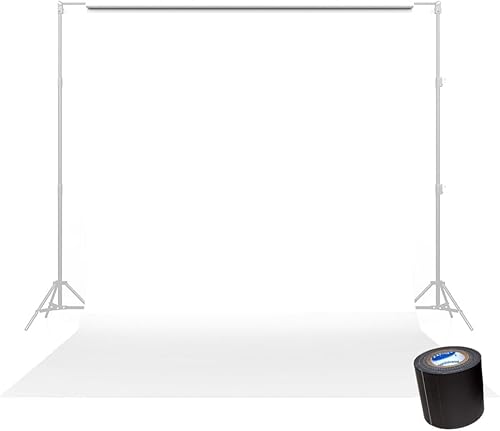
The paper is Savage Widetone #1 Super White, 53 inches by 36 feet, $66.99. Fifty-three inches is 4.4 feet, enough for a head-and-shoulders or seated frame and no wider. Super White is the color to buy first because it is two backdrops in one: lit by the key’s spill alone it lands a soft gray, and with a light on it it goes clean white.

The Neewer T-shape backdrop stand holds that roll on 5-foot crossbars at up to 8.5 feet, for $41.49. It is a light-duty stand, and for 53-inch paper that is fine: the roll weighs little. It will not take the 107-inch roll and it will not take a light clamped to it.

Tier 2: two lights and 107-inch paper, about $1,000
The second tier changes three things: a real strobe as the key, a second light for separation, and paper wide enough to stand in. The seven priced lines come to $948.56; the Bowens bracket, the reflector and the sandbags take it to about $1,000.
| Item | Role | Price |
|---|---|---|
| Godox AD200Pro II | Key light | $349.00 |
| Godox TT685II (your mount) | Second light: hair or background | $129.00 |
| Godox X3 (your mount) | Trigger | $89.00 |
| Neewer 7.2 ft stainless stand, two | Light stands | $102.58 |
| Amaran Light Dome 60 (Bowens) | Key modifier | $89.00 |
| Bowens S-type bracket for the AD200Pro II | Mounts the key in the dome | not priced |
| Neewer 43-inch 5-in-1 reflector | Fill | not priced |
| Savage Widetone #1 Super White, 107 in x 36 ft, with gaffer tape | Backdrop | $109.99 |
| Neewer 8.5 x 10 ft backdrop stand | Backdrop stand | $79.99 |
| Sandbags, two | Weights | not priced |
| Subtotal | plus 3 items not priced | $948.56 |
The key light: Godox AD200Pro II, $349
The Godox AD200Pro II is a 200 Ws strobe the size of a paperback, with its own battery and interchangeable heads. Through a 60 cm dome at six feet it has the output to put a standing subject at f/8 and base ISO with power to spare, instead of nursing a speedlight at full power and waiting for the recycle. One listing covers every mount, because it only ever fires from the X3 trigger. It is $349 at Amazon and at Adorama. What the box does not include is a Bowens S-type bracket to hang it in a Bowens-mount softbox; Godox’s S2 is the usual answer. The speedlight from Tier 1 moves to the second stand as the hair or background light.

The modifier: Amaran Light Dome 60, $89
The Amaran Light Dome 60 is a 60 cm Bowens-mount octa with an inner baffle and a front diffuser, $89. Double diffusion eats about two stops, which is why the 200 Ws key matters; in return a small strobe becomes a soft, round catchlight at arm’s length. It is the same dome the continuous kit puts on a COB light, so a room that does both buys it once.

The backdrop: Savage 107-inch on a 10-foot stand, $189.98
Savage Widetone Super White at 107 inches by 36 feet is the full-length roll: 8.9 feet wide, enough for a standing subject who moves, a couple, or a seated group of three. It is $109.99 with a roll of gaffer tape in the bundle, which you will use on the first sweep. The Neewer 8.5 x 10 ft backdrop stand spans it: $79.99 for two uprights and four crossbar sections, nothing else. A $289.99 “kit” under the same name is a Canadian lighting bundle, so read the listing title. If paper will not survive your life, the fabric answer is the Westcott X-Drop Pro 3-pack. That gets you three 8 x 8 ft wrinkle-resistant drops for $349.90. It travels and washes, and it costs more than three rolls of the Savage.
How I’d light it
Tier 1 is one light and a bounce, and it is the setup I’d use for most headshots with ten times the budget. Subject five to six feet off the paper. Softbox 45 degrees off the camera axis, the top of the box a little above eye line and angled down, the front edge about an arm’s length from the face. Camera at 1/200, ISO 100, f/5.6. Flash at a quarter power. Take a frame, then adjust the flash, not the camera, until the bright cheek sits where you want it. Then the reflector goes on the shadow side at about waist height, angled up at the face, white side first, and slides in until the shadow side opens up about a stop. The paper behind, lit only by what spills past the subject, lands a soft gray.
Tier 2 is the same key in the Light Dome, plus two decisions. The TT685II on the second stand goes behind and to the side of the subject, aimed back at the hair and the far shoulder. Set it about a stop under the key and zoom the head tight so it does not flare the lens. That rim separates a dark jacket from a gray background. Or put it on the floor behind the subject, aimed at the paper, and the Super White goes white. Meter in that order every time: key first until the face is right, then the second light, then the reflector.
The backdrop: widths, stand span and the sweep
Savage sells Widetone in 53 and 107 inches at 36 feet long. The 53 covers head and shoulders, a seated subject, a product shot. Full length needs the 107. A standing person who shifts their weight walks off the edge of a 53 at anything wider than a half-body crop. The 107 also wants a room where the camera can back up far enough to use it. The stand has to span the roll with a margin. The T-stand’s 5-foot crossbars hold the 53 and nothing wider. The 107 goes on the 8.5 x 10 ft stand, whose crossbar builds out to 10 feet in sections. Its uprights want a sandbag each under that weight. Both stands top out at 8.5 feet, which is fine under an 8-foot ceiling.
The sweep is the part people skip. Pull the paper down the stand, out across the floor three or four feet, and tape the leading edge down with the gaffer tape; the curve where wall meets floor disappears and the frame has no horizon line. Shoes come off before anyone steps on it. When the floor section scuffs, cut it off and pull down two more feet.
What to add next
After the kit above, the next $100 goes to three things. A grid for the second flash, so the hair light stays off the lens. A second roll of Widetone in a dark color, Thunder Gray or Black, so the white sweep becomes a choice. And a sheet of white foam board as a fill that stands on its own. A boom arm for the key comes after that. The lens matters more than any of it; a headshot wants an 85 mm, and if you are still on the kit zoom, the first lenses worth buying for hybrid shooters is the list to start from.
FAQ
What size backdrop do I need for portraits?
Fifty-three inches for head-and-shoulders and seated frames, 107 inches for full length or more than one person. The 53 fits on a 5-foot crossbar in a small room. The 107 needs a 10-foot stand and a room deep enough to back the camera up.
Paper or fabric?
Paper for a room that stays set up: it is flat out of the box, the sweep is clean, and a scuffed section costs a foot of roll. Fabric for a kit that travels or lives in a closet; the Westcott X-Drop Pro is the one that resists wrinkles. Muslin in a kit box is neither; it creases in the bag and shows every crease on camera.
Do I need two lights for a portrait?
No. One key through a softbox and a reflector on the shadow side is a complete headshot, and it is how Tier 1 works. The second light buys separation, meaning a rim on the hair and shoulder, or a white background. It only makes sense once the one-light frame already looks right.
How far should the subject stand from the backdrop?
Five to six feet. That keeps the subject’s shadow off the paper and lets white paper fall to gray on its own. Move them closer, or add the second light on the paper, when you want it white.
Set it up once, shoot it for years
The camera is the part this post skips. Any current mirrorless body with a hot shoe fires this kit. If you are still choosing one, best camera for YouTube and content creators and best cameras under $1,000 are the two lists to read. The flashes are in best flash for Sony, Canon and Nikon, with every mount and the step up to the V860III and V1. The continuous fixtures are compared in best key lights for talking-head video.
And that’s it. One flash, a reflector and a roll of paper under $500. Or two flashes and the wide roll for about $1,000. Nothing on either receipt gets thrown out on the way from the first tier to the second. As always, this is the kit I’d build for the room described here; your room, your ceiling and your camera get the final vote. The rest of our buyer’s guides live on the Gear Guides page.


