


The most expensive lighting mistake never shows up on the receipt. It shows up in Resolve, weeks later, when a batch of talking-head clips arrives keyed with a low-CRI panel and backed by a warm hallway bulb, and every clip needs its own skin-tone rescue. I have spent that evening, node by node, trying to pull faces back to something human from light that never recorded real skin in the first place.
So this kit is built backward from the grade. One good key light through real diffusion, bounce instead of a second fixture, and controlled practicals instead of RGB toys. Nine line items, $471.98 all-in, and the whole thing corrects with one white balance adjustment instead of forty.
A framing note before the receipt: I light interview setups and grade this kind of footage for a living, but I don’t run a YouTube studio myself. Treat this as the lighting kit I’d spec for a friend, informed by what the footage looks like when it lands in post. It’s the lighting slot of our talking-head studio kit, broken out and rebuilt for a hard $500 ceiling.
Last updated: July 2026. Some links below are affiliate links. Buy through them and it helps keep the site running, at no extra cost to you. Prices were verified on July 17, 2026, and in this market they will drift; read every number as “around this much at the time of writing.”
TLDR
The kit is anchored by the Godox SL60IID at $139, fired through the Amaran Light Dome 60 at $79. Everything else on the receipt exists to support, bounce, or stay out of the way of that one light: fill comes from a reflector rather than a second fixture, and the background from seamless paper and one clamp light. Total: $471.98, with about $28 of headroom left under the ceiling.
The receipt: a YouTube lighting setup under $500
Here is the whole build, line by line, with a running total. Every item gets its own section below.
| Item | Job | Price | Running total |
|---|---|---|---|
| Godox SL60IID | Key light | $139.00 | $139.00 |
| Amaran Light Dome 60 | Diffusion | $79.00 | $218.00 |
| Neewer 7.2ft stainless steel stand | Light stand | $50.99 | $268.99 |
| Neewer 43″ 5-in-1 reflector | Fill / bounce | $29.99 | $298.98 |
| White foam board 20×30″, 5-pack | Rigid bounce | $25.99 | $324.97 |
| Savage Widetone seamless paper, 53″ x 36′ | Background | $61.54 | $386.51 |
| Neewer T-shape backdrop support, 8.5ft | Backdrop stand | $42.49 | $429.00 |
| Simple Deluxe 8.5″ clamp light | Accent fixture | $23.99 | $452.99 |
| Govee smart bulb 2-pack | Accent bulbs / practicals | $18.99 | $471.98 |
Notice what’s not on it: no second powered light, no RGB tube, no ring light. The “what you don’t need to buy” section below makes the case for each omission.
The key light: Godox SL60IID, $139
The Godox SL60IID is a daylight 5600K COB with CRI 96 and TLCI 97, 18,600 lux at one meter with the included reflector, a Bowens mount, app and 2.4G remote control, and a fan quiet enough to sit four feet from a live mic. Those two quality numbers are the entire reason this light anchors the kit: CRI 96 means the light renders real skin tone onto your sensor, so the grade has information to work with instead of a hole to patch. And one fixed color temperature means the whole shoot corrects with one white balance move, not a per-clip rescue.
The caveat: 60 to 70 watts through diffusion is the right amount of light for a seated subject at three to four feet. It is not a room light, and it won’t overpower a sunny window. On price, every current listing is a third-party seller at $139, a touch above the $110 to $130 this light has historically sold for; treat that as a snapshot. If the Nanlite FS-60B is in stock when you read this, it runs $99 and adds bi-color on top, and it’s the value pick in our key lights for talking-head video roundup, where the full comparison lives.

The diffusion: Amaran Light Dome 60, $79
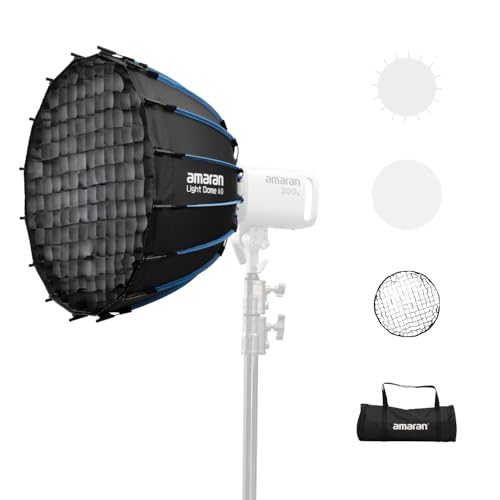
Soft light is a size problem. The bigger the source relative to your face, the softer the shadow edges, which is why a 60cm octa two feet away flatters a face in a way no bare bulb at any price can. The Amaran Light Dome 60 is that octa: Bowens mount, a one-snap quick release that pops open like an umbrella instead of a wrestling match with sixteen rods, two diffusion layers, and a fabric grid. The grid matters more than it looks like it should. It narrows the spill so your key lights the face and not the backdrop, which keeps the paper’s color clean and the frame from going flat.
The tradeoff: double diffusion eats better than two stops of output. That’s fine at three feet with a seated subject, and it’s exactly why the upgrade path below is more light rather than more modifiers.
The stand: Neewer 7.2ft stainless steel, $50.99
Fifty dollars for a light stand looks like the padding on this receipt. It’s the opposite. A 1.4kg COB with a 60cm octa hanging off it at six feet is exactly the load that makes a $25 aluminum stand drift mid-take, and a key light that sags two inches over an hour is a continuity problem you will find in the edit, not on set. The Neewer 7.2ft stainless steel stand is spring-cushioned, so a loose knob lowers the light gently instead of guillotining it, and the steel holds position under a real load. The one downside is weight: it’s heavier than aluminum, which is fine for the one piece of this kit that never leaves the room.

The fill: a reflector and a stack of foam board, $55.98
This is where the kit saves you $100 and a color problem at the same time. Bounced light is the same spectrum as the light that hit it, by definition. So a Neewer 43″ 5-in-1 reflector on the dark side of the face gives you fill that matches your key perfectly, every time, for $29.99, with no second fixture to buy, power, and color-match. White for gentle lift, silver when you need more punch, and the translucent center panel doubles as a window scrim, which makes it two tools. The one real annoyance is that a collapsible disc doesn’t hold itself up; you’ll clamp it to a chair back or lean it against a stand.
Which is what the white foam board 5-pack is for: $15.99 of rigid bounce that stays where you put it. Lean one against a wall just out of frame and it fills all day without complaint. Buy a black board or two as well for negative fill when a small white room bounces too much. And if you’d rather skip the line item entirely, a single craft-store board is about $3; the 5-pack is just the lazy way to always have one within reach.

The background: Savage paper on a T-stand, $104.03
A 53-inch by 36-foot roll of Savage Widetone seamless reads as a real set on camera, and when a section gets scuffed you cut it off and pull down fresh paper. Egg Nog is the 53-inch color in stock at this writing, at $61.54. One shopping note: Amazon’s 53-inch Widetone pricing is currently running $17 to $22 over B&H, where the identical roll is $44.99. Check B&H first and pocket the difference; the paper doesn’t care where you bought it.
The Neewer T-shape backdrop support holds the roll at up to 8.5 feet for $42.49, so the set goes up the same way every time. It’s a light-duty stand and that’s fine: paper weighs almost nothing. Don’t hang a light off it and it will outlive the roll.


The accent: a clamp light and two smart bulbs, $42.98
Depth in the background is what separates “lit video” from “webcam in a room,” and it costs $43 here. The Simple Deluxe 8.5″ clamp light clamps to a shelf, a doorframe, or the backdrop stand’s leg, so it needs no stand of its own. It ships without a bulb, which is the point, because the bulb is where the control lives.
The Govee smart bulb 2-pack is $18.99: one bulb goes in the clamp light as the background accent, the other goes in a lamp you already own that’s visible in frame. Then comes the discipline part. Set both to one color temperature, and leave them there. Mixed practicals are the number one “why does my background look magenta” ticket in the grade, and a $9.50 bulb you can lock to a value beats a $90 RGB tube you’ll keep fiddling with. Two limits worth knowing: they’re 800 lumens each, accents rather than fill, and no smart bulb’s spectrum is good enough to light a face. Keep them behind you, not on you.


One swap down, one swap up
The cheaper background, $437.94 total. If seamless paper isn’t your look, drop lines six and seven from the receipt and put a Govee RGBIC floor lamp at $69.99 in the back corner of the room instead. That trades the clean paper sweep for depth: a gradient of color climbing the wall behind you, with the room itself as the set. Different look, $34 cheaper, and it skips the backdrop stand entirely.
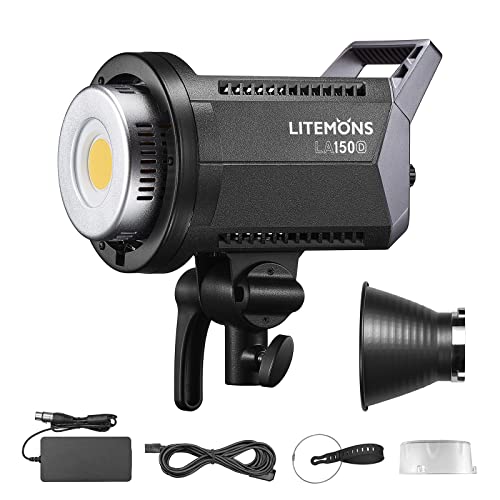
The +$80 key light upgrade, $541.98 total. Swap the SL60IID for the Godox Litemons LA150D at $219 and the output number jumps from 18,600 to 84,800 lux at one meter: four and a half times the punch, same Bowens mount, same CRI 96 and TLCI 97. That headroom is what you want once a double-diffused octa eats its two-plus stops, because it means the light cruises at half power instead of maxed out. If your room has a bright window or you sit farther than four feet from the key, this is the one line on the receipt worth breaking the ceiling for.
What you don’t need to buy
Every dollar on the receipt above had to beat these. None of them made it, each for a reason you’d eventually meet in the grade.
A ring light. One flat frontal source on the lens axis, a donut-shaped catchlight in both eyes, and on the cheap ones, low CRI on top. Flat light gives the grade nothing to shape: no shadow side to lift or deepen, just a face-shaped plane.
The Amazon-brand three-point softbox kit. The $90 to $150 bundles with two or three panels and a boom. The panels are CRI-80s and don’t match each other’s color temperature, so you’re mixing bad spectra from the start, on stands that fold under a sneeze. A broken spectrum never records real skin tone, and no Resolve node recovers information the light didn’t render. This is the single biggest source of the footage this article opened with.
RGB everything. At this price tier, the RGB engine is a tax on the white light: a $130 RGB fixture produces worse 5600K white and worse skin rendering than a $130 plain daylight COB, because the budget went to the color mixing instead of the emitters. Buy the color in a $9 bulb for the background, not in your key.
Bi-color, at this tier. A bi-color fixture is two emitter sets sharing one housing, so at any given color temperature roughly half the light is loafing, and a 60W bi-color keys like a 30-something-watt daylight. You don’t need to match your key to your practicals; you control the practicals and match them to the key. That’s what the smart bulbs are for.
A second powered fill light. The reflector and the foam board are the fill. A bounce can’t drift in color temperature and can’t disagree with your key. Matching a second cheap fixture to your key is precisely where mixed-temperature problems start, and the $100-plus it costs is the money this kit spent on a better key instead.
Why one good light beats three cheap ones
Is one light enough for YouTube videos? For a seated talking-head frame, yes, and it’s not a compromise. It’s the setup a working interview crew would build with ten times the budget: one good key through diffusion, bounce fill, one small accent for depth. The kit above is that setup at consumer prices.
The reason it works starts in post. One light means one spectrum in the frame, and one correction in the grade: your fill is bounced key so it matches automatically, and your practicals are locked to a temperature you chose. White balance becomes a single adjustment on the first clip, copied down the timeline. Three mismatched lights produce three spectra fighting in every shot, and the fix becomes per-clip surgery: mask the face, rescue the skin, chase the background cast, repeat forty times. The gear was cheaper; the evenings are not.
Shape doesn’t need a second fixture either. With one key you set the mood by moving the bounce: pull the reflector close for bright, open corporate-friendly light, or pull it away and let the shadow side fall off for something moodier. Distance and angle of a $30 disc replace the entire job of a second light, minus the color risk.
The output math is the one place to pay attention. A double-diffused octa swallows more than two stops, which is why “60W is plenty” and “60W is barely enough” are both true depending on distance. At three feet from a seated subject, the SL60IID through the Dome 60 gives you a proper key with the aperture and ISO where you want them. If your setup pushes past four feet, that’s the LA150D‘s case, made above.
The last piece is the discipline that costs nothing: every light visible in your frame gets set to one color temperature, once. The lamp in the corner, the bulb in the hallway behind the door. Cheap and controlled beats expensive and mixed, every time.
FAQ
Is one light really enough for YouTube videos?
For seated talking-head content, yes. One key through diffusion, a reflector for fill, and one accent for background depth is the standard interview setup, scaled down. What one light can’t do is light a room, a standing set, or a moving subject; if your format walks around, you’re shopping for a different article.
How much should I spend on lighting for video?
For a seated setup, around $270 gets the part that touches your face: key light, diffusion, and a stand that holds them still. That’s less than a mid-range lens, and it does more for how your footage looks than the lens does. The rest of this kit’s budget is background and control. Past $500, the returns get thin until you have a bigger room, a standing set, or a second shooting position to light.
Do I need a softbox, or can I use the bare light?
You need the softbox. A bare COB is a small, hard source, and on a face that means crisp nose shadows, hot highlights on the forehead, and squinting talent. The softbox is what turns a work light into a key light; it’s the least optional $79 on the receipt. If the budget truly can’t stretch, bounce the bare light off a white wall or ceiling as a stopgap, and buy the octa next month.
What about natural window light?
Great, when it cooperates. A big north-facing window is a beautiful soft key, and the reflector’s translucent panel turns a harsh window into a decent one: that’s a real setup, not a consolation prize. The problem is scheduling. Window light changes color and intensity by the hour, so two clips shot a day apart won’t match, and your channel shoots when the sky allows. This kit exists for consistency: the same frame at 9 a.m., 9 p.m., and next February.
Build it once, grade it in one node
And that’s the whole receipt: $471.98, one light doing the work, and footage that corrects in one move instead of forty. As always, this is the build the spec sheets and a lot of graded footage point at; your room and your format get the final vote. If you put a kit like this together and something’s fighting you, leave a comment and I’ll take a look.
For the deeper key light comparison, the key lights for talking-head video roundup covers the field this kit’s anchor was picked from. The talking-head studio kit is the whole-room version with camera and audio included. And the rest of our buyer’s guides live on the Gear Guides page.


