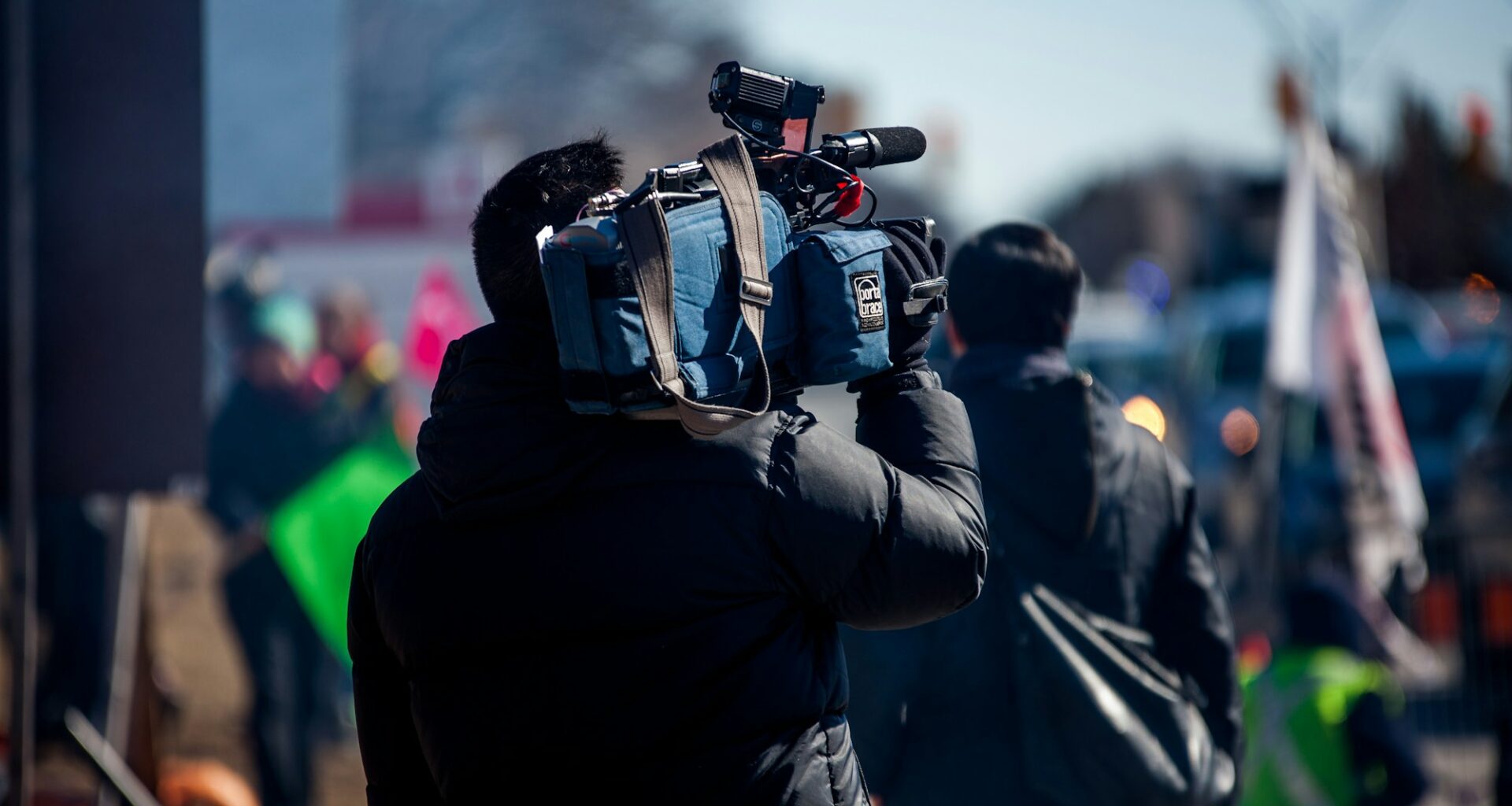

A friend who shoots news for a living texted me last week. Their on-camera lights were Lume Cubes, and in their words, the Lume Cubes had exploded on them. What they wanted was something exactly like a Lume Cube but from somebody else, a straight answer on on-board lights versus a light on a stand, and while I was at it, the mics. Then the real brief arrived: write it for run-and-gun ENG, and make it the kit a station would buy, not the kit a creator would buy. Battle-hardened was the phrase.
So the boxes below are the station tier: the gear an engineering desk at a network affiliate signs off on, because it survives a decade of being thrown into a car at 5 a.m. Under each one I’ve named the lower tier, the pick you buy on your own dime when you’re an MMJ and the station gave you a camera and a smile. Every pick was judged by two questions: will it still be working at hour ten, and can you fix it mid-shift with something you can buy at a gas station.
Two things to know before we start. This is a research kit, not my personal loadout; I live in post, and I judge field gear by what the footage looks like when it hits a timeline. And I’m not here to pile on Lume Cube. The problem my friend hit is a category problem, and I’ll explain it in a minute, because it decides which lights belong on a news camera at all.
Last updated: October 2026. Some links below are affiliate links. Buy through them and it helps keep the site running, at no extra cost to you. I only point at gear I’d be comfortable putting in a friend’s cart, and in this case, I literally am.
TLDR
- The on-camera light: Litepanels Lykos+, $760, 2,000 lux at a meter, runs on the Sony L-series batteries you already own
- The stand light: Litepanels Astra IP Half, $1,111.50, IP65 weatherproof, takes a Gold Mount or V-Mount battery bracket
- The handheld: Electro-Voice RE50B, $219, the stick on every station’s mic flag
- The wireless: Sennheiser EW-DP ENG Set, $999, digital UHF with a bodypack and a plug-on transmitter in one kit
- The shotgun: Sennheiser MKH 416, $1,041, the broadcast standard for forty years
- The power: Anton/Bauer Titon Micro 90 two-battery kit, $860, two 94 Wh Gold Mount bricks and the dual charger
Add it up and the station tier lands a hair under $5,000 per photographer, before the camera. That’s less than most stations spend on the lens. Prices are from October 2026 and will drift; the boxes below show what each piece costs today.
Why on-camera lights die on a news shift
A Lume Cube, and every light shaped like one, is a sealed lithium cell with LEDs glued to the front. That design is fine for a vlogger who films for twenty minutes and charges overnight. A news shooter asks it to do something else: run at 80 or 100 percent for a stand-up, then a presser, then a live shot, on a hot camera, in the sun, and then charge from a car inverter while it’s still warm so it’s ready for the next hit. Heat is what kills a lithium cell, and a sealed light has no way to shed it. Lume Cube’s own manual for the Panel Pro 2.0 tells you not to use, store or charge it in a hot environment or in direct sun, and rates it at two hours at full output. On the drone forums, the small cubes shut themselves down after a few minutes at full power. That’s a light built for a different job.
The ENG answer has been the same for thirty years: the light doesn’t own its power. It takes a camera battery you can swap in four seconds, or it runs off the camera’s own brick through a D-tap cable. When a cell dies, you drop in another one and the light keeps going; when a cell swells, you throw away a battery instead of a light. Every light in this article passes that test, at both price tiers.
The on-camera light: Litepanels Lykos+
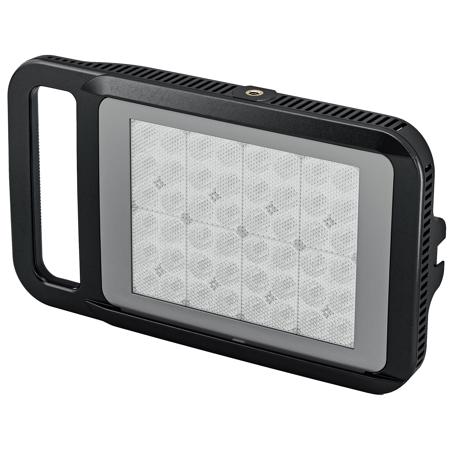
Litepanels is the brand on top of a lot of station cameras in this country, and the Lykos+ is their current small bi-color panel. It puts out 2,000 lux at a meter at 5600K from 23 watts, with the same LED and lens package as their Astra panels, so the color matches the stand light in this kit without a correction node. CRI and TLCI are both 96, the range is 3200K to 5600K, dimming runs 0 to 100 percent without flicker, and the whole thing weighs 1.1 pounds with a handle built in. The part that makes it an ENG light is the back: an L-series battery mount, so it runs on the Sony NP-F batteries every station already has in a drawer, and a dead light is a four-second swap. It’s $760 at Adorama as of October 2026, shipping from the manufacturer, and Amazon only carries it in a $2,350 flight-kit bundle, so Adorama is where I’ve linked it.
Seven hundred and sixty dollars for a 23-watt panel is station money, and you’re paying for the color accuracy, the metal and the warranty desk, not the lumens. The output is enough to lift a face at six feet at night and to fill under a ball cap at noon; it won’t fight the sun from across a sidewalk, and nothing this size will. It also stops at 5600K, which is fine for news and wrong for mixed LED streetlight. If the station is buying, this is the one. If you’re buying, Litepanels’ own Croma 2 is on closeout at $574.75, a 14-watt version of the same idea on the same batteries. Below that, the picks change character: the Aputure MC Pro ($179) is the one sealed-cell light I’d put on a news camera, because it’s IP65 rated and runs off USB-C so the cell can be the reserve; the amaran Ace 25x ($69) is the brightest Lume Cube-shaped light you can buy, 1,600 lux at a meter, also on USB-C; and the Viltrox L116T ($29.99) is a plastic NP-F panel that does the Lykos job at a thirtieth of the price and a third of the output.
On-board light or a stand: which one wins when
An on-camera light exists so that there is a face in the frame at all. It sits on the lens axis, so it flattens the subject, it falls off fast (double the distance, a quarter of the light), and when the subject is a reporter at six feet and a building at sixty, the reporter is lit and the building is black. For spot news, walking stand-ups, man-on-the-street and anything where the camera moves, that trade is correct, because the alternative is no face in the frame.
A light on a stand exists so the shot looks like television. Move the key 30 or 40 degrees off the lens and put diffusion on it, and the same reporter has shape, the background keeps its exposure, and the colorist (hi) has something to grade instead of something to rescue. It costs you two minutes of setup and a second bag, and it means the camera’s own battery isn’t also running the light. The rule I’d give a new MMJ: on-camera for anything with a clock on it, the stand for the live shot and the sit-down, and never skip the stand when you have the two minutes.
The stand light: Litepanels Astra IP Half
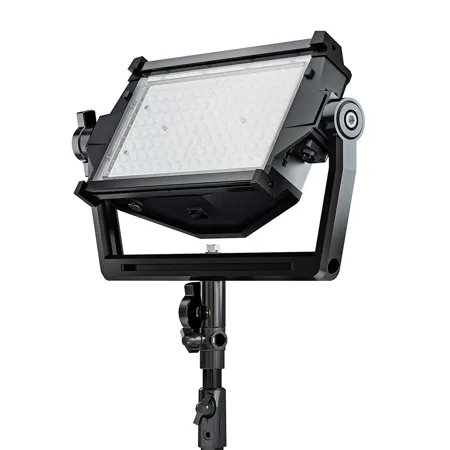
The Astra 1×1 is the panel in the back of a lot of news cars, and the Astra IP Half is the current version cut down for one person: half the panel, 63 watts, 1,500 lux at three meters, 2700K to 6500K, and an IP65 rating, which means it keeps working in the rain, the snow and the dust of a brush fire, which is where a station light spends a lot of its life. It’s $1,111.50 at Adorama as of October 2026. The battery side is the ENG part again: it takes Litepanels’ Gold Mount, V-Mount or Sony BP-U brackets, so it runs on the same bricks as the camera, and the bracket is sold separately (the V-Mount one is $518.70, which is the number that makes MMJs wince).
Add the bracket and a softbox and you’re near $2,000 for one key light, and a half-panel at three meters is a key for one reporter, not a two-shot in a dim hallway. That’s the shape of station gear: it costs what a car payment costs and it outlives the car. If you’re buying it yourself, the Aputure LS 60x ($419) is the light I see most often in newer one-person kits: 30,000 lux in spot, 2700K to 6500K, weather-resistant, and it ships with a V-Mount receiver, a D-tap cable and a dual NP-F plate, so it runs on whatever the camera runs on. Below that, the amaran COB 60x S ($159) with the Light Dome 60 ($79) is a 60-watt Bowens COB on a dual NP-F plate, and it’s the kit I’d hand a journalism student.
The mics: three jobs, three tools
News audio is three separate problems that happen to arrive in the same hour. A handheld for the stand-up and the sidewalk interview, where you control the distance and the subject doesn’t. A wireless system for the sit-down and the live shot, where the reporter is twenty feet away and the venue is full of other people’s transmitters. And a shotgun on the camera for everything you didn’t plan, which in news is most of it.
The handheld: Electro-Voice RE50B
The RE50B is the microphone in your mental image of a reporter, and the reasons are all practical. It’s an omnidirectional dynamic, so it doesn’t care whether the subject is on axis, it has no proximity effect to boom their voice when they lean in, and it needs no phantom power and no battery. The Dyna-Damp internal shock mount is why you can hand it to a nervous stranger who grips it like a baseball bat and still get clean audio. The 80 to 13,000 Hz response reads like a flaw on paper and is a feature in practice: nothing below 80 Hz means less wind and less traffic, and news voices live in the middle anyway. It’s $219 as of October 2026, from a third-party seller at Electro-Voice’s list price, and it comes with a 15-foot cable and a stand clip. Stations buy these by the case, and the one thing to add is the flag with the logo on it.
What it isn’t is pretty. It’s a 12-ounce rubber-jacketed tube, and on a long stand-up the reporter will notice. For a longer handle that leaves room for a bigger flag, the Shure SM63 ($169) is the other omni dynamic on station flags.

The wireless: Sennheiser EW-DP ENG Set
The EW-DP ENG Set is the one box that covers both wireless jobs a news crew has. In the case: a bodypack transmitter with an ME 2 lav for the sit-down, a plug-on transmitter that screws onto the bottom of the RE50B and makes the handheld wireless for the live shot, and the camera receiver, which mounts magnetically and stacks with a second one when you need two channels. It’s fully digital UHF, 520 to 576 MHz on the R1-6 version linked here, with 134 dB of dynamic range, which in practice means the reporter can go from a whisper to shouting over a fire engine and nothing clips. Sennheiser rates the transmitters at 12 hours and the receiver at 7, and the receiver sits on the camera’s shoe. It’s $999 as of October 2026, sold by Amazon itself, and it replaces the EW 100 ENG G4 kit that a lot of stations still run.
Two things a station engineer will say. First, the network tier is Lectrosonics: an SRc receiver in the camera’s slot and SMWB transmitters, which is what Dateline and ABC News carry, at several times the price of this set and with the same band plan to manage. The EW-DP is what a local affiliate buys, and it’s digital where the Lectros are hybrid, so it’s not a step down in audio. Second, pick the band for your market. Every UHF kit shares the TV band with the stations themselves, and after the 600 MHz repack the legal room is 470 to 608 MHz, so the engineer will want to know which block you bought. For the lav, the ME 2 in the box is fine; the station standard is a Sanken COS-11D ($347), the lav that hides under a tie and survives being clipped on by a hundred different reporters. The budget route is the analog Sony UWP-D21 ($584), the kit I’d have put in this slot before the brief changed: UHF, true diversity, AA batteries, no plug-on in the box. What doesn’t belong here is the creator tier. The Rode Wireless Pro and the DJI Mic 3 are excellent kits that our wireless mic guide picks for good reasons, and they’re 2.4 GHz, the same band as every phone and hotspot at a press conference, which is the one room where they fall over.

The shotgun: Sennheiser MKH 416
The MKH 416 has been the camera-mounted shotgun on broadcast cameras since the 1970s, and the reason it never got replaced is the RF condenser design: the capsule shrugs off humidity, so it works in the rain and the fog and the 95-percent-humidity summer that kills ordinary condensers, and it has a sound every audio operator in the country already knows how to mix. It’s a supercardioid with an interference tube, 48-volt phantom only, and about 250 millimeters long. As of October 2026 it’s $1,041.23 sold by Amazon itself. On a news camera it does nat sound under every shot and a usable interview at arm’s length when the lav didn’t get clipped on in time, which is the job that pays for it.
The trade-offs: it needs phantom, so it’s for a camera with real XLR inputs, and it’s long enough to be in the shot at the wide end of a short lens. If the budget is yours, the Sennheiser MKE 600 ($349 with a shock mount and windshield) is the same company’s answer at a third of the price, and it runs 150 hours on one AA when the camera has no phantom; our on-camera and shotgun mics guide covers the 3.5 mm options for mirrorless bodies.

The power: Anton/Bauer Titon Micro 90
Everything above runs on a camera brick, so the brick is a pick, and at a US station the brick is Anton/Bauer. The Titon Micro 90 two-battery kit is two 94 Wh Gold Mount batteries, each with a D-tap and a USB port on the side, plus the GM2 dual charger, for $860 as of October 2026 (a third-party Amazon seller at list; Adorama’s V-Mount twin of the kit is $861). Ninety-four watt-hours is the number that matters: it’s under the 100 Wh airline limit, so it flies in a carry-on, and it runs an ENG camera for a couple of hours, which is why the kit is two bricks and a charger and why a station buys four. The D-tap is what feeds the Astra’s bracket and the LS 60x’s cable, so one brick and one charger cover the camera and the stand light, and a drawer of NP-Fs covers the panel on top.
Gold Mount or V-Mount is a religion, and the answer is whatever your camera already wears. Sony’s FX6 and FX9 and most of the newer ENG bodies take V-Mount through a plate, and for those the Core SWX Nano X V98 ($198) is the small 98 Wh brick I’d buy two of. The rest of the kit is the stuff every truck already has: the Sachtler Ace M tripod system ($760) for the live shot, Sony MDR-7506 headphones ($113), and a Think Tank Emergency Rain Cover ($48.75) that lives in the bottom of the bag until the day it saves a camera.

How the kit adds up
| Component | Station tier | Why it earns its slot | Street price | On your own dime |
|---|---|---|---|---|
| On-camera light | Litepanels Lykos+ | 2,000 lux, CRI 96, L-series battery mount | $760 | Aputure MC Pro, $179 |
| Stand light | Litepanels Astra IP Half | IP65, Gold Mount / V-Mount brackets | $1,111.50 | Aputure LS 60x, $419 |
| Handheld | Electro-Voice RE50B | Omni dynamic, no power, shrugs off handling | $219 | Same mic |
| Wireless | Sennheiser EW-DP ENG Set | Digital UHF, bodypack plus plug-on | $999 | Sony UWP-D21, $584 |
| Shotgun | Sennheiser MKH 416 | RF condenser, works wet, the broadcast sound | $1,041 | Sennheiser MKE 600, $349 |
| Power | Anton/Bauer Titon Micro 90 kit | Two 94 Wh Gold Mount bricks, D-tap, dual charger | $860 | Core SWX Nano X V98, $198 each |
| Total | About $4,990 | About $1,950 |
Not in either number: the Astra’s battery bracket and softbox, a light stand, a mic flag, and the tripod. The own-dime column with two Core SWX bricks instead of one comes to about $2,150, and it’s a kit I’d defend at any station in the country; it just won’t be there in ten years, and the Litepanels will.
What matters on a news shift
Standardize the brick. Every powered thing in this kit runs on the camera brick, an NP-F, an AA, or a USB-C bank. That’s four kinds of power for a whole rig, and two of them are sold at every gas station in the country. A kit where each light and mic has its own proprietary cell is a kit with five chargers in the truck and one of them always missing.
The light shouldn’t own its power. The sealed-cell light failed my friend because it was asked to run hot and charge hot for months. A light that takes a camera battery, or runs off a D-tap, moves the wear onto something cheap and replaceable. If you keep one cube-style light for its size, make it the IP65 one and run it from a bank.
Seconds beat stops. The Lykos is on the camera before you leave the truck. The RE50B needs no power and no menu. The plug-on transmitter turns the handheld wireless in the time it takes to screw it on. The stand light takes two minutes, and two minutes is the budget: if the setup is longer than that, the stand stays in the car and the shot gets flat. Buy for deploy time, because the alternative to a fast key light is no key light.
Give the edit something to cut. The 416 is always on, which means there’s nat sound under every shot and a usable track when the lav didn’t get clipped on in time. Digital UHF with the right block means fewer dropouts to patch around. A key light off the lens axis means a face the colorist can grade instead of flatten. Every pick here is about what shows up in the timeline at 4 p.m., which is where I live.
FAQ
Are Lume Cubes bad lights?
No. They’re sealed-cell lights built for short sessions, and Lume Cube says as much in the manual: keep them out of heat, don’t charge them hot, expect about two hours at full. A news shift breaks all three rules by lunch. That’s a mismatch, and it’s the reason this kit is built around lights that take a camera battery or a D-tap instead.
On-camera light or a stand light for a live shot?
The stand, every time you have two minutes. A live shot is a locked frame with a reporter standing still, which is the one situation in news where a soft key off the lens axis is both possible and visible on air. The on-camera light is for the walk-and-talk, the sidewalk interview and the fire at midnight, where the camera moves and the light has to move with it.
Do I need UHF wireless, or is a DJI or Rode kit fine for news?
For a solo MMJ who mostly shoots sit-downs in quiet rooms, the Wireless Pro‘s 32-bit float recording is a real safety net and the price is hard to argue with. The day it bites you is the press conference with eight other crews and a hotel’s worth of Wi-Fi in the same 2.4 GHz band. If pressers and stadiums are part of the job, buy UHF: the EW-DP ENG Set if the station is paying, the UWP-D21 if you are.
Gold Mount or V-Mount?
Whatever your camera and your station’s charger wall already use. Gold Mount is the American broadcast tradition and the reason Anton/Bauer is in this kit; V-Mount is the world standard and what most new cinema-style bodies take through a plate. Both lights here accept either through a bracket or a D-tap cable, so the mount decides nothing about the lights. Pick one, buy four bricks under 100 Wh so they fly, and never mix.
Go make the slot
If one piece of this kit sent you shopping in a different aisle, we’ve got you. The camera and support side of a one-person rig is the run-and-gun documentary kit. The 3.5 mm shotguns for mirrorless bodies are in best on-camera and shotgun mics, and the creator-class wireless kits get their full comparison in best wireless mics for creators. For lighting that stays indoors, best key lights for talking-head video and the creator lighting kit under $500 cover the studio side of the same brands.
And that’s it! Two lights, three mics, one battery standard, a hair under $5,000 at the station tier and about $2,000 on your own, and nothing in either kit that dies because it got warm. As always, these are the picks the research backs; your market, your camera and your chief photographer get the final vote. Shoot news and have a kit you’d defend, or a light that survived something my friend’s didn’t? Drop it in the comments. The rest of our buyer’s guides live on the Gear Guides page.