Buy a shotgun mic and the box will tell you two things: a polar-pattern diagram and a range number. Neither one predicts how the mic sounds on a timeline. The spec that does is self-noise, the low hiss the mic generates all by itself, which lands on top of whatever hiss your camera’s preamp was already making. Hiss stacked on hiss. That’s what you end up fighting in post, and it’s the spec this whole guide is organized around.
The good news: the middle of this market has gotten legitimately good. A hundred to two hundred dollars now buys a mic quiet enough to sit under dialogue without a denoise pass fighting it the whole way. “So what’s the extra $800 for?” Mostly reach, rejection, and a build that survives a working schedule. Not a night-and-day jump in sound. Most people reading this should spend less than they think, and the step-up picks in the back half are for the people who need them.
One thing before the picks: a shotgun on top of the camera is not always the right tool. It wants a subject at a fixed distance in a room you control. The moment your subject starts moving, or you can’t get the mic within a few feet of their mouth, a wireless lav beats every shotgun on this page. If a wireless kit is the next purchase, Black Friday wireless mic deals for creators lists the price that makes each one a buy. If that’s your shoot, start with our wireless mic guide instead. This one is for when the camera and the subject hold still long enough for a shotgun to win.
Last updated: July 2026. Some links below are affiliate links. Buy through them and it helps keep the site running, at no extra cost to you. One note: the post-production side of this, what survives an edit and what doesn’t, is my day job. The mic picks are research, verified against current US stock and pricing in mid-July 2026, not gear I own personally. Prices drift, so check the current number before you buy.
TLDR
If you just want the answer: buy the Rode VideoMic NTG. It’s quiet, it runs on its own battery instead of gambling on your camera’s plug-in power, and it moonlights as a USB desk mic when you get home. Tight budget? The Rode VideoMic GO II keeps the parts that matter for $109. Sony shooters get their own answer: the Sony ECM-B10 skips the camera’s analog preamp entirely, and it’s the cleanest thing you can bolt to an a-series body. The premium XLR picks further down are for people building toward a recorder rig, not for a bare mirrorless camera.
The picks
Best overall: Rode VideoMic NTG
The VideoMic NTG borrows its acoustic design from Rode’s broadcast NTG5, and the number that matters is the self-noise: around 15 dBA. That’s low enough to disappear under a talking voice instead of adding a layer you subtract later. It runs about 30 hours on a built-in battery and charges over USB-C, so there’s no plug-in-power lottery with your camera’s 3.5mm jack. It auto-senses whether it’s on a camera or a phone, gain is an infinitely variable dial on the body, and a safety channel backs you up when someone laughs into it.
The sleeper feature is that same USB-C port: plug the NTG into a laptop and it becomes a perfectly good voiceover and meeting mic. Two purchases in one. It costs about twice the GO II, and the battery is sealed, so you can’t swap a dead cell years from now. Neither one moves it off the top spot. At around $239 this is the default, and I’d need a specific reason to talk you out of it.
Best value: Rode VideoMic GO II
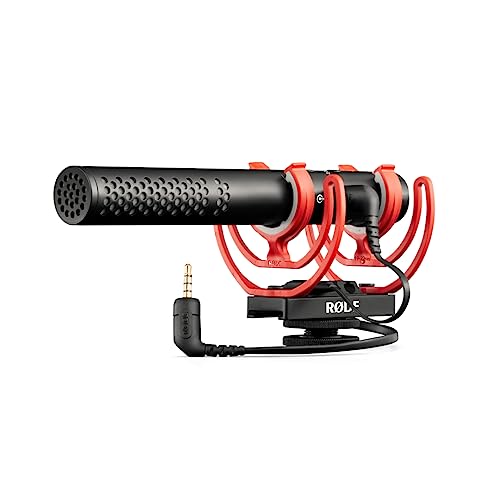
The VideoMic GO II is the NTG with the extras shaved off, and Rode shaved smart. No battery (it runs on plug-in power or USB bus power), no switches on the body, almost no weight. What survives the cut is the part you actually hear, a clean supercardioid capsule, plus the same USB-C output that turns it into a desk mic. At around $109 it’s the floor of the category, and the cheapest mic here I’d put under paid work.
No onboard controls, so tone and level shaping happen in Rode’s app before the shoot, not on a dial during it. No headphone jack for monitoring. And it leans on your camera’s plug-in power, so a hissy preamp will color it more than it would the battery-powered NTG. For a gimbal build, a vlog rig, or a first serious mic? None of that is a dealbreaker.

Best for run-and-gun and interviews: Deity V-Mic D4 Duo
The V-Mic D4 Duo has a trick nothing else in this guide matches: two capsules, one aimed forward at your subject and one aimed back at you. Solo creator doing a piece to camera? Quick two-person interview where you’re the other voice? Both sides get picked up, no second mic rigged. It’s also one of the lightest mics here at around 40 grams, it runs entirely on plug-in power, and at roughly $96 it’s cheap enough to just live on the camera.
Plug-in power means the sound quality rides on your camera’s 3V supply, and the self-noise is higher than the Rode and Sennheiser picks, so this is not the mic for quiet, controlled dialogue. It’s the mic for run-and-gun, where things are messy anyway and that rear capsule saves you a whole setup. One buying note: Deity sells a D4, a D4 Mini, and this D4 Duo on nearly identical listings. Make sure the one in your cart says Duo.

Best compact for mirrorless: Sennheiser MKE 400
The second-generation Sennheiser MKE 400 is what you buy when you want the whole package in one housing. The windscreen and the shock mount are built into the body, so nothing dangles off the mic to catch wind or telegraph handling noise into your track. Two AAAs run it for about 100 hours, there’s a three-stage gain switch and a low-cut right on the mic, and the 3.5mm output locks, with camera and phone cables both in the box. All metal, too, so it shrugs off life in a backpack.
At around $188 it’s most of the way to NTG money without the NTG’s second life as a desk mic, so the choice comes down to what you value. The Sennheiser gives you built-in wind and shock protection and AAAs you can swap anywhere on earth; the Rode gives you a rechargeable battery and the USB trick. If your work lives outdoors on top of a mirrorless body, take the MKE 400 and don’t overthink it.

Best premium shotgun: Sennheiser MKH 416
The Sennheiser MKH 416 is the shotgun you’ve been hearing your whole life without knowing it. Film sets, broadcast, voiceover booths: this is the standard. Self-noise around 13 dBA, a tight lobar pattern that rejects the room, and an RF-bias design that keeps working in humidity that makes lesser condensers crackle. It also barely depreciates, because it doesn’t go out of date.
It’s XLR only, and it needs 48-volt phantom power. You cannot plug it into a bare mirrorless camera’s 3.5mm jack. At all. It needs a field recorder, an XLR-equipped camera, or a wireless XLR transmitter to power it and carry its signal. That puts it in a different category: the 416 belongs to people already building a boom-and-recorder kit. At around $1,049 you’re buying into that whole workflow, not just a microphone. If that’s where you’re headed, our solo creator kit covers the pieces around it.

The Sony wildcard: Sony ECM-B10
If you shoot Sony, the ECM-B10 gets to cheat. It sends audio to the camera as a digital signal over Sony’s Multi Interface shoe, which means it skips the camera’s analog preamp, and with it, basically all of the hiss this guide has been complaining about. No cable, no battery, no gain-matching. You get three selectable pickup patterns in a unit under three ounces, and setup is: click it onto the shoe.
The limit is obvious: Sony-only. The MI-shoe connection does nothing on a Canon, Nikon, Panasonic, or Blackmagic body, and there’s no 3.5mm fallback. But inside the a-series world this is the tidiest, quietest on-camera option going, and at around $249 it’s priced like a serious mic, not a flagship. Sony’s larger ECM-B1M is the older, pricier sibling if you want more reach; most creators should take the B10 and keep the difference.

How the six compare
| Mic | Price | Connection | Power | Self-noise | Doubles as USB mic |
|---|---|---|---|---|---|
| Rode VideoMic NTG | ~$239 | 3.5mm TRS / USB-C | Built-in battery, ~30 hrs | ~15 dBA | Yes |
| Rode VideoMic GO II | ~$109 | 3.5mm TRS / USB-C | Plug-in / USB bus power | n/a | Yes |
| Deity V-Mic D4 Duo | ~$96 | 3.5mm TRS | Plug-in power | n/a (higher than the Rode and Sennheiser picks) | No |
| Sennheiser MKE 400 | ~$188 | 3.5mm locking | 2x AAA, ~100 hrs | Low teens dBA | No |
| Sennheiser MKH 416 | ~$1,049 | XLR | 48V phantom required | ~13 dBA | No |
| Sony ECM-B10 | ~$249 | Sony MI shoe (digital) | From camera shoe | n/a (digital out, skips the camera preamp) | No |
What to look for in a shotgun mic
Self-noise is the spec that shows up in your edit. It’s the mic’s own hiss, measured in dBA, and lower is better. Low teens (the NTG, MKE 400, and 416 all get there) means the mic’s own hiss stays well under a voice. A noisy mic means a denoise pass in post, and denoise always takes something real out along with the hiss. The marketing buries this number, so shop on it first.
How the mic gets power decides how much you trust it. Three worlds here. A built-in battery (the NTG) is the most predictable, because the mic doesn’t lean on the camera for anything. Plug-in power (the GO II, the D4 Duo) draws from the camera’s 3.5mm jack, which is convenient and exactly as clean as that jack. And 48-volt phantom (the 416) needs real gear behind it, which is why an XLR mic is a whole-kit decision.
Match the connector to the camera before you fall for a mic. Most mirrorless and DSLR bodies take 3.5mm TRS, which covers the Rode, Deity, and compact Sennheiser picks. XLR mics like the 416 need an adapter, a recorder, or a camera with XLR handles. Sony’s MI-shoe mics are their own island: brilliant on a Sony body, useless everywhere else. Sort this out first and you’ll never own a mic you can’t plug in.
Wind and handling protection matter more than reach. The foam that comes in the box is rarely enough outdoors; a furry windscreen (yes, it’s really called a dead cat) is the single accessory that most improves real-world recordings, and a built-in shock mount like the MKE 400’s keeps rig bumps out of your track. Chasing a longer interference tube for “reach” is mostly a distraction; the upgrade is getting the mic closer and out of the wind.
FAQ
Shotgun mic or wireless lav?
Watch your subject. If you control the distance and the room, seated interviews, pieces to camera, a presenter on a mark, the shotgun wins. The moment people move, or the mic can’t get within a few feet of a mouth, the lav wins. If your shoots mix the two, own both and pick per shot. If your work leans toward the moving kind, our wireless mic guide is the companion read.
Will a shotgun mic fix a noisy room?
A little. A tighter pattern rejects some off-axis sound, so a shotgun does beat a wide capsule in a bad room. But it won’t cancel reverb or an air conditioner, and no mic un-bounces sound that’s already ringing around hard walls. The real fixes are getting the mic closer to the subject and avoiding the worst-sounding spaces.
Do I need 32-bit float on the mic?
You can’t, and that’s fine. These are on-camera mics, so they record at whatever bit depth your camera or recorder uses, not their own. The 32-bit-float safety net lives in wireless kits and field recorders, a different purchase covered in our wireless and recorder guides. On a shotgun feeding a camera, what protects your audio is a quiet mic and a sane level.
Is the MKH 416 worth $1,049 for a solo creator?
For most solo creators, no. If you’re feeding a mirrorless camera and shooting alone, the NTG at a fifth of the price gets you most of the way to the same clean dialogue. The 416 is for people who already run a recorder or XLR workflow, do this for clients, and need the mic that sounds like the industry standard because it is the industry standard. Buy it when the rest of your kit catches up to it, not before.
Buy for the edit, not the spec sheet
And that’s it. Shop on self-noise, match the connector to your camera, and put the money you save into a decent windscreen instead of a longer tube. For most people that means the VideoMic NTG, or the GO II when the budget says so, with the premium XLR picks waiting until the rest of your kit justifies them.
The neighbors are worth a look, too: the talking-head studio kit for the seated version of this job, the wireless mic guide for when people move, and our budget headphone guide for what to monitor all of it on. For a phone-first creator who wants a clip-on instead of an on-camera mic, start with DJI Mic Mini vs Rode Wireless Micro. For the mic that stays on the desk, see the best podcast microphone guide. As always, these are the picks I’d stand behind; your work and your budget get the final vote. The rest of our buyer’s guides live on the Gear Guides page.