
Search “best internal SSD for video editing” and count how many results try to sell you a portable USB drive. I did. Roughly a third to half of the top ten, on a query with the word “internal” in it, are pages recommending Samsung T7s. Portable drives convert better for affiliate sites, so every internal-drive question on the internet gets hedged with external picks and the question never gets answered. If the external question is the one you have, we already answered it in the T7 vs T7 Shield vs T9 guide. This one is about the M.2 slots inside the machine.
The other thing wrong with those pages: everything is ranked by speed, as if “fastest” were the spec. It isn’t. An editing workstation runs three distinct storage jobs (OS, media, cache), each with a different workload, and the advice you’ll find about which drive goes where is inherited from spinning hard drives and backwards on NVMe. There’s also a fourth job the roundups keep trying to sell you a drive for. You don’t need it, and I’ll show you the measurement that says so.
Last updated: August 2026. Some links below are affiliate links; buying through them supports the site at no cost to you. NAND contract prices climbed 70 to 75 percent in a single quarter this year, so every price here is a late-July snapshot of an Amazon or manufacturer-direct listing. Check before you click buy.
TLDR
If you just want the shopping list: the WD_Black SN7100 2TB ($289.99) runs your OS and apps, the Lexar NM790 4TB ($509.99) holds your media, and the Samsung 990 Pro 2TB ($389.99) takes cache and scratch duty… or the 9100 Pro 2TB ($399.99) if your board has a CPU-attached Gen5 slot. The export drive: there isn’t one. Write your masters to the media drive or straight to the NAS and put the money into capacity instead. The rest of this guide is the why.
Five terms people use interchangeably (and shouldn’t)
Half the bad drive advice out there starts with vocabulary. “Scratch disk,” “media cache,” and “render cache” get used as synonyms across the entire first page of Google, including by pages that then tell you where to put them. They’re different things that write to different places:
- Scratch disks (Premiere) are where preview renders and captured video land. A per-project setting.
- Media cache (Premiere) is the pile of .pek waveform files, conformed .cfa audio, and the cache database. It defaults to your boot drive, and its size cap defaults to 10 percent of whatever volume it lives on. That’s a percentage, not a fixed number, which nearly every third-party write-up gets wrong.
- Cache clips (Resolve) are the render cache, written to a hidden CacheClip folder on the first volume in your Media Storage list. Which, if you never touched that list, is your system disk.
- Optimized media (Resolve) goes to the same directory as the cache files. Generate optimized media from H.265 originals into one of the ProRes flavors and it can dwarf the source footage.
- Gallery stills (Resolve) live in a hidden .gallery folder on the same volume, saved as DPX.
The pattern: unless you go set them, all of this lands on your boot drive. Blackmagic’s own manual warns that leaving the scratch location on the system disk “may pose problems with capacity and/or performance.” So before you buy anything, know what you’re placing where.
What each role does to a drive
The OS drive gets small random reads. Booting Windows and launching Resolve is thousands of tiny reads, not one big one. Microsoft’s DirectStorage documentation puts it concretely: modern apps break assets into 64 KB blocks, and moving 2.4 GB/s that way means over 35,000 individual IO requests per second. Per-request overhead is the cap, not the sequential rating on the box. TechSpot measured about 15 percent between the fastest Gen5 drive and the slowest Gen3 in real load times. Fifteen percent, across four generations of interface. This is the role where drive money matters least.
The media drive gets simultaneous sustained reads. Every video layer, every multicam angle, every audio track is its own read stream, all at once, for hours. Puget Systems’ sizing rule is a drive that can handle about 4x the bitrate of your media, more for multicam. Capacity matters just as much, because footage only accumulates.
The cache drive gets writes. Conformed audio, peak files, render cache, optimized media: it’s the write bucket for everything above, generated and regenerated all day. Endurance and sustained write behavior matter here in a way they don’t anywhere else in the machine.
And the export “role” barely touches the disk. Puget measured it: render and export times were only 5 to 15 percent storage-sensitive. Exporting is a CPU and GPU job. Hold that thought for the picks section.
The advice that’s backwards
The oldest storage advice on the internet says to put your scratch disks on the fastest drive you own. That line was written when drives had physical read heads and separating workloads meant the heads stopped fighting each other. On NVMe there are no heads, and the advice inverts: the role that needs your fastest drive is the media drive, with its stacked concurrent reads. Cache is bulk sequential writes. Any decent TLC drive shrugs at it.
So is a separate cache drive pointless? Not that either. Puget measured a real separation win years ago, and it’s specifically about getting cache off the OS drive: media imports ran 6 to 8x faster on average, and 20 to 30x for H.264, once cache stopped sharing a disk with Windows. Their stated reason for the three-drive layout is telling too: it spreads the writes across drives so no single one eats all the wear. The performance side they call a small boost. Separating cache from your media drive, meanwhile, is organizational. Adobe’s own guidance says that on a two-drive system you should put media and media cache on the same drive. Nobody’s measured a penalty for it.
How fast does the media drive really need to be?
Slower than the roundups claim. Camera files are smaller than the fear around them. Real manufacturer-published rates, converted to MB/s:
| Codec (one stream) | Data rate | Streams on SATA (550 MB/s) | Streams on Gen4 (7,000 MB/s) |
|---|---|---|---|
| Sony XAVC HS 4K60 (10-bit H.265) | 25 MB/s | 22 (5 with headroom) | 280 (70) |
| ProRes 422 HQ, UHD 30p | 110.5 MB/s | 4 (1) | 63 (15) |
| 6K Blackmagic RAW 5:1, 30fps | 194 MB/s | 2 (0) | 36 (9) |
| Canon R5 II 8K RAW | 325 MB/s | 1 (0) | 21 (5) |
The parentheses apply Puget’s 4x headroom rule, and they tell the story. A SATA SSD is a single-stream drive for UHD ProRes HQ. A Gen3 NVMe covers a realistic four-to-seven-layer 4K timeline. And Gen4’s seventy streams of XAVC is a number no CPU on earth will decode, which is the point where the disk stops being your constraint. Notice the H.265 row while you’re here: 25 MB/s is nothing for a drive and murder for a processor. If long-GOP 10-bit 4:2:2 footage stutters on your timeline, the fix is proxies or a hardware-decode-capable GPU, not a faster SSD.
The picks, by role
The OS drive: WD_Black SN7100 2TB ($289.99)
This is the one role where a DRAM-less drive is the correct buy, not the compromise. DRAM-less designs borrow a sliver of system RAM for their mapping tables, and the cost shows up under sustained writes: PCWorld ran a 450 GB write against the SN7100 and watched it settle between 500 MB/s and 1 GB/s once the SLC cache ran out. For a cache or media drive, that’s disqualifying. For a drive that boots Windows and launches apps in 64 KB sips? Irrelevant. The SN7100 2TB gives you fast Gen4 random reads, low power, and a five-year, 1,200 TBW warranty for $289.99, sold by Amazon. Buying a drive whose weakness your workload never touches is how you spend well in a shortage.

One heads-up before you search for it: SanDisk retired the WD_Black name in January 2026, and this drive’s new identity is the SanDisk Optimus GX 7100. On sandisk.com the rebrand is finished. Amazon is another story: the legacy WD_Black listings and the new Optimus listings sit side by side as separate products, at different prices, for the same drive. The WD_Black SN7100 1TB is $189.95 while the Optimus GX 7100 1TB is $209.00, a $19 spread that depends entirely on what the box says. Amazon has even flipped the brand field to “Sandisk” on the old listings while leaving WD_BLACK in the titles. Search both names, compare, buy the cheaper one. Same silicon.
Cheaper option: the Kingston NV3 2TB at $269.99 saves you $20 and works fine as a boot drive, with two flags. Its rated endurance is 640 TBW, roughly half what the SN7100 carries at this capacity, and Kingston swaps controllers and NAND on the NV line without changing the model name, so two NV3s bought a year apart can be different drives inside. Boot duty, sure. Nothing else.
And two drives to walk past. Samsung now sells a plain “990” (not Pro, not EVO): $269.99 for 1TB direct from Samsung, QLC flash, DRAM-less. The SN7100 2TB is $20 more for double the capacity and better flash. That naming, one word away from the excellent 990 Pro, is doing a lot of work. Meanwhile, if you came here planning to grab the old reliable 980 or 970 EVO Plus: the plain 980 and the 970 EVO Plus are gone from Samsung’s own store, and the 980 Pro 2TB is still listed at $129.99 but the button reads “Notify me.” Retail supply is exhausted. Stop hunting for it and let it go.
The media drive: Lexar NM790 4TB ($509.99)
Capacity is the spec here, and the NM790 4TB owns the price-per-terabyte column at $509.99, which is $127.50/TB in a market where name-brand 4TB drives run $160/TB and up. It reads plenty fast for every row in the table above, it’s single-sided (so it fits laptops and under thin motherboard heatsinks), and its 3,000 TBW rating is the best endurance figure on this whole page. The usual knock on it is a sustained-write floor lower than the DRAM flagships, and for this role that knock doesn’t land: a media drive spends its life being read.
One practical note: the NM790 4TB’s buy box is currently a marketplace seller rather than Amazon itself, so returns and warranty go through that seller, and it’s worth checking who you’re buying from before you order.

I’ll tell you what happened to the drive that was supposed to be in this slot, because it’s a snapshot of 2026 drive shopping. The WD_Black SN850X 4TB looked like the pick at $539.99, until a closer look at the listing: that price was a used offer. “Buy used: Very Good,” third-party seller, two left. The bare 4TB SN850X has no new buy box on Amazon at all, and the nearest new one is the heatsink version at $649.00 from a marketplace seller. A great drive with no clean way to buy it isn’t a pick. Read the buy box, not just the number.
Need more than 4TB? Run the two-versus-one arithmetic before assuming bigger is better. Two NM790 4TBs cost $1,019.98; the NM790 8TB is $1,383.41. That’s a $363 penalty for the convenience of one stick, and the pair gives you more total SLC cache. But it’s not a universal rule anymore: in the SN850X line the 8TB heatsink model is $1,279.99 sold by Amazon, which undercuts a pair of $649 4TBs by $18 and is the only version of that drive Amazon itself still sells new. So: two 4TB drives usually beat one 8TB, but check your line, because on some of them the 8TB is the only sane listing left. The NM790 8TB has one unique card to play, being the only single-sided 8TB on the market, which makes it the laptop answer. What you should not do is pay Gen5 prices for this role: the Samsung 9100 Pro 8TB runs $2,299.99, a four-figure premium over the SN850X 8TB for read speeds a media drive will never use.
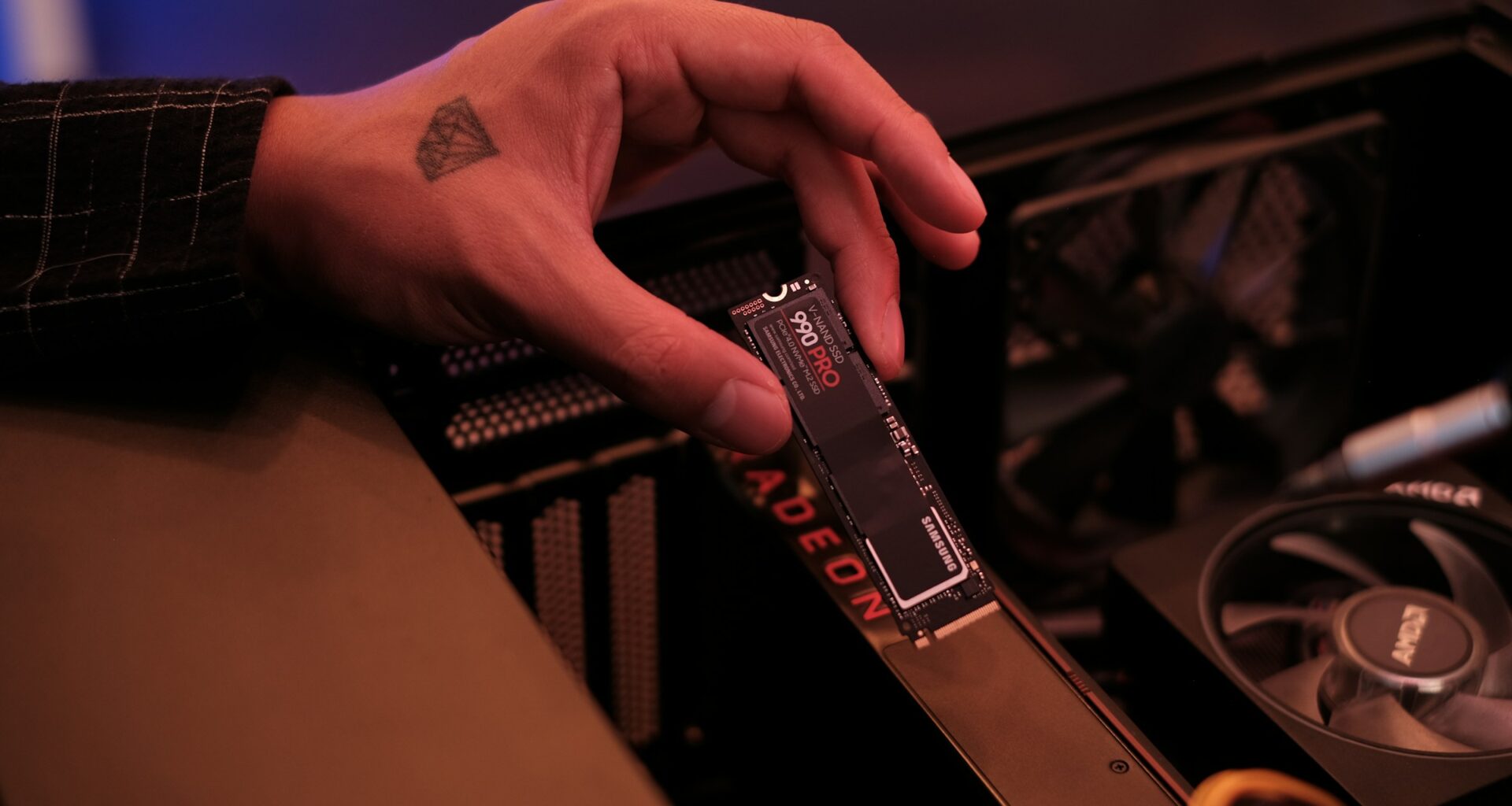
The cache drive: Samsung 990 Pro 2TB ($389.99)
The 990 Pro has been my Gen4 answer since it launched, and at $389.99 for 2TB it still is: DRAM on board, a measured post-cache write floor around 1.7 GB/s that keeps conform-and-render churn smooth long after the SLC cache empties, and 1,200 TBW of rated endurance. One housekeeping note if you buy one used or old-stock: early firmware had a health-reporting bug that Samsung fixed ages ago, so run Magician and update on day one.

If your board has a CPU-attached Gen5 slot, the 9100 Pro 2TB is $399.99. Ten dollars. We wrote a whole piece on that gap (the $10 question) and the verdict holds at these verified prices: at a $10 difference you take the Gen5 drive in a Gen5 slot and think about something else. In a Gen4 slot it’s wasted money.

Heavy After Effects or Fusion users are the one group that should look further up the shelf. Puget’s AE cache testing puts uncompressed 4K playback in Gen4 territory and 8K30 in Gen5 territory, with a 4TB cache drive on the spec sheet, and the WD_Black SN8100 2TB now costs the same $399.99 as the 9100 Pro while holding a measured post-cache write floor near 3.9 GB/s, the highest in the consumer market. That floor is the spec an AE disk cache lives on. For everyone else: 2TB is the standard cache size, and Premiere’s defaults will happily manage it.
“But won’t scratch writes chew through the drive?” Do the arithmetic once and stop worrying. A 1,200 TBW warranty over five years is 240 TB a year, which is 660 GB of writes every single day, weekends included. An editor ingesting a terabyte of footage a week, with cache and optimized media and render churn doubled on top, lands around 100 to 150 TB a year. TLC endurance ratings are theater for this job. The exception is QLC: Crucial’s P310 is rated 440 TBW, about 240 GB a day, and a busy scratch drive can meet that number for real. Speed was never the argument against QLC for cache duty. Endurance is.
The export drive: don’t buy one
Every four-drive build guide gives the fourth M.2 slot to a “delivery drive,” and no measurement supports it. Puget’s storage-optimization testing found render and export only 5 to 15 percent storage-sensitive; the job is bottlenecked by encode, on your CPU and GPU. Adobe, which publishes storage guidance for every other role, publishes none for export destinations. None. The fastest delivery codec you’re likely to write is a fraction of the write floor of every drive on this page, and even a ProRes 4444 XQ UHD master at 248.6 MB/s fits inside the worst TLC floor here with room to spare.
So export to the media drive, or straight to the NAS your delivery workflow ends up on anyway, and spend the fourth-slot money where this market is punishing you: capacity. The only reader who should think twice is someone mastering uncompressed or 4444 XQ all day, and even then the answer is “make sure the target isn’t QLC,” not “buy a dedicated drive.” An empty M.2 slot is a fine thing to own. It’s where your media drive’s replacement goes in two years.
The picks side by side
| Role | Pick | Price | $/TB | Endurance | Why this drive here |
|---|---|---|---|---|---|
| OS / apps | WD_Black SN7100 2TB | $289.99 | $145 | 1,200 TBW | DRAM-less weakness never touched by boot-drive reads |
| Media / projects | Lexar NM790 4TB | $509.99 | $127.50 | 3,000 TBW | Best $/TB and endurance on the page; single-sided |
| Cache / scratch (Gen4) | Samsung 990 Pro 2TB | $389.99 | $195 | 1,200 TBW | DRAM + ~1.7 GB/s post-cache write floor |
| Cache / scratch (Gen5 slot) | Samsung 9100 Pro 2TB | $399.99 | $200 | 1,200 TBW | $10 over the 990 Pro; only in a CPU-attached Gen5 slot |
| Export / delivery | None | $0 | n/a | n/a | Export is 5 to 15% storage-sensitive; write to media or NAS |
Buying drives in a shortage (2026 rules)
The background you should price against: AI datacenters are eating the world’s NAND supply. TrendForce tracked contract prices up 33 to 38 percent in Q1 2026 and another 70 to 75 percent in Q2, with capacity relief unlikely before late 2027. SanDisk repriced its whole SSD line in January; the SN8100 2TB went from $279.99 to $644.99 overnight. Kioxia’s managing director says this year’s production is already sold out. Nobody credible forecasts prices falling in 2026, so “wait for the sale” is not a plan. The one sale worth a look is Black Friday, and the targets for every drive on this page are on Black Friday SSD deals for video editors.
Which changes the useful question from “which drives” to “which roles get cut first.” Here’s the consolidation ladder. One drive: everything shares, and you set Premiere’s cache and Resolve’s scratch location to it knowingly. Two drives: OS on one, media and cache together on the big one. That’s Adobe’s own two-drive fallback, and it keeps the measured win (cache off the OS disk) while skipping the unmeasured one. Three drives: split the cache out, mostly to move its constant writes off drives you care about. Four drives: you skipped the export section. Go read it, then buy capacity.
Know which brands will still exist for your next build. Micron killed the entire Crucial consumer line in its AI pivot; the T710 and T500 stock on Amazon right now is real, with single-digit inventory counters, so a discounted T-series is a fine buy if you catch one, from a brand that’s gone. Solidigm exited consumer drives too. And the shortage has made counterfeits a business: fake 990 Pros are circulating that look right in Windows and benchmark slower than USB 2.0. Buy sold-by-Amazon or manufacturer-direct where that option exists, read the seller’s feedback where it doesn’t, then validate day one with the vendor’s own tool (Magician for Samsung, Dashboard for WD/SanDisk), which catches the fakes and gets you firmware fixes. That last part isn’t paranoia either: in one 2025 incident, retail drives from multiple brands shipped with pre-release firmware that made them vanish mid-transfer during long sustained writes. During, say, a card offload.
Do you even have the slots?
Before you order three drives, read your motherboard manual’s storage page, because M.2 slots share bandwidth in ways the spec sheet buries. On the ASUS ProArt X870E, populating the second CPU-attached M.2 drops your graphics card from x16 to x8. Whether that matters depends on the GPU generation: Puget’s lane-scaling tests put a Gen5 GPU at x8 at about a 2 percent loss in Resolve (take the drive, you’ll never notice) but a Gen4 GPU at x8 at nearly 12 percent (don’t). The chipset-attached slots have their own ceiling: on AM5 the chipset’s uplink is about 8 GB/s, shared with your USB, SATA, and network, so two chipset Gen4 drives can outrun the pipe during drive-to-drive copies. Playback won’t care. Big migrations will. Our Resolve workstation build guide walks the whole board layout if you’re starting from parts.
FAQ
Do I really need a separate cache drive?
Every forum thread on this splits into a “NVMe is so fast it doesn’t matter” camp and a “separation is about performance” camp, and both are arguing about the wrong thing. The speed gain from separating cache from other NVMe storage is small; Puget says so directly. The reasons that hold up in 2026: it moves a constant stream of writes off your boot drive, it protects free space (SLC caches shrink as drives fill, so a boot drive stuffed with .cfa files is a slower boot drive), and it makes the cache disposable. When Premiere’s cache database corrupts, and someday it will, you nuke a dedicated volume without a second thought.
Can the media cache live on the media drive?
Yes. Adobe’s storage guidance says it plainly: with two drives, media and media cache share one. The split that has measured evidence behind it is cache versus the OS drive, not cache versus media.
Is Gen5 worth it for editing?
For playback, no; go back to the stream table and see how absurd Gen4’s numbers already are. For cache, only when the price gap is trivial, which right now it is: $10 between the 990 Pro and 9100 Pro at 2TB. The long version, thermals and all, is in our Gen4 vs Gen5 piece.
So how many drives do I need?
Two is the floor: OS on one, media plus cache on the other, which keeps the cache writes off your boot drive. Three is the full build this guide describes. Four is for people who enjoy buying drives. Nobody needs four.
Is a SATA SSD still good for anything?
Cache in a pinch (Puget still lists it as acceptable there), and project archive. Not media: after headroom, 550 MB/s is a single stream of UHD ProRes HQ. Price it against NVMe before you assume it’s the budget move, though. SATA lines are being cleared rather than restocked, and the listings have gone strange: Samsung’s 870 EVO 1TB is $414.99 direct from Samsung right now, which is more per terabyte than any drive in this guide. If the number looks like that, skip it entirely.
In conclusion
Buy by role, not by rank. The SN7100 2TB boots the machine, the NM790 4TB holds the footage, the 990 Pro 2TB (or the 9100 Pro, for ten bucks, in a Gen5 slot) catches the writes, and the export drive stays a rumor. If the budget only covers two drives, keep the OS drive separate and let media and cache share; that’s the split with a measurement behind it. And whatever you buy this year, check who’s selling it before you check out and verify it with the vendor tool once it lands, because the shortage brought out the fakes.
And that’s it! This is the internal half of the storage story; the external half lives in the portable SSD guide, and if your capacity problem has outgrown internal drives entirely, the Thunderbolt DAS roundup is the next stop. What’s here is what I’d put in my own tower this month at these prices. If your board, footage, or budget is doing something stranger, drop it in the comments and I’ll point you at the right slot for it.