


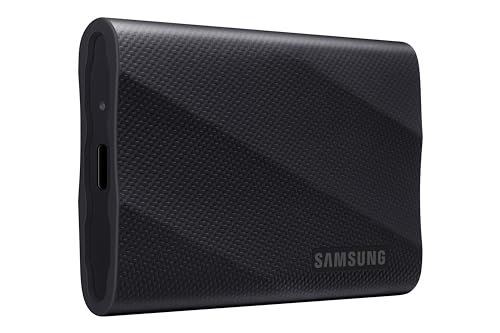
The Samsung T9’s box says 2,000 MB/s. Plug it into a MacBook Pro and you’ll get about 950. That’s not a defective drive, and it’s not a bad cable. It’s the dirty little secret of this entire product line: the T9 speaks USB 3.2 Gen 2×2, a 20Gbps standard that almost no computer you own supports. Every Apple Silicon Mac ever made, including the M4 machines with Thunderbolt 5 ports, falls back to 10Gbps with a Gen 2×2 drive. Most Windows laptops do the same.
So the T9 is a scam? No, and that’s what makes this comparison interesting. The T9 is still the drive I’d buy, just not for the reason on the box. Let me walk you through the three-way fight between the T9, the T7 Shield, and the plain T7, because the winner is decided by numbers Samsung doesn’t print on the front.
TLDR
Buy the T9 2TB. At $444.44 it’s currently cheaper than the T7 Shield 2TB ($517.47), it holds around 900 MB/s for an entire card offload where the plain T7 collapses to a third of that, and Samsung’s clearance pricing means you’re paying Gen 2 money for the better drive. Buy the T7 Shield only if you specifically need its IP65 weather sealing for rain-and-dust location work; on a Mac the two perform the same. And skip the plain T7 at 2TB: it’s a third-party-only listing with a cache cliff that turns long offloads into a coffee break.
| Drive | Rated speed | Real speed on a Mac | Sustained write | Price today |
|---|---|---|---|---|
| T9 1TB | 2,000 MB/s | ~950 MB/s | ~900 MB/s after 22GB cache | $241.89 |
| T9 2TB | 2,000 MB/s | ~950 MB/s | ~1,800 MB/s for 88GB, then ~900 | $444.44 |
| T7 Shield 2TB | 1,050 MB/s | ~1,000 MB/s | ~900 MB/s, full drive | $517.47 |
| T7 2TB | 1,050 MB/s | ~1,000 MB/s | 867 for ~84GB, then 337 MB/s | 3rd-party only |
Amazon, September 28, 2026. The T9 2TB and 1TB and the Shield 2TB are first-party listings today; the plain T7 2TB is marketplace sellers only, which tells you where that model is headed. All of it is NAND-shortage pricing, so re-check before you buy.
The port problem nobody mentions
USB 3.2 Gen 2×2 doubles the 10Gbps of Gen 2 by running two lanes at once. Sounds great. It’s optional in the USB4 spec, though, and host support basically never happened. The realistic list of machines with a working 20Gbps port in 2026: recent desktop motherboards (Intel Z690 through Z890, AMD B650/X670/X870 boards usually have one Type-C at 20Gbps), add-in cards built on ASMedia’s ASM3242 controller, and a handful of gaming laptops. Not one Mac. Apple has never shipped Gen 2×2, and a T9 on any Apple Silicon machine, M1 through M4, negotiates plain 10Gbps. Thunderbolt and USB4 don’t rescue it; the drive isn’t a Thunderbolt device.
So on the computer most editors carry, the T9 and the T7 Shield deliver the same interface speed, about 950 to 1,000 MB/s. If that were the whole story, you’d buy whichever is cheaper and move on. It’s not the whole story.
Sustained writes: where the plain T7 loses
Every drive here uses a fast cache in front of slower flash. What separates them is what happens when the cache runs dry, and for offload work, that’s the number that owns your evening.
The plain T7 2TB writes at 867 MB/s for about 84GB, then drops to 337 MB/s for the rest of the transfer. The T7 Shield fixed exactly this: Samsung rates it above 900 MB/s across the full drive, and Tom’s Hardware’s testing backs it up. The T9 behaves like a Shield with a turbo: roughly 1,800 MB/s for its first 88GB (on the 2TB), then the same ~900 MB/s floor, which PCWorld confirmed across a brutal 450GB continuous write. In practice: the Shield and T9 finish a big offload at a steady jog; the plain T7 sprints the first mile and crawls the rest.
What that does to real card dumps from a 10Gbps port, using the sustained floors:
| Card size | T9 / T7 Shield | Plain T7 2TB |
|---|---|---|
| 128GB | ~2.5 minutes | ~4 minutes |
| 256GB | ~5 minutes | ~10 minutes |
| 512GB | ~9.5 minutes | ~23 minutes |
On a real Gen 2×2 port the T9 shaves those further (a 512GB dump lands around 8.7 minutes, and small cards fly at full cache speed), but the short version is that the 20Gbps port only pays off big on cards smaller than the cache. The T9’s advantage is that steady 900 floor plus the price. Card choice matters as much as the drive here; that math lives in the CFexpress vs SD guide.
When the Shield is the right call
The T7 Shield is the only drive here with a real environmental rating: IP65 against dust and water jets, a 3-meter drop spec, and a rubberized body that shrugs off the inside of a run bag. The T9 has a rubberized shell and a 9.8-foot drop rating of its own, but no IP rating. If your drives ride on documentary shoots, beaches, ski hills, or anywhere weather is part of the job description, buy the Shield and don’t overthink it. Its sustained writes match the T9’s floor, so you’re giving up nothing that matters on location. What you’re paying for that sealing today: $73 more than the T9 at 2TB, which is the market being briefly ridiculous in your favor either way.
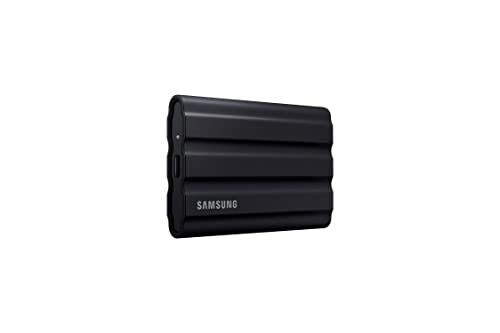
One warning while we’re here: the Shield 1TB is priced at $269.05 right now, still well above its pre-shortage price, and $27 more than the T9 1TB. Don’t buy it at that number. The T9 1TB at $241.89 is the sane small-capacity buy today.
Should you wait for the P9?
Samsung announced the P9 at CES in January 2026: a USB4 portable rated at 4,000 MB/s that would erase the T9’s Mac problem entirely, since USB4 runs full speed on every modern Mac. As of late July 2026 it had no price, no ship date, and no presence in Samsung’s own store (the price table above is more recent, from September 28). Meanwhile the T9 2TB still undercuts the slower Shield 2TB by about $73 while the rest of the storage market climbs. Buy the T9 now; when the P9 actually ships, it will launch into shortage pricing anyway, and your T9 will still be a great offload target. I’ll update this page when that changes.
In conclusion
The T9 2TB wins this three-way on the two numbers that matter: a ~900 MB/s floor that holds through a full card dump, and a price that undercuts its own slower sibling. The Shield is for weather, the plain T7 is for nobody at current 2TB pricing, and the 20Gbps badge is for the six of you with an ASM3242 card in a desktop. These drives are one piece of a bigger discipline, and the rest of it, the 3-2-1 copies, the verified offloads, the don’t-format-until-it’s-safe rules, is in the travel offload and backup workflow guide. Roundup of the wider portable field, including the non-Samsung options: portable SSDs for editing.
And that’s it. If the next question is which drives go inside the machine, the internal NVMe guide covers boot, media, and cache roles. Prices here have moved monthly all year, so trust the listing over my table if they disagree, and holler in the comments if your machine’s ports are doing something weirder than what I’ve described. There’s always something weirder. Black Friday targets for the T7, the Shield, and the T9 are on Black Friday SSD deals for video editors.


