


Let’s get one thing straight before anyone spends money: this guide is about the drives you throw in a bag. The SSD that rides shotgun from set to the edit suite, catches a full day of card offloads, and hands the footage to whoever’s cutting it. If you’re shopping for the drive that lives inside your machine, that’s a whole different animal, and I already covered it in my internal NVMe guide. This page is bag drives only.
Now, a quick reality check, because the marketing in this category is shameless: the giant number printed on the box is a burst speed. Every drive here has a fast cache that runs out partway through a big transfer, and what happens after that cliff is what decides your offload day. A drive that bursts at 4,000 MB/s and then faceplants to 200 is not a 4,000 MB/s drive when you’re dumping cards at midnight. So for every pick below, I’m giving you the real-world sustained numbers from independent testing, not just the marketing.
One more heads-up: the 2026 NAND shortage has portable SSD prices swinging by hundreds of dollars, sometimes week to week. So I’m mostly avoiding hard dollar figures in this post. The product boxes below show live pricing, and I’ll tell you what a fair buying band looks like where it matters.
Last updated: July 2026. Some links below are affiliate links. Buy through them and it helps keep the site running, at no extra cost to you. I only point at gear I’d be comfortable handing to a friend.
TLDR
If you just want the answer: the Corsair EX400U is the one to beat. It’s a native USB4 drive that stays fast after the cache runs out, which is the whole game. On a tighter budget, the Kingston XS1000 is the cheap pick for proxies and project shuttling. The rest of this guide is who should pick what, and why.
Best overall: Corsair EX400U 2TB
The 2026 roundups mostly crowned this drive, and after digging through the testing, I get it. It’s native USB4, so it hits around 4,000 MB/s read and 3,600 MB/s write on any USB4, Thunderbolt 4, or Thunderbolt 5 port. No “only on the newest Macs” asterisk. The part that matters more: in KitGuru’s 15-minute continuous-write torture test it held 1,600 to 1,700 MB/s without thermal throttling. That post-cache floor is faster than most 20Gbps drives run at their peak. There’s also a magnetic MagSafe-style ring on the back, which sounds like a gimmick until you’re recording ProRes off an iPhone and it suddenly isn’t. Timing also helps this pick: Crucial’s X10 line is dead (Micron bailed on consumer SSDs in early 2026) and Samsung is clearance-pricing the T9, so this is the strong pick that’s in steady supply.
The cons: the SLC cache is only about 55GB on the 2TB model, and once it’s gone, write speed steps down (PCWorld measured closer to 1,100 MB/s post-cache on their bench, so your floor depends on the host). On a plain 10Gbps USB port it’s a ~1,000 MB/s drive, so if your laptop doesn’t have USB4, you’re paying for speed you can’t use. One availability note as of September 13, 2026: the standard 2TB listing has gone unavailable on Amazon and the 1TB is a third-party seller asking $475, so the box below links the EX400U Survivor 2TB, the same drive in an IP55 rugged shell, $429.99 sold by Amazon itself. The price has been all over the map since the NAND squeeze hit, so check the listing and pounce on a dip.

Best value: Kingston XS1000 2TB
Not everyone needs USB4 money. If your drive’s job is proxies, project files, and shuttling deliverables to clients, the XS1000 is the cheapest name-brand 2TB that’s still competent, and it weighs 29 grams. That is not a typo. It consistently delivers its rated 1,050 MB/s read and 1,000 MB/s write over 10Gbps, holds 800+ MB/s for the first ~50GB of a dump, and carries a five-year warranty. While everything else spiked with the NAND shortage, this one has stayed reachable: buy it in the $200 to $270 band and you’ve done well.
Now the part where I talk you out of misusing it. TechPowerUp ran a full-drive write and it averaged just 214 MB/s once the roughly 180GB cache was spent. So do NOT buy this to offload a full day of 4K camera originals in one go… that’s the job for the Corsair or the Lexar. It’s also capped at USB 3.2 Gen 2 forever, so it can’t grow with a USB4 laptop, and there’s no drop or water rating. It’s budget storage, not a fast scratch disk. Know which one you need.

Best rugged: Lexar ARMOR 700 2TB
From my days of DITing I can tell you exactly how drives die: they get dropped, rained on, and buried in a run bag under a light stand. The ARMOR 700 is built for that life. IP66 sealing (a step better than the SanDisk Extreme’s IP65), a 3-meter drop rating, and a full 20Gbps interface rated at 2,000 MB/s both ways. The number that earned it this slot, though, is the boring one: in PCWorld’s long 450GB write test it ranked near the top of the entire 20Gbps class with no dramatic cache cliff. It just keeps writing. That’s the exact behavior you want at 1am when the cards have to be cleared for tomorrow. It also comes in 4TB and 8TB if you want rugged and roomy.
The catches: full 20Gbps speed needs a USB 3.2 Gen 2×2 port, and Macs don’t have those, so on any Mac this runs at ~1,000 MB/s. (USB4 and Thunderbolt ports fall back to 10Gbps for this drive. Yes, USB naming is a clusterf*ck.) It’s also chunkier than the pocket drives, and it has the worst price whiplash of any pick here: I’ve seen it swing from just over $200 to well past $400 depending on the week and the retailer. Check the box below AND check B&H before you buy.

Best high-capacity (4TB+): SanDisk Professional PRO-G40 4TB
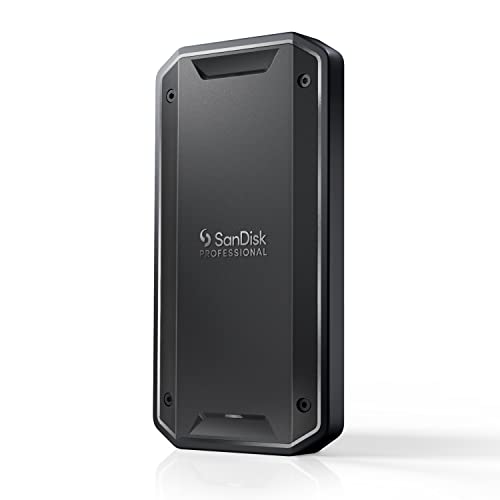
When the project won’t fit on 2TB, this is the grown-up option. The PRO-G40 is a dual-mode drive: Thunderbolt 3 at a rated 3,000 MB/s read and 2,500 MB/s write, with a USB-C 10Gbps fallback for everything else. The Thunderbolt mode is the part to care about: it runs full speed on every TB3, TB4, and TB5 Mac ever made, with none of the “only on the newest machines” fine print that comes with the Thunderbolt 5 drives. The build backs it up: IP68 sealed, rated to survive 4,000 pounds of crush, an aluminum core that pulls heat out, and a five-year warranty. B&H lists it as the official replacement for the old G-DRIVE SSD, which tells you the audience: this is the working-pro field drive.
I’ll be straight with you on the numbers, though: I don’t have an independent full-drive write test in hand for this one, so I’m quoting rated specs only, not measured sustained speeds. The other knock is that on a plain USB-C port without Thunderbolt, it drops to ~1,000 MB/s, same as every dual-mode drive. If your whole world is non-Thunderbolt Windows laptops, the Corsair is the better spend.
Price is the sore spot, and it’s not a SanDisk problem: the NAND shortage has roughly doubled this entire class over the past year. At about $870, the PRO-G40 is now the cheapest name-brand Thunderbolt 4TB on the market. Adorama lists the same drive at $899, and the OWC and LaCie equivalents run $1,100 to $1,600. Waiting for a return to its old $400 street price is not a plan. Pay up if the capacity is a hard requirement; if it isn’t, spending half as much on one of the 2TB picks above is the saner move.
Fastest (Thunderbolt 5): OWC Envoy Ultra 2TB
This slot belonged to the LaCie Rugged SSD Pro5 until Seagate let it die: the 2TB is gone from every retailer we track, and the 4TB only surfaces at $1,700. The drive that actually ships is the OWC Envoy Ultra 2TB, and it gives up very little. It’s rated at over 6,000 MB/s sequential on a Thunderbolt 5 host, and it keeps the rugged story too: IP67, crushproof, with the one caveat that the captive cable’s connector end isn’t waterproof. OWC covers it for five years. If you’re playing back multicam 8K RAW or BRAW straight off a portable, this is the quickest thing in a bag you can buy.
The fine print carries over with different numbers. You still need a genuine Thunderbolt 5 host to see 6 GB/s, which mostly means M4 Pro/Max Macs; on Thunderbolt 4 or USB4 it tops out around 3,800 MB/s. And it’s $700 for 2TB, which is real money. If the budget says no, the Sabrent Rocket XTRM 5 2TB is the cheapest true Thunderbolt 5 drive at $400 and lands in the 4 to 5 GB/s range in real transfers; fewer reviewers have banged on it, but it’s the sane value route. The box below shows the live listing.

How the five compare
| Drive | Capacity tested | Interface | Rated seq. write | Sustained write (real-world) | Weight | Street price |
|---|---|---|---|---|---|---|
| Corsair EX400U | 2TB | USB4 (40Gbps) | 3,600 MB/s | 1,100-1,700 MB/s post-cache | Pocket drive + magnetic ring (Survivor: IP55 shell) | $429.99 (Survivor 2TB, Amazon) |
| Kingston XS1000 | 2TB | USB 3.2 Gen 2 (10Gbps) | 1,000 MB/s | ~214 MB/s full-drive average | 29 g | ~$200-270 band |
| Lexar ARMOR 700 | 2TB | USB 3.2 Gen 2×2 (20Gbps) | 2,000 MB/s | No cache cliff over 450GB test | Chunky, armored | Whiplash, check listing |
| SanDisk PRO-G40 | 4TB | TB3 + USB-C 10Gbps | 2,500 MB/s (TB3) | n/a (rated 2,500 TB3) | Solid, aluminum core | ~$870, cheapest 4TB in class |
| OWC Envoy Ultra 2TB | 2TB | Thunderbolt 5 | 6,000+ MB/s | n/a (no cache-cliff bench yet) | Rugged, IP67 | $700, sold at list by OWC |
What to look for in a portable editing SSD
Sustained write is the spec that matters, and nobody prints it on the box. Every consumer portable SSD writes to a fast SLC cache first, and when that cache fills mid-transfer, speed falls off a cliff. Cache sizes here range from about 50GB to 180GB. If your offloads are bigger than that (and a shoot day of 4K usually is), the post-cache number is your real speed. It’s the entire reason the Corsair and Lexar outrank drives with bigger numbers on the front.
Match the drive to the ports you own. This is where people torch money. A USB4 drive on a 10Gbps port runs at 10Gbps. A 20Gbps Gen 2×2 drive on ANY Mac runs at 10Gbps, because Apple never adopted Gen 2×2. A Thunderbolt 5 drive needs a Thunderbolt 5 machine to justify its price. Before you buy anything on this page, look up what your laptop’s ports support. Five minutes of reading beats paying double for speed you’ll never see.
Rugged ratings are insurance, priced accordingly. IP66 means sealed against dust and heavy spray; IP68 means it can survive actual submersion. If your drive lives on a desk, skip the armor and pocket the difference. If it lives in a run bag or a camera cart, the rugged tax is cheaper than one reshoot. Ask yourself where the drive will be when something goes wrong.
Buy on the dips, because 2026 pricing is chaos. The NAND shortage has every drive on this list swinging in price, sometimes by 50% or more. The picks stay the same, but the smart money watches a listing for a week or two before pulling the trigger. And one more thing: whatever you buy is one copy of your footage. One copy is zero copies. Offload to two places before anyone wipes a card.
FAQ
Is a portable SSD fast enough for 4K or ProRes editing?
Yes, comfortably. Even the 10Gbps drives here read at roughly 1,000 MB/s, which is many times the data rate of 4K ProRes playback, and the reads stay steady even when writes slow down. Where a portable drive bites you is sustained writes during offload, and multi-stream monsters like 8K RAW multicam, which is where the Thunderbolt drives pull ahead.
Portable SSD or portable hard drive for video work?
For anything you’ll edit from or offload to on a deadline: SSD, no contest. A spinning portable drive is dramatically slower, and one good drop while it’s writing can kill it. Where spinning drives still make sense is cold archive, the finished projects you stash on a shelf, because the price per terabyte is way better. Shoot on SSD, retire to spinning rust.
Can you edit directly off a portable SSD?
Absolutely, and plenty of editors run whole projects this way. Keep your media on the portable, but put your project file, cache, and scratch on the internal drive if you can; that split keeps the app responsive even if the portable gets busy. Just remember the golden rule: a drive that travels is a drive that gets lost, so back it up before it leaves the building.
Where these drives fit in the bigger picture
A bag drive is one piece of a storage chain. The drive inside your edit machine matters just as much, and that’s covered in my internal NVMe guide. When you’ve outgrown shuttling drives entirely and want your footage in one place, it’s time to build an editing server. And if you want to see where portable drives slot into on-set work, my DIT data wrangler kit is exactly that setup.
And that’s it! As always, what you see here is what works for me, my clients, and my crew. No drive makes the cut better, but a drive that keeps up means you spend the night editing instead of watching a progress bar. Got a portable you trust with your life’s work? Drop it in the comments. The rest of our buyer’s guides live on the Gear Guides page.


