


You can hear a bad podcast mic before you can name it. The room is in the recording, the plosives land like someone tapping the glass, and every time the host leans back the voice goes thin. The fix is not a $1,000 microphone. Podcasting is one of the few audio jobs where the right $100 to $500 mic, placed a hand’s width from a mouth, beats a studio condenser that costs five times more and hears the refrigerator in the next room.
This guide is written for the video-first reader, because the mic you buy for the podcast is the same mic that records your voiceover, your interview B-roll audio, and your client call, and that changes a couple of the picks. Alex wrote up his own starter podcast rig a few years ago, and his interface pick in that piece still stands; this page is the microphone half, brought up to what’s on the shelf in September 2026. For mics that mount on a camera, the on-camera and shotgun mic guide is the sibling read, and for talking-head shoots where the mic has to hide, the wireless mic guide.
Last updated: September 2026. Some links below are affiliate links. Buy through them and it helps keep the site running, at no extra cost to you. Every price here was read on the live Amazon listing on September 13, 2026. Three picks, the Shure MV7+, the Samson, and the Rode NT1, were third-party sellers at their list prices that day; the rest were sold by Amazon itself. We say which is which.
TLDR
If you just want the answer: the Shure SM7dB at $549 is the best podcast microphone you can buy, because it’s the SM7B with the preamp problem solved inside the mic. The best value is the Rode PodMic USB at $189, which plugs into a laptop today and an interface next year. If you want one mic that does USB and XLR without sounding like a compromise on either, the Shure MV7+ at $299. And the budget answer is still the Samson Q2U at $99.99, the mic a lot of the podcasts you listen to started on.
Dynamic or condenser: the one decision before the list
Podcast mics come in two families, and the room you record in picks the family for you. A dynamic mic hears what’s close and ignores most of what isn’t, which is why the broadcast world runs on them: put a dynamic six inches from a mouth in an untreated spare bedroom and the bedroom mostly disappears. A condenser hears everything, in detail, including the HVAC, the street, and the reflection off the desk. In a treated room, or a closet full of coats, a condenser sounds more open and more expensive than any dynamic. In a normal room it sounds like a normal room. Five of the seven picks below are dynamics for that reason, and the two condensers come with a warning label about where to use them.
The picks
Best overall: Shure SM7dB ($549)
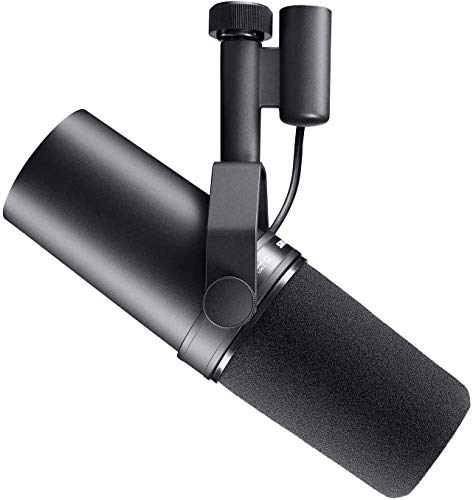
The SM7B has been the podcast mic for fifteen years, and it has one famous problem: it’s quiet. It needs about 60 dB of clean gain, which most interfaces can’t give it without hiss, so the standard advice was to add a Cloudlifter or a FetHead in line, another $150 and another box on the desk. The SM7dB is the same capsule, the same air-suspension shock mount, the same built-in pop filter, with that booster built into the body. Flip the switch to +18 or +28 dB, feed it phantom power from any interface, and it drives a $150 interface’s preamp like a $1,500 one. A bypass switch turns it back into a plain SM7B if you already own the outboard gain. It’s XLR only, it wants a real boom arm because it’s heavy, and $549 is a lot of money for a dynamic mic. But the sound is the sound every listener has been trained to think of as “professional,” the rejection of a bad room is the best in this group, and for a video editor it’s also the voiceover mic you’ll never replace. If you’re going to buy one mic for the next decade, this is it.

The classic: Shure SM7B ($439)
“So why would anyone still buy the old one?” Because $110 buys a lot of gain if you already have it. The SM7B sounds identical to the dB, and if your interface has strong preamps, or a Cloudlifter is already on your desk, the extra $110 for the built-in booster is money spent twice. It’s the mic in Alex’s podcast setup, running into an SSL 2+, and that pairing works because the SSL’s preamps have the gain to spare. On a cheaper interface, the story changes, and that’s the whole reason the SM7dB exists. So the rule: strong preamp or outboard booster already in hand, buy the SM7B and save $110. Anything else, buy the dB and skip the extra box. Either way it’s XLR only, it needs a boom arm, and it will outlive three computers.
Studio Recording, Home Recording, Podcasting and Streaming. The SM7B Is Trusted By The Worlds Leading Vocalists, Podcasters and Streamers.
Best USB and XLR hybrid: Shure MV7+ ($299)
The MV7+ is the mic for the person who records on a laptop this year and might buy an interface next year. It has USB-C and XLR on the back, both live at once, so it plugs straight into a computer for the solo show and into a mixer when the show grows. Over USB it brings its own processing: an auto-level mode that rides gain for you, a real-time noise reducer, a digital pop filter, and Shure’s MOTIV Mix app for the settings, which means a first-time host gets a broadcast-shaped voice without learning what a compressor is. The dynamic capsule is a cousin of the SM7’s, tuned brighter, and it holds up on an XLR chain later. What you give up against the SM7 line is a little of the low-end weight and a lot of the off-axis rejection: in a lively room the MV7+ hears more of it. At $299 it’s the most flexible mic on this page, and the one we’d hand to a video editor who does client calls, voiceover, and a podcast on the same desk. The Amazon listing was a third-party seller at the $299 list, shipped from Amazon’s warehouse, when we checked.

Best value: Rode PodMic USB ($189)
The original PodMic was a $99 XLR dynamic that sounded like it cost three times that, and the PodMic USB adds a USB-C output and Rode’s onboard processing to it for $189. Over USB you get the APHEX Aural Exciter and Big Bottom effects, a compressor, a noise gate, and a high-pass filter, all switchable in Rode’s software, and over XLR you get the plain broadcast dynamic that made the first one a hit. The internal pop filter is good enough that most hosts never add one. It’s built like a doorstop, in a good way, and the heft is the one practical warning: budget a boom arm that can hold it. Against the MV7+ it’s $110 cheaper, a touch darker in tone, and a little less polished in software. Against everything else under $200 it isn’t a contest. This is the mic most podcasts should buy.

Best budget: Samson Q2U ($99.99)
The Q2U has been the answer to “what’s the cheapest mic I won’t regret” for a decade, and nothing at $100 has unseated it. It’s a handheld-style dynamic with both USB and XLR outputs, a headphone jack on the body for zero-latency monitoring, and a desk stand and both cables in the box. Plug it into a laptop, talk into the top of it from four inches away, and you have a podcast. The trade-offs are the ones you’d expect at the price: the processing lives in your software rather than the mic, the tone is a little flat next to the Rode, and the included stand puts the mic at desk height, which puts it too far from your mouth, so plan on a cheap boom arm. On September 13 the Amazon listing was a third-party seller at the $99.99 list price with 13 units left; it goes in and out of stock, so if it’s gone, the PodMic USB above is the next rung and worth the extra $89.

Best condenser for a treated room: Rode NT1 5th Gen ($212)
Here is the warning label. If your room has foam, a closet, a rug, and a door that closes, the NT1 5th Gen will make your voice sound more expensive than anything else on this list. It’s a large-diaphragm studio condenser with a self-noise of 4 dBA, which is close to silent, and the fifth generation added something no other mic here has: USB-C alongside the XLR, with 32-bit float recording over USB. That last spec means a take can’t clip. A guest laughs into it, the level slams past zero, and the file still has the whole waveform; you pull it down in the edit and it’s fine. For a video editor who records voiceover in a treated bay, that’s the whole pitch. If your room is a spare bedroom with a window, don’t. A condenser this sensitive will record the bedroom, and no plugin takes a room back out. The Amazon listing was a third-party seller at the $212 list price when we checked; Rode’s US distribution has been uneven this year, so read the seller line.

Best USB condenser: Elgato Wave:3 MK.2 ($144.99)
The Wave:3 MK.2 is the USB-only pick for the person who will never own an interface and wants the mic to handle the engineering. Elgato’s Clipguard 2.0 rides a second, quieter signal path and switches to it when you peak, so the same laugh that ruins a take on a cheap USB mic just gets quieter here. Auto gain sets the level for you, and the onboard voice enhancer, compressor, and EQ mean the recording that lands in your NLE is already most of the way mixed. The multifunction dial on the front handles gain, monitoring mix, and mute without touching software. It’s a condenser, so the room warning from the NT1 applies, softened a bit by the tighter pickup and the fact that it lives close to your mouth on the included stand. For a streamer, a solo host in a small treated room, or an editor who wants one cable and no menus, it’s the easiest mic here to get a good result from on day one. Rode’s own NT-USB+ would normally sit next to it in this slot; Amazon listed it as unavailable when we checked, so it’s out for now.

How the seven compare
| Mic | Type | Outputs | Onboard processing | Needs | Amazon, Sept 13 | Best for |
|---|---|---|---|---|---|---|
| Shure SM7dB | Dynamic | XLR | Built-in +18/+28 dB preamp | Interface with phantom power, boom arm | $549 | The one mic for a decade |
| Shure SM7B | Dynamic | XLR | None | Strong preamp or a Cloudlifter, boom arm | $439 | Owners of good preamps |
| Shure MV7+ | Dynamic | USB-C + XLR | Auto level, denoiser, digital pop filter (USB) | Nothing today, an interface later | $299, third-party seller | Laptop now, mixer later |
| Rode PodMic USB | Dynamic | USB-C + XLR | APHEX effects, compressor, gate (USB) | A boom arm that can hold it | $189 | Most podcasts |
| Samson Q2U | Dynamic | USB + XLR | None | A boom arm (the included stand sits too low) | $99.99, third-party seller | The first mic |
| Rode NT1 5th Gen | Condenser | USB-C + XLR | 32-bit float over USB | A treated room, a shock mount, phantom power on XLR | $212, third-party seller | Voiceover in a treated bay |
| Elgato Wave:3 MK.2 | Condenser | USB-C | Clipguard 2.0, auto gain, voice enhancer, compressor, EQ | A quiet room, nothing else | $144.99 | One cable, no menus |
What matters in a podcast mic
Distance beats everything. Every mic on this list sounds good at four to six inches and bad at eighteen. A $100 dynamic on a boom arm at the right distance beats a $500 mic on a desk stand at the wrong one, every time. Budget the arm into the purchase; it’s the second most important thing you’ll buy.
The room picks the family. Untreated room, dynamic. Treated room or closet, condenser if you want the open sound, dynamic if you want forgiveness. Nobody has ever regretted buying a dynamic for a podcast. Plenty of people have regretted a condenser.
USB and XLR on the same mic is the feature to pay for under $300. The MV7+, PodMic USB, Q2U, and NT1 all have it, and it means the mic survives the upgrade from laptop to interface. A USB-only mic is a fine first mic and a dead end; an XLR-only mic is the pro answer and needs a $150 interface before it makes a sound.
Gain is the SM7 tax. The SM7B needs around 60 dB of clean gain. If your interface tops out at 50 or 55 with hiss, you’ll be adding a $150 booster, which is why the SM7dB exists and why, on a cheap interface, the PodMic USB or MV7+ will sound better than a starved SM7B.
Onboard processing is real now, and it’s for the host who won’t learn a compressor. The Shure, Rode, and Elgato USB modes each ship a compressor, a noise reducer, and some flavor of EQ inside the mic. For an editor who will run the audio through Resolve’s Fairlight or Premiere’s Essential Sound anyway, it’s optional. For a co-host who records at home and sends you files, it’s the difference between usable and not.
FAQ
Do I need an audio interface for a podcast mic?
Only for the XLR-only mics, the SM7dB and SM7B. Everything else here has a USB output and plugs into a computer directly. When the show outgrows one mic, an interface with two or more preamps is the upgrade, and the hybrid mics above carry over to it.
Is the SM7dB worth $110 more than the SM7B?
If you’d otherwise buy a Cloudlifter, yes, because it replaces one and removes a box and a cable from the desk. If your interface already has the gain, or you own the booster, no. The two mics sound the same.
Can I use a podcast mic for voiceover?
Yes, and the same rules apply: close, on an arm, dynamic in an untreated room. The SM7 line is the industry’s default VO mic for a reason, and the NT1 is the step up in a treated bay. For a video editor, this is the argument for spending a little more on the podcast mic than the podcast alone needs.
What about the Blue Yeti?
It’s a multi-pattern USB condenser that made a generation of podcasts sound like they were recorded in a kitchen, because most of them were. In a treated room it’s fine. For everyone else, the Wave:3 MK.2 handles clipping and gain far better at a similar price, and a $100 dynamic beats it in any normal room.
Two hosts in one room: what changes?
Two dynamics, two arms, one interface with two preamps, and the mics pointed away from each other. Dynamics matter twice as much here because each mic hears the other host’s bleed, and a condenser turns two people in a room into one smeared track.
Where this fits in your setup
The microphone is the front of a short chain. Behind it, Alex’s podcast setup post covers the interface, the boom arm, and the headphones, and his interface pick, the SSL 2+, has the preamps to run an SM7B without a booster. If the show is shot on camera as well as recorded, the shotgun and on-camera mic guide and the wireless mic guide cover the mics that don’t live on a desk.
And that’s it. Prices are what we read on September 13, 2026, with the third-party listings flagged; mic prices move less than laptops but stock moves a lot, so check the seller line before you buy. Running a show on a mic we skipped? Leave a comment. The rest of our buyer’s guides live on the Gear Guides page.


