


For photography, the two numbers that matter on an SD card are the bus and the capacity. The bus, UHS-I or UHS-II, sets how fast data moves in either direction, and the capacity sets how many frames fit. The V class printed next to them is mostly a video number. V30, V60 and V90 promise a sustained write of at least 30, 60 or 90 MB/s. That guaranteed minimum exists because a camera recording video writes a fixed stream and cannot pause. A stills camera writes in bursts and the buffer absorbs the difference, so the write speed and the bus matter more than the class, and every camera in the table below clears its buffer onto a V30 card.
The class is also where most of the money gets wasted. A V90 card costs more than four times what a V30 card costs at the same capacity, and most of the people buying one never record a mode that needs it. So match the card to the work. V30 covers stills and 4K30, and V60 handles deep RAW bursts and 4K60 10-bit. V90 is only for the cases where a menu demands it. Whichever one you pick, buy it from Amazon.com itself or the maker’s own storefront, because that is how you filter out the counterfeits.
Some links below are affiliate links. Buy through them and it helps keep the site running, at no extra cost to you. Readers are a separate guide: the best SD card reader.
TLDR
The SanDisk Extreme 128GB UHS-I V30 ($44.99) is the card for most photographers, at 230 MB/s read and 120 MB/s write. If you want 256GB, the SanDisk Extreme PRO 256GB UHS-I V30 is the better value. The price is down from $129.99 to $92.99, and the card writes at 170 MB/s. For long RAW bursts and 4K60 10-bit you need UHS-II, which means the Lexar Silver Pro 128GB UHS-II V60 ($89.99). A hybrid kit should step up to the 256GB Silver Pro ($149.99). The ProGrade Digital Gold 128GB V60 ($129.99) is the same class with a card maker’s support desk behind it. The V90 pick is the Lexar Professional 2000x 128GB UHS-II V90, at $193.88 on a $269.99 list. Buy it only for 8K and 600 Mb/s ALL-I work. Most photographers never need it.
The picks
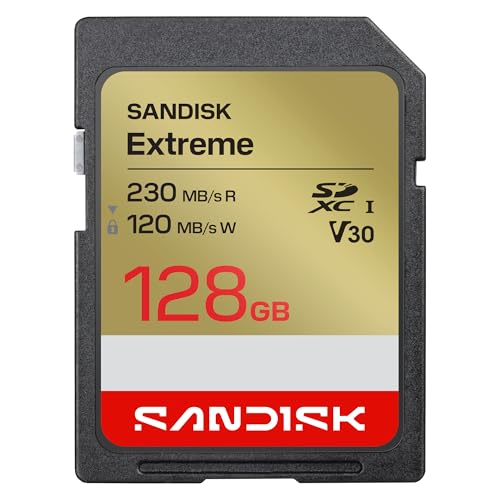
Best for most photographers: SanDisk Extreme 128GB UHS-I V30
A card’s job in a stills camera is to drain the buffer before the next burst, and a 120 MB/s write on a UHS-I bus is enough to do it. That holds on every body in the table below, in RAW, at the frame rates those cameras shoot through an SD slot, which is why most photographers can stop at the SanDisk Extreme 128GB. SanDisk’s 2026 version of the card is rated V30 and U3, reads at 230 MB/s and costs $44.99. The 128GB size suits a 24 to 33 megapixel body that gets offloaded after each shoot.
The catch is the offload. UHS-I tops out at 104 MB/s and a reader gets roughly 90 of it, so a full 128GB card takes around 24 minutes to copy in any reader, while the UHS-II cards below do it in about eight. Spending $7 more will not fix that. The SanDisk Extreme PRO 128GB UHS-I at $51.99 raises the read to 250 MB/s and leaves the write at 120, which does nothing for a photographer. Don’t go looking below $44.99 either, because the cheaper cards on Amazon are the ones the counterfeit warning further down is about.
Best value per GB: SanDisk Extreme PRO 256GB UHS-I V30
At 256GB the PRO stops costing extra. The SanDisk Extreme PRO 256GB UHS-I is down from a $129.99 list to $92.99, which works out to 36 cents a gigabyte, only a cent more than the 128GB Extreme. For that cent you get the 250 MB/s read and the PRO write speed, 170 MB/s instead of 120. The result is double the frames per card and a buffer that clears about 40 percent faster.
The offload is the catch again. UHS-I holds it to the same ceiling, and with twice as much to copy, a full card takes about 47 minutes. If the camera has a single slot, think about two Extreme 128GB cards at $44.99 instead, since they cost about the same and split the risk of a card failure.

Best for burst RAW and 4K60: Lexar Silver Pro 128GB UHS-II V60
Long RAW bursts and 4K60 are the reason to move to UHS-II. The second row of pins lifts the bus ceiling from 104 MB/s to 312 MB/s, which keeps the buffer from filling on a long RAW burst and gets a 128GB card off the reader in about eight minutes. The Lexar Silver Pro 128GB reads at up to 280 MB/s and carries the V60 guarantee, a minimum sustained write of 60 MB/s that covers every long-GOP 4K60 10-bit mode on the cameras below. At $89.99 it costs $45 more than the V30 pick, and that money pays for the faster bus and the V60 floor.
UHS-II only pays off in a UHS-II slot and a UHS-II reader. In a UHS-I slot or a $10 reader the card drops to one row of pins and runs like the $44.99 card. Every body in the table below has a UHS-II slot, so the reader is the only thing to add, and the UGREEN SD 4.0 UHS-II reader is $19.99. SanDisk’s Extreme PRO 128GB UHS-II is the other V60 card, at $189.99 with a 300 MB/s read and 210 MB/s write. Its name reads like a V90 card, but the model (SDSDXEM) is V60. The extra $100 gets you the same guarantee and a faster write-back. And if your bursts are short, you can skip UHS-II altogether and buy the SanDisk Extreme 128GB from the top of the list.

Hybrid shooters: Lexar Silver Pro 256GB UHS-II V60
Hybrid shooters need the bigger card, because an event day that mixes stills and video runs out of card before anything else. The V60 bitrates in the table below are 340 and 360 Mb/s, and at those rates a 128GB card holds only about 47 to 50 minutes of footage. The Lexar Silver Pro 256GB doubles the room for $149.99. It is otherwise the same UHS-II V60 card, with the same 280 MB/s read. On a dual-slot body you don’t need two of them, because one as the video card and a V30 as the stills backup makes a cheaper kit.
You pay for that room at 59 cents a gigabyte, compared with 36 for the UHS-I 256GB, and on a stills-only day the only thing you get back is a faster offload. The other 256GB UHS-II card is the SanDisk Extreme PRO 256GB UHS-II. It is also a V60 card. The read is 300 MB/s and the write 250 MB/s, but at $299.99 it costs double the Lexar for the same class. If a card swap at lunch doesn’t bother you, the 128GB Silver Pro at $89.99 handles the same modes.

The pro-support brand: ProGrade Digital Gold 128GB UHS-II V60
ProGrade’s card has the same V60 floor on the same UHS-II bus as the Lexar, and the reason to pay more for it is who answers the phone. ProGrade Digital sells memory cards and readers to working photographers and stands behind them with its own support. The ProGrade Digital Gold 128GB reads at up to 250 MB/s and writes at up to 100 MB/s. ProGrade sells it for $129.99 through its own Amazon storefront.
On the numbers it is the slowest UHS-II card here, and it costs $40 more than the Lexar Silver Pro 128GB. A photographer who shoots paid jobs on this card will find the support desk worth that, and everyone else should buy the Lexar, which is the same class for less money.

Best V90 (8K and high-bitrate hybrid work): Lexar Professional 2000x 128GB UHS-II V90
V90 guarantees 90 MB/s sustained, or 720 Mb/s. Very little SD recording needs it. The 600 Mb/s ALL-I modes do, such as the Sony a7 IV’s XAVC S-I 4K60 in the table below. So does 8K on the few bodies that write it to SD. No camera below needs V90 for stills. For those video modes, the Lexar Professional 2000x 128GB is the card to get, at $193.88 on a $269.99 list. Lexar’s listing gives a 300 MB/s read and no write figure, so the V90 label is the number to buy on.
The 2000x costs $104 more than the Silver Pro, and only a hybrid shooter uses the guarantee that money pays for. The seller on its listing also changes, so buy it only when the “Sold by” line reads Amazon.com. A cheaper way to get V90 is the ProGrade Digital Iridium 128GB at $179.99 through ProGrade’s own Amazon storefront, with a stated 200 MB/s write and the same 90 MB/s floor. Stills shooters don’t need either one and should stay with the Lexar Silver Pro at $89.99.

Which class your camera needs
Every body here has at least one UHS-II SD slot, and a UHS-I card works in every one of them at UHS-I speed. The video column shows the class for the heaviest mode the SD slot records. The classes come from the bitrate bands in CFexpress vs SD cards and readers. Long-GOP modes to 200 Mb/s are V30, modes from 230 to 480 Mb/s are V60, and 600 Mb/s ALL-I is V90.
| Camera | SD slots | Stills | Video through the SD slot |
|---|---|---|---|
| Sony a7 IV | Slot 1 CFexpress Type A or UHS-II SD, slot 2 UHS-II SD | V30 | V60; V90 only for XAVC S-I 4K60 (600 Mb/s) |
| Sony a7C II | One UHS-II SD | V30 | V60; V90 only for XAVC S-I 4K60 |
| Canon EOS R6 Mark II | Dual UHS-II SD | V30 | V60 covers every mode (4K60 is 340 Mb/s) |
| Canon EOS R8 | One UHS-II SD | V30 | V60 for 4K60 10-bit |
| Fujifilm X-T5 | Dual UHS-II SD | V30 | V60 (6.2K30 is 360 Mb/s) |
| Nikon Z6 III | CFexpress Type B plus UHS-II SD | V30 | V60; N-RAW goes to the CFexpress slot |
| Nikon Z5 II | Dual UHS-II SD | V30 | V60 for the 10-bit 4K modes |
| Panasonic S5 II | Dual UHS-II SD | V30 | V60 (internal recording is capped at 200 Mb/s; the menu asks for V60) |
The class is a floor the card guarantees when freshly formatted, so format in camera before a job. And some menus refuse a recording mode unless the printed rating matches; when the manual names a class, buy the class.
How the picks compare
| Card | Price | Bus | Class | Read / write | Best for |
|---|---|---|---|---|---|
| SanDisk Extreme 128GB | $44.99 | UHS-I | V30 | 230 / 120 MB/s | Most photographers |
| SanDisk Extreme PRO 256GB UHS-I | $92.99 | UHS-I | V30 | 250 / 170 MB/s | Value at 256GB |
| Lexar Silver Pro 128GB | $89.99 | UHS-II | V60 | 280 MB/s read | Burst RAW, 4K60 10-bit |
| Lexar Silver Pro 256GB | $149.99 | UHS-II | V60 | 280 MB/s read | Hybrid shooters |
| ProGrade Digital Gold 128GB | $129.99 | UHS-II | V60 | 250 / 100 MB/s | Pro support |
| Lexar Professional 2000x 128GB | $193.88 | UHS-II | V90 | 300 MB/s read | 8K, 600 Mb/s ALL-I |
| ProGrade Digital Iridium 128GB | $179.99 | UHS-II | V90 | 300 / 200 MB/s | Cheaper V90 |
| SanDisk Extreme PRO 128GB UHS-I | $51.99 | UHS-I | V30 | 250 / 120 MB/s | The $7 read bump; skip it |
| SanDisk Extreme PRO 256GB UHS-II | $299.99 | UHS-II | V60 | 300 / 250 MB/s | Fastest write-back; double the Lexar |
Read and write figures are the maker’s printed maximums; the class is the guaranteed minimum.
What matters
UHS-II is the one upgrade that changes the day. It triples the bus at both ends. The buffer drains while you are still shooting, and a 128GB card comes off the reader in about eight minutes instead of 24. To get that you need a UHS-II slot, which every camera above has, and a UHS-II reader, which you will probably have to buy because most laptop and dock SD slots are UHS-I. The UGREEN SD 4.0 at $19.99 does it for one card, and the OWC Atlas Dual SD does two at once for a dual-slot body. Sony shooters with a CFexpress Type A card in slot 1 want the ProGrade PG09, which reads Type A and UHS-II SD side by side. If none of those fits your desk, the reader guide covers the rest.
Check the seller line. Counterfeit SD cards are a long-running marketplace problem. A fake carries the right logo, a smaller real capacity than printed, and no guarantee of any kind. SD-3C, the body that licenses the SD logo, says to buy from licensed makers and their authorized channels, which on Amazon means the “Sold by” line reads Amazon.com or the maker’s own storefront. A card at half the price from a seller with a made-up name is the fake. Lexar also prints a code on its cards that can be checked on its verifi page. SanDisk publishes no verification page, so for SanDisk the seller line is the only check.
128GB or 256GB. A 128GB card holds a full day of 24 to 33 megapixel RAW for most shoots. Step up to 256GB for a 45 or 61 megapixel body, for hybrid days, or if you offload weekly.
FAQ
Is a V90 card worth it for photography?
No. V90 is a video guarantee. No camera in the table above needs it for stills. The buffer does clear a little faster than on a V60, but the card costs more than four times the price of the V30 card. Buy the Lexar 2000x when a menu names V90 for a video mode you shoot, and check that the seller line still reads Amazon.com.
Can a UHS-I card go in a UHS-II slot?
Yes, and the other way around; the slot uses the first row of pins and the card runs at UHS-I speed. The SanDisk Extreme 128GB works in every camera in the table, minus the faster buffer clearing and offload. A UHS-II card in a UHS-I reader drops the same way, which is why the reader has to match the card.
Does a faster card change image quality?
No. The file is identical on every card that keeps up. A slow card changes how many frames fit in a burst before the camera pauses and how long the offload takes; it never changes the pixels. Video is the exception: a card below the required class drops frames or stops the recording.
Match the class to the camera, then buy the real card
V30 on UHS-I covers stills and 4K30, and V60 on UHS-II is for deep bursts and 4K60 10-bit. V90 is only for when a menu demands it. Whichever class the camera needs, buy the card from Amazon.com itself or the maker’s storefront. For the video side, read CFexpress vs SD cards and readers. For the other half of the offload, there is the best SD card reader. Samsung T7 vs T7 Shield vs T9 covers the drive the cards copy to. For the verified copy on the road, read the travel offload and backup workflow. And the best camera for YouTube covers the hybrid bodies that push a card to V60.


