Shopping for a voiceover mic looks like a spec problem. It’s two decisions wearing a trench coat. Decision one: USB or XLR, meaning straight into the laptop, or into an interface that gives you room to grow. Decision two: dynamic or condenser, and that one is secretly a question about your room, not your voice. Most guides skip both and hand you a list. This one is built around the two decisions, because getting them right matters more than whichever logo ends up on the mic.
Here’s the correction almost nobody makes: if you record in a normal room, a spare bedroom, an office with bare walls, buy a dynamic mic. Not the condenser everyone recommends. A condenser hears everything. The air conditioner, the keyboard, the sound bouncing off your drywall, all of it, faithfully. A dynamic ignores most of that and makes an untreated space sound far better than it has any right to. The best-sounding voiceover setup for real money is usually a good dynamic in a slightly deadened room, not an expensive condenser in a live one.
The other thing to know before you spend: USB or XLR isn’t a forever choice. Several of the picks below do both from one body, so you start plugged into a laptop and move to an interface later without re-buying the mic. Think you might get serious about this? Buy one of those and settle the question in a single purchase.
Last updated: July 2026. Some links below are affiliate links. Buy through them and it helps keep the site running, at no extra cost to you. One note: cleaning up dialogue in post is my day job, so the advice about rooms and signal chains is first-hand. The specific mics are research, verified against current US stock and pricing in mid-July 2026. Prices move, so confirm the current number before you buy.
TLDR
If you just want the answer: the Shure MV7+ is the pick for most people. It’s a dynamic that runs USB today and XLR later, it sounds broadcast-adjacent out of the box, and it forgives an untreated room. On a tight budget, the Samson Q2U pulls the same USB-and-XLR trick for about sixty bucks. If you’re committed to a full XLR chain and want the broadcast standard, the Shure SM7B is the one, with a gain catch we’ll get to. And if your space is quiet and treated, the Rode NT1 5th Generation is the condenser to get.
Best overall: Shure MV7+
The MV7+ settles both decisions at once, which is exactly why it’s the top pick. Dynamic, so it shrugs off a noisy room. USB-C and XLR outputs on the same body, so it plugs into a laptop now and into an interface whenever you outgrow that. And in USB mode you get onboard processing, real-time monitoring through a headphone jack, and level control with no extra box in the chain. It gets you most of the way to the classic broadcast sound for a fraction of what that sound used to cost.
The trade-offs: $249 is not a starter price, the app and DSP take an afternoon to learn, and in XLR mode the processing goes away and you’re left with a plain (good) dynamic mic. None of that dents the recommendation. If you record voiceover constantly and don’t want to buy twice, this is the center of the whole category.

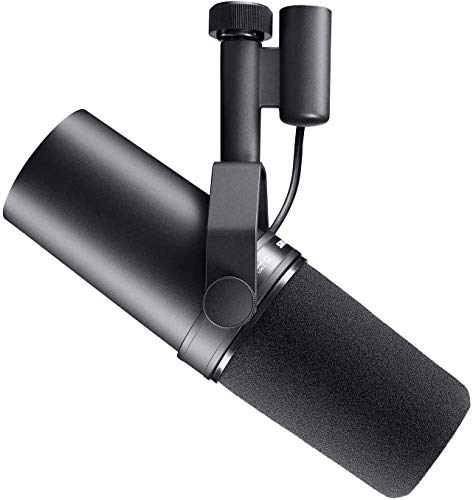
Best XLR broadcast standard: Shure SM7B
The SM7B is the voice you’ve heard on a thousand podcasts and radio stations, and the reputation is earned. Warm low-mid body, plosives and sibilance handled like they’re barely there, and off-axis rejection that makes an ordinary room disappear behind the voice. If you’re building a dedicated XLR chain and want the sound that reads as “professional” before you’ve said anything interesting, this is the mic.
The catch you have to plan for: the SM7B is a quiet mic that wants a lot of clean gain, roughly 60 dB, which is more than many budget interfaces deliver before they start hissing. The usual fixes are an inline booster like a Cloudlifter or a higher-gain interface, both of which point you at our recorders and interfaces guide. Or skip the whole headache: the Shure SM7dB is the same capsule with an active preamp built in, so it runs off standard phantom power with no booster box, for roughly what an SM7B plus a Cloudlifter would cost together anyway. For a lot of people the SM7dB is the smarter buy of the two.
Studio Recording, Home Recording, Podcasting and Streaming. The SM7B Is Trusted By The Worlds Leading Vocalists, Podcasters and Streamers.

Best budget: Samson Q2U
The Q2U is the classic first mic that refuses to become a mistake. Dynamic, so it handles a noisy room. USB and XLR outputs plus a headphone jack for monitoring, so the same sixty-dollar mic that plugged into your laptop on day one still belongs on the desk when you add an interface later. Nothing about it sounds like sixty dollars in a bad way.
What you give up is detail and polish next to the pricier dynamics, and the build is plasticky. But as the mic that teaches you whether you even like doing voiceover, without locking you into a dead end? Close to unbeatable. Audio-Technica’s ATR2100x-USB is the near-identical twin if the Q2U is out of stock. Same idea, different logo.

Best value condenser: Audio-Technica AT2035
If your room is quiet or treated and you want the detail and air a condenser gives, the AT2035 has been the value answer for years. It’s quieter and more sensitive than the cheaper AT2020 it sits above, it ships with a real shock mount, and it adds a pad and a low-cut switch. In a treated booth or a quiet space, that’s a studio sound for around $149.
The caveat is this guide’s whole thesis: it’s XLR only, so it needs an interface with phantom power, and being a condenser it will faithfully record every reflection and every minute of HVAC in an untreated room. Put it in the wrong space and you’ll end up blaming the mic for what the room did. In the right space it’s a lot of microphone for the money.

Best premium hybrid: Rode NT1 5th Generation
The NT1 5th Generation is the condenser to buy if you have the room for it. Self-noise around 4 dBA, which makes it one of the quietest studio condensers ever made, a smooth and detailed voice, and Rode’s dual-connect design that outputs XLR and USB from the same body. Over USB it records 32-bit float, so you can whisper or shout without setting a level or risking a clip. Shock mount and pop filter are in the box, so there’s no accessory tax waiting for you at checkout.
Same caveat as any condenser: it wants a treated or naturally quiet space, and there’s no onboard DSP shaping your tone the way the MV7+ does. Stock has also been in and out this year, so check availability before you commit. But for the cleanest, most detailed voiceover with a USB-to-XLR path in one mic, this is the pick at around $245.

The wildcard: Rode PodMic USB
The PodMic USB is for anyone who wants the broadcast-dynamic sound and a USB-to-XLR path without spending MV7+ money. It’s a dynamic with a heavier, radio-style voicing, an internal pop filter, both outputs, and onboard processing with headphone monitoring in USB mode. The build is a tank, and at around $199 it undercuts the MV7+ while covering most of the same ground.
The trades: Rode’s app and DSP ecosystem runs a step behind Shure’s, and the low-end-forward voicing isn’t for everyone, though it flatters most speaking voices. It’s also legitimately heavy, so budget for a sturdy boom arm. If your room is echoey and you like a fuller sound, this is the strong cheaper alternative to the top pick.

How the picks compare
| Mic | Price | Type | Connection | Onboard monitoring/DSP | Best in |
|---|---|---|---|---|---|
| Shure MV7+ | ~$249 | Dynamic | USB-C + XLR | Yes (USB mode) | Untreated rooms |
| Shure SM7B | ~$399 | Dynamic | XLR | No (needs ~60 dB gain) | Broadcast chains |
| Shure SM7dB | ~$549 | Dynamic + preamp | XLR | Built-in preamp | SM7B sound, no booster |
| Samson Q2U | ~$60 | Dynamic | USB + XLR | Headphone jack | First mic / budget |
| Audio-Technica AT2035 | ~$149 | Condenser | XLR | No | Treated rooms |
| Rode NT1 5th Gen | ~$245 | Condenser | XLR + USB | No (32-bit float USB) | Quiet/treated rooms |
| Rode PodMic USB | ~$199 | Dynamic | USB + XLR | Yes (USB mode) | Echoey rooms, value |
How to choose a voiceover mic
Decide dynamic or condenser by looking at your room, not the mic. This is the choice that makes or breaks a home recording. Bare walls, an audible AC, street noise? Dynamic, which rejects most of what it isn’t pointed at. Quiet, treated, or naturally dead room? A condenser will reward it with more detail and air. If your space is a normal bedroom, a dynamic beats a pricier condenser every time.
Treat USB and XLR as a timeline, not a fork. USB is the simple path: plug into a laptop, record. XLR is the path that grows, into interfaces, better preamps, a proper chain. The mics here that do both, the MV7+, Q2U, NT1, and PodMic USB, let you walk that timeline on one purchase instead of two. Sure you’ll stay casual? A USB-only mic is fine. Not sure? Buy a hybrid.
Budget for gain, not just the mic. A quiet dynamic like the SM7B needs a lot of clean gain, and a cheap interface that hisses when you crank it will undo everything the mic does well. Either buy an interface with real headroom, add an inline booster, or sidestep the problem entirely with a mic that carries its own preamp like the SM7dB or MV7+. Our recorders and interfaces guide covers what to feed these with.
Monitoring and processing on the mic are worth real money. A headphone jack on the mic lets you hear yourself with zero latency, which improves every take you record. Onboard DSP, on the MV7+ and PodMic USB, evens out levels and tames plosives before the audio ever reaches your editor. None of it replaces technique, but for a solo creator with nobody riding the board, these features do a job you’d otherwise be doing by hand in post.
FAQ
USB or XLR for voiceover?
USB if you want to be recording one minute after the box opens, with nothing else to buy. XLR if you want to build a chain over time and squeeze the most out of a mic. The tidy answer is a hybrid that does both, so you start on USB and switch when you add an interface, without replacing the microphone. Most people should just start there.
Is the SM7B worth it for a beginner?
Usually not as a first mic. It’s a superb microphone that needs an interface with serious clean gain or a booster behind it to sound its best, which is more setup and cost than a beginner needs on day one. Start with an MV7+ or a Q2U, learn what you want, and step up to an SM7B or SM7dB when the rest of your chain is ready. The mic will still be there.
Do I need to treat my room?
A little treatment beats a lot of mic upgrade. A rug, curtains, a few soft furnishings, something on the hard wall behind you: that does more for your sound than another hundred dollars of microphone. If treatment isn’t happening, lean dynamic and get the mic close to your mouth. Those two moves fix most home-recording problems by themselves.
Will one of these work for podcasting too?
Yes, completely. Voiceover and podcasting want the same thing from a mic: a clear voice from a forgiving capsule, which is why the dynamics here, the MV7+, SM7B, Q2U, and PodMic USB, are podcast staples as much as voiceover ones. If you do both, buy for the harder job (an untreated room, recorded solo) and the easier one comes along for free.
Buy for your room and your next year
And that’s it. Pick dynamic or condenser by being realistic about your space, treat USB and XLR as one timeline instead of a fork, and leave room in the budget for clean gain. For most people that means the MV7+, or the Q2U when money’s tight, with the condensers reserved for rooms that have earned them.
The companion reads are close by: our recorders and interfaces guide for what to plug an XLR mic into, the on-camera and shotgun mic guide for when the mic has to ride on the camera instead, and the budget headphone guide for monitoring what you record. As always, these are the mics I’d buy today; your room and your budget get the final vote. The rest of our buyer’s guides live on the Gear Guides page.