


Last updated: September 2026. Some links below are affiliate links. Buy through them and it helps keep the site running, at no extra cost to you. Every price here was read on the live Amazon listing on September 28, 2026. The Rode NT1 5th Gen was a third-party seller at list price that day, shipping from the seller; the Shure SM7B was sold by Amazon itself.
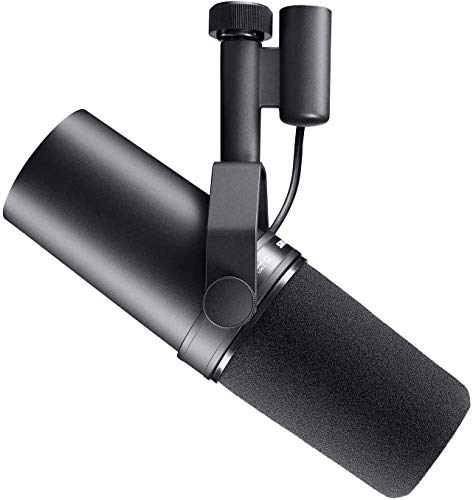
The two microphones sit 27 dB apart in sensitivity and $227 apart in price, and both numbers point the same way. The Shure SM7B is a dynamic that needs 60 dB of clean gain and hears very little of the room. The Rode NT1 5th Gen is a 1-inch condenser with 4 dBA of self-noise, a USB-C port next to its XLR, and 32-bit float recording over USB. Which one belongs on the desk depends on the room it will sit in and the preamp it will plug into.
TLDR
Buy the Shure SM7B ($439) for spoken word in a real office or a spare-room edit suite, provided the interface on the desk delivers 60 dB or more of gain. Buy the Rode NT1 5th Gen ($212) for a treated room, for music on the side, or for one USB-C cable into a Mac with no interface at all. The NT1 is the better microphone on paper and the cheaper one at the register. The SM7B wins for most editors because most editing rooms are not quiet and most desks already have an interface that can drive it. The wider field is in the best podcast microphone guide.
What the room does to each mic
Working distance decides this section. Lewitt’s level-matched test put a condenser and a dynamic in the same untreated room at the same distance and found room noise “not a deal breaker” for either type. A dynamic like the SM7B is worked at 2 to 4 inches. A large-diaphragm condenser like the NT1 is worked at 8 to 12 inches, because proximity effect and plosives get worse as the talker moves in.
Each halving of distance raises the voice by about 6 dB while the room stays where it was. Moving from 12 inches on the NT1 to 3 inches on the SM7B is two halvings, so the voice lands roughly 12 dB further above the workstation fan and the drive enclosure. That gap is larger than the NT1’s self-noise advantage, which is why The Podcast Host still heard a computer fan through the NT1 in an untreated room despite the 4 dBA spec. In a treated room the order flips: with the fan gone, the NT1‘s 4 dBA floor and extended top end record more of the voice than the SM7B does. Room noise that still gets through is a job for the audio rescue guide.
The gain chain: 60 dB is the SM7B’s real price
The SM7B‘s output is 1.12 mV/Pa, or -59 dBV/Pa, and Shure’s spec calls for at least 60 dB of preamp gain. The NT1 puts out 25 mV/Pa at -32 dBV/Pa and is comfortable around 35 dB, which any phantom-powered input supplies with room to spare. The 27 dB between them is the whole interface question.
Interfaces that drive an SM7B on their own: the Focusrite Scarlett 4th Gen at +69 dB with an equivalent input noise of -127 dBu, the RODECaster Pro II at +76 dB, and the Focusrite Vocaster and Elgato Wave XLR at +75 dB. Interfaces that do not: Scarlett Gen 1 through 3 at +56 dB and the Universal Audio Volt at +55 dB, which run out of gain and add hiss on the way. Audio Science Review measured an SM7B on a MOTU M4 at about 22 dB SPL equivalent noise, fine close-miked and audible at a foot. The interface field is covered in the recorders and interfaces guide.
A Cloudlifter adds gain, not quiet. Audio University and audioforgepro each measured an SM7B through a modern interface at maximum gain and then through a Cloudlifter into the same interface, and neither found a meaningful noise difference. The booster fixes a shortage of gain on an older or cheaper interface; it does not lower the noise floor of one that already has 60 dB. On a Volt or an older Scarlett, the SM7dB, the same mic with the booster built into the body, is the cleaner buy. The NT1 needs none of this.
The NT1’s USB path: 32-bit float, with conditions
The 5th Gen is the first NT1 with a USB-C port, and it records 32-bit float over that port. Sound On Sound confirmed the behavior in Reaper and Pro Tools: a take that slams past zero looks clipped on the meter and recovers intact with clip gain in the timeline. Over XLR the NT1 5th Gen is a normal 48 V condenser and the float feature does not apply.
There is no headphone jack on the mic, so monitoring over USB goes through the computer’s output and whatever latency it adds. The USB output runs at 48 kHz multiples only, so a 44.1 kHz session has to move to 48 or 96 before the mic shows up. On a Mac no driver is involved. On Windows it needs Rode’s ASIO driver, and audionewsroom reported problems with that driver as recently as October 2025. Audacity does not record 32-bit float input, and Rode’s onboard DSP switches off in float mode. The NT1 is a strong one-cable option for a Mac; on Windows, plan on the XLR.

What’s in the box, and the $227 gap
As of September 28, 2026, the silver NT1 5th Gen is $212 from a third-party seller shipping from its own warehouse, under Rode’s $249 list; the black version is $224 from a third-party seller with Amazon handling fulfillment. The SM7B is $439, sold by Amazon. It was $399 before the 2025 tariff increase and has not come back down.
The NT1 ships with the SM6 shock mount, a detachable pop shield, an XLR cable of about 20 ft, and a USB-C cable of about 10 ft, so it records the day it arrives. The SM7B ships with the A7WS foam windscreen and needs an XLR cable, a boom arm rated for 765 g of microphone, and the 60 dB interface described above. A working SM7B chain is $439 plus whatever the preamp gap costs. A working NT1 chain is $212 plus a stand, whether it runs over XLR into the interface already on the desk or over USB into a Mac with no interface at all.
Neither mic has a successor coming. There is no NT1 6th Gen, and the SM7B has used the same cartridge since 1976. The cheaper sibling worth naming is the Rode NT1 Signature Series at $159, the same HF6 capsule with XLR only and no USB. Amazon’s Prime Big Deal Days ran October 6 and 7, 2026; the June 2026 Prime Day before it took $66 off the SM7B.
Side by side
| Spec | Rode NT1 5th Gen | Shure SM7B |
|---|---|---|
| Type | 1-inch large-diaphragm condenser (HF6), cardioid | Dynamic, cardioid (RPM106 cartridge) |
| Sensitivity | -32 dBV/Pa (25 mV/Pa) | -59 dBV/Pa (1.12 mV/Pa) |
| Self-noise | 4 dBA | Not published; the preamp sets the floor |
| Gain needed | About 35 dB | At least 60 dB |
| Power | 48 V phantom or USB-C bus | None |
| Outputs | XLR and USB-C (32-bit float over USB) | XLR only |
| Working distance | 8 to 12 inches | 2 to 4 inches |
| In the box | SM6 shock mount, pop shield, 20 ft XLR, 10 ft USB-C | A7WS windscreen |
| Weight | About 310 g | 765 g |
| Amazon, September 28, 2026 | $212, third-party seller | $439, sold by Amazon |
Who should buy which
Voiceover in a spare-room edit suite: SM7B
The SM7B, close-miked, on an arm. The workstation fan and the RAID share the room with the voice, and the 12 dB of working-distance advantage is worth more than any self-noise spec. The interface has to have 60 dB; if it does not, the SM7dB is the fix. The wider VO field is in the voiceover microphone guide.
Podcast, one or two hosts: SM7B
The SM7B, twice over with two people in the room, because each mic hears the other host’s bleed and a condenser turns two voices into one smeared track. A single host in a treated room can take the NT1 for the more detailed recording.
Zoom and client review calls: NT1 5th Gen
The NT1 5th Gen over USB works on a Mac with no interface and no phantom supply, and it is the only one of the two that can. Without a headphone jack, monitoring runs through the computer, as on any call.
ADR scratch tracks and music on the side: NT1 5th Gen
A dynamic worked at 3 inches is the wrong tool for a guitar or an actor who needs to move, and the 32-bit float path makes an unattended scratch session hard to ruin. In a treated bay the NT1 5th Gen is the better voice mic as well.
FAQ
Does the SM7B need a Cloudlifter?
Only on an interface with less than about 60 dB of gain. On a Scarlett 4th Gen, a RODECaster Pro II, a Vocaster, or a Wave XLR, the booster adds nothing measurable to the noise floor. On a Volt or a Gen 3 Scarlett, the cleaner fix is the SM7dB, which has the booster built in.
Does 32-bit float on the NT1 5th Gen work on Windows?
It requires Rode’s ASIO driver, and the most recent reports on that driver, from late 2025, were of problems. The Mac path needs no driver and works in Reaper and Pro Tools. On Windows, the XLR output into an interface is the dependable route, and the float feature is lost.
Is the NT1 5th Gen a good podcast mic?
In a treated room with one host, yes, and the NT1 records more of the voice than the SM7B for $227 less. In an untreated room or with two hosts, no. The dynamic is the podcast default because the podcast room is usually an office.
In conclusion
The Shure SM7B is the pick for spoken word in an ordinary room, on the condition that 60 dB of gain is already on the desk. The Rode NT1 5th Gen is the pick for a treated room, for music alongside the voice work, and for the one-cable Mac setup, and it costs $227 less with the shock mount and cables included. The chain behind either mic, from the interface to the arm and the headphones, is laid out in Alex’s podcast setup guide.


