Under $2,000 is the sweet spot where cameras stop making excuses. You’re past the entry-level bodies that overheat or cap your recording at eight minutes, and you’re into gear that working shooters put on paid jobs. The catch is that “under $2,000” almost always means body only. Glass, a couple of fast cards, and a spare battery can add another $600 before you’ve shot a frame, so be honest with yourself about where the real ceiling is.
The other thing worth saying up front: most people reading this don’t need the most expensive option here. A 24-megapixel full-frame sensor and 10-bit color will outlast your skills for years. I’d rather you spend less on the body and put the difference toward a lens you’ll keep through three camera upgrades. With that out of the way, here are the five I’d recommend at this price, sorted by what you’re trying to do.
Last updated: June 2026. Some links below are affiliate links. Buy through them and it helps keep the site running, at no extra cost to you. I only point at gear I’d be comfortable handing to a friend.
TLDR
If you just want the answer: the Panasonic Lumix S5 II is the one to beat. It packs the most camera of any full-frame body here and still leaves a few hundred dollars for a lens. Shooting mostly video on a rig? Step to the Sony FX30. On a tighter number, the Fujifilm X-S20 does almost everything the big bodies do for around $1,300. The rest of this guide is who should pick what, and why.
Best overall: Panasonic Lumix S5 II
This is the default. Around $1,498 buys you a 24.2MP full-frame sensor, in-body stabilization that lets you shoot handheld, and unlimited 10-bit 4:2:2 recording up to 4K60, plus 6K open-gate if you like to reframe in post. Nothing else here gives you that much camera with a few hundred dollars left for glass. The real downsides: autofocus is much improved over the old contrast-only Panasonics but still trails Sony and Canon on erratic, fast-moving subjects; the L-mount lens lineup is smaller than Sony E or Canon RF; and at around 740 grams it’s the second-heaviest body on this list, with noticeable rolling shutter if you whip-pan. For most people shooting a mix of work, none of that is a dealbreaker.

Best for video: Sony FX30
The FX30 is the odd one out because it isn’t a hybrid stills camera trying to do video. It’s a Cinema Line body that happens to take photos. If the question is whether to stretch to the full-frame FX3 instead, Sony FX3 vs FX30 settles it from the edit bay. For around $1,500 you get Sony’s cine menus, dual base ISO, 4K up to 120fps in 10-bit 4:2:2, and the same color science as bodies costing three times as much. If your work lives on a tripod, gimbal, or shoulder rig, this is the pick. Just know what you’re trading: it’s a Super 35 (APS-C) sensor, so low-light falls behind the full-frame options, and 4K120 crops in further on top of that. There’s no viewfinder, no mechanical shutter, and proper XLR audio needs the bundled top handle. The menu system is also a lot to learn if you’ve never shot Sony cine before.

Best hybrid (photo + video): Nikon Z6 III
If you split your time between stills and motion, the Z6 III is the most capable body that still fits under $2,000 (barely) at around $1,997. Its partially-stacked sensor unlocks internal 6K60 N-RAW and 4K120, and the stills side is top-tier with the best electronic viewfinder in this group. Stabilization is rated up to eight stops. The compromises are real, though: that fast sensor shows more shadow noise and a little less base dynamic range than the conventional 24MP sensors here, it’s power-hungry, and at around 760 grams it’s the heaviest body on the list. You’re also spending the entire budget on the body with nothing left for a lens, so factor that in.

Best value: Fujifilm X-S20
At $1,299.95, the X-S20 is the one I’d hand a new shooter without a second thought. It’s a 491-gram APS-C body that still records internal 6.2K30 and 4K60 in 10-bit 4:2:2, with in-body stabilization and Fujifilm’s film simulations baked in. For most people leveling up from a phone or a kit DSLR, this does 90% of what the pricier bodies do for hundreds less. Where it shows its price: a single UHS-II card slot, the older 26MP X-Trans sensor rather than the 40MP one, a small 0.39-inch viewfinder, and visible rolling shutter when you push the 6.2K mode. Fair trades at this number.

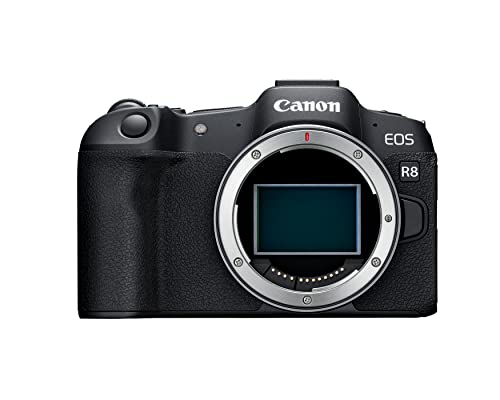
Best for low light: Canon EOS R8
The R8 borrows the 24.2MP full-frame sensor from Canon’s much pricier R6 Mark II, which means class-leading clean high-ISO performance in a body that runs $1,300 to $1,500. If you shoot events, concerts, weddings, or anything dim, this sensor pulls usable footage out of light the APS-C bodies struggle with. The asterisk is a big one for handheld shooters: there’s no in-body stabilization, so you’re leaning on stabilized lenses or a gimbal. It also has a single card slot and Canon’s small LP-E17 battery, so pack spares. Pure sensor for the money, with stabilization as the trade-off.
How the five compare
| Camera | Sensor | Max internal video | Mount | IBIS | Weight | ~Price |
|---|---|---|---|---|---|---|
| Panasonic S5 II | Full-frame, 24.2MP | 6K30 10-bit, 4K60 10-bit 4:2:2 | L-mount | Yes | ~740 g | ~$1,498 |
| Sony FX30 | Super 35 (APS-C), 26MP | 4K120 10-bit 4:2:2 | Sony E | Yes | ~646 g | ~$1,500 |
| Nikon Z6 III | Full-frame stacked, 24.5MP | 6K60 12-bit N-RAW, 4K120 | Nikon Z | Yes | ~760 g | ~$1,997 |
| Fujifilm X-S20 | APS-C, 26.1MP | 6.2K30 10-bit, 4K60 10-bit 4:2:2 | Fuji X | Yes | 491 g | ~$1,300 |
| Canon EOS R8 | Full-frame, 24.2MP | 4K60 10-bit | Canon RF | No | 461 g | ~$1,300-1,500 |
What to look for in a sub-$2,000 camera
10-bit color is the line that matters. If you ever plan to color grade, you want 10-bit recording, not 8-bit. Every camera on this list shoots 10-bit internally. That’s the floor at this price now, and it’s the single spec that separates “good enough” from “frustrating in post.”
Full-frame versus APS-C is a real choice, not a ranking. Full-frame gives you better low-light and shallower depth of field; APS-C bodies are lighter, cheaper, and their lenses cost less too. The FX30 and X-S20 aren’t compromises so much as different tools. Don’t pay for a full-frame sensor you’ll never push.
Budget for the lens and the ecosystem, not just the body. A cheap body on an expensive mount can cost more over five years than a pricier body with affordable glass. L-mount and Sony E have the deepest third-party support right now, which keeps lens prices down.
Have a plan for the footage before you shoot it. 10-bit 4K and 6K fill cards fast, and that media has to land somewhere safe. If you’re shooting regularly, sort out offload and backup early. Here’s how I’d build storage on a budget so you’re not juggling loose SSDs.
FAQ
Is full-frame worth it under $2,000?
If you shoot in low light a lot, yes: the Canon R8 and Panasonic S5 II will pull cleaner footage out of dim rooms than the APS-C bodies. If you mostly shoot in decent light, an APS-C camera like the X-S20 saves you money on both the body and the lenses, and you’ll struggle to see the difference in the final cut.
Do I need 6K, or is 4K enough?
4K is plenty for almost everyone delivering to the web, TV, or clients. The case for 6K is reframing and cropping in post while still finishing in 4K, plus a little extra sharpness. It’s a nice-to-have, not a reason to spend more.
Which of these is best for a total beginner?
The Fujifilm X-S20. It’s light, the film simulations make footage look good straight out of camera, and the price leaves room in the budget for a lens and cards. You won’t outgrow it for a long time.
Why isn’t the Blackmagic Pocket Cinema Camera on here anymore?
The original 6K is used-only now, and the current G2 version has crept above the $2,000 body ceiling this guide holds to. It’s a great camera. It just doesn’t fit the price bracket cleanly in 2026. For a pure video tool under budget, the FX30 covers that ground.
Working a different budget?
If $2,000 is more than you want to spend, the picks change a fair bit. See Best Cameras Under $1,000. Got more room and want to step into proper cinema territory? That’s Best Cameras Under $5,000.
Want the rest of our buyer’s guides in one place? They all live on the Gear Guides page.