Some links below are affiliate links; buying through them supports the site at no cost to you.
I legitimately could not believe we got what was supposed to be a TikTok video into one of the most prestigious festivals in the world for young directors, The Cannes Young Director Awards.
The journey begins
This one started on a slow summer afternoon at my day job, cutting commercials for corporate overlords at a production company. Steady work, sure, but the monotony was getting to me, and I needed a reminder of why I got into filmmaking at all. What I didn’t know was that my friend, roommate, and director Zac Stracener was about to pull me into something unexpected.
I was in the living room with the sun going down, grinding through work Slack, when Zac walked in fired up about an idea. Zac has a real following on TikTok, so him wanting to make a TikTok video was nothing new. This one was different though. He wanted to make something for Mental Health Awareness Month that said something, which meant a script, a plan, and a lot more thought than the usual post that’s gone in a day.
Zac was never a typical TikToker anyway. His videos are scripted shorts about real things people go through, not trends. So when he pitched this, I was in. I wanted to work on something that mattered.

Anyway… we began talking. What exactly were we going to make? So as a low-budget filmmaker does, we decided to create a 5 minute science fiction short film. As we all know, science fiction short films almost never require expensive VFX, props, or set design. Actually… we both know that’s a lie. But I like doing hard things and so does Zac so we went with it. We saw something on the news about these extremely dystopian “medical devices” called Sarco. Basically, it was an assisted suicide device… and it just left us feeling uneasy… to say the least. We wanted to present an alternate world where this device was used not to end life but to help someone who is clinically depressed understand that life is still worth living.
Our brainstorming kept circling therapy tech, and we landed on the device being a tool for psychedelic-assisted therapy, a young field showing real results against severe depression. If this interests you, read more on the Johns Hopkins Medicine website.
With a concept in hand, our first target was a TikTok-sponsored short film competition at Cannes. Then I read Zac’s script, and it was obvious this story deserved more than a vertical video on TikTok. It wanted to be a real short film. Here’s the synopsis:
After Cole Powell loses his wife and newborn in a car accident, he decides to end his life via Forever Sleep™️. Once it begins, his whole life flashes before him as he relives his most precious and traumatic memories. He is given a choice to terminate the procedure and live or to “sleep” forever.

First call was to Eric Ulbrich, a cinematographer I’ve worked with for years and whose eye I trust more than just about anyone’s. He was as excited as we were, and once we had a DP it was on to locations and props. Locking locations on a tight schedule was a headache, and then there was the pod: the centerpiece of the whole film, and a 350lb prop we would have to move ourselves.
We found the pod at a prop house in Glendale, and getting it from there to set was a job on its own. Our two locations were a beach in Malibu and an empty warehouse in DTLA, and that contrast turned out to be a good match for the story: one place for the despair, one for the hope.


Everything was going smoothly. We were going to make this thing and it was going to be epic.

To enhance the pod, we added some white electrical tape and random clear tubes to make the screen and the pod a little more interesting…the tape also acted as practical tracking markers for our VFX. It worked perfectly.
We needed actors
We really tried to find someone to play the lead but honestly… Zac always acted in his TikTok videos and always killed it. I felt he would be able to accurately portray the real pains of depression and the character of Cole Powell better than anyone we could have hired given the minimal budget.
We also needed someone to play the nurse, and that role went to the amazing actress and friend of ours, Alivia Levie. She crushed the role and perfectly portrayed the caring nurse towards the end of the film.
Shoot day
On a budget this small you can’t afford a sloppy production. I ran ours in StudioBinder, which is built for projects this size: call sheets, call times, parking diagrams, and the shot list for the day all lived in one place.
After arriving at the beach, we started the morning violating every OSHA rule in the book by carrying this 350lb fiberglass sarcophagus out of the U-Haul truck, down a steep rocky “driveway”, and then across 300 feet of sand.
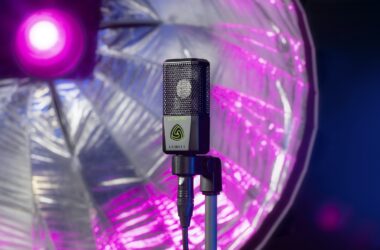
After that spawn from hell was settled, I donned my sound equipment. Being the producer it made perfect sense for me to also be the sound guy you know? Luckily, I used to run sound on sets professionally so I still had my Lectrosonics gear and Rode Mics. I geared up and headed down to the beach.
While I rigged up, Eric and the 1st AC built the camera: a RED V-Raptor with rehoused Canon FD lenses, picked for a soft, dreamy sci-fi look.

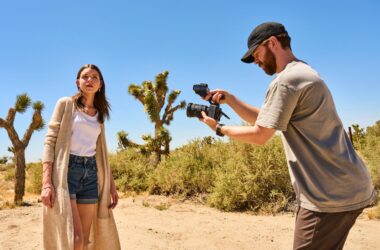
The overcast sky gave us the exact gloom the story needed, and the day ran without a hitch, which anyone who’s been on set knows almost never happens. Weather, crew, story: everything just lined up. Below are some behind-the-scenes captures from that day:


And so we wrap
Now begins the long and tedious process of post-production. Having two jobs on the production wasn’t enough. Not only was I the producer and sound guy, but I was also the editor. My ritual after a shoot is to watch everything, flag the shots I love, let them sit in my head for a while, and then sketch out how the edit should move. The reference in my head was Terrence Malick’s ‘The Tree of Life’: calm and chaotic at the same time, with room for the small, beautiful details of a life.
Then I sat down in Adobe Premiere Pro and started cutting. It wasn’t a straight line; Zac and I went back and forth hard on the ending. “Too obvious.” “Too ex machina.” “It needs ambiguity.” Eventually Zac cracked it, and the fix needed one small pickup shot: a laptop screen captured through his RED Komodo.
We also grabbed a day of B-roll in Malibu for the flashback scenes. For the “old film footage” look we went to FilmSupply, who cut us a deal on clips that punched way above our budget. That B-roll did a lot of quiet work in the final film.
After around a month of editing, we finally had a product we were happy with. Generally, both me and Zac are very critical of our work and usually hate it after working on it for a few weeks. When we sat down to watch it though, we both said that this film was “fucking great.” We had ourselves a winner.
To color
Color is everything. If you can’t get a good grade on the footage you are quite literally wasting your film’s potential. I would say the color grade is just as important as the audio mix. Do not neglect it.
There are only a few colorists I know who can really take a project to another level, and for this film I chose long-time collaborator Matt Osborne at Company 3. He’s the best colorist I’ve worked with. Matt got what we were going for immediately. Two grading passes and one round of detailed notes later, the film had the exact visual tone we’d been chasing.
To mix
For the score, we wanted live instruments, not a synth pass. We brought in composer Alex Shenkman and pointed him at the score from Denis Villeneuve’s ‘Arrival’ as the emotional reference. He delivered. The score carries scenes we’d been worried about for weeks.
For the sound design, I hired an old college friend, Ryan Baker, who worked closely with Zac and me on sound effects that tie the picture and the score together.
We brought the mix back from Pro Tools into our timeline, and just like that… were we done? Well, not quite.
To VFX
Remember, this is a science fiction short film. We have to have VFX. I hired our motion artist Gary Schutz and VFX generalist, Sergio Mishchenko. Between the two of them we got these incredible-looking HUD elements for the pod. We also cleaned up a few footprints in the sand and removed some blemishes from the warehouse in the final scene. None of that is flashy, but that kind of cleanup is what makes the film feel finished.
We render
This project was a rollercoaster. There were stretches where we doubted the story, doubted the plot, and seriously talked about shelving the whole thing and starting over. We didn’t. Every problem got a solution, and we refused to take no for an answer, because a shot at failing beats the guaranteed loss of quitting. The payoff caught us completely off guard.
I made this for myself during a time when I needed it most. I want this film to be used as a tool for others to share and talk about mental health and suicide prevention. This film may be fiction but the stories it originates from are not. They are real. These issues are real. And they need to be discussed far more often than we do. No more masquerading with mere talk about how mental health matters. Let’s dive head-first into these conversations. Every second counts.
Zac Stracener
We knew we had made something we were proud of. What we didn’t see coming was what it would do once it was out. The film premiered on Beyond The Short and then picked up a nomination for a Cannes Young Director Award, which was surreal. It also turned out to be the small part. The week of the premiere, Zac got a message on Instagram from someone who had been thinking about ending their life, and who said our film was what pulled them back. More messages like it came in over the days that followed. Every filmmaker hopes their story lands with someone. We never imagined ours would be a lifeline. When Zac told me, it wrecked me a little, and it still does.
I sat down to write this as a “look what you can pull off with no budget” piece. It turned into something else. Films can entertain, sure, but they can also change how someone thinks, and once in a while they can save a life. That part gets lost in the grind of making them. It also doesn’t happen alone. This film was friends and volunteers giving up their time for nothing, and without them it stays an idea. The budget matters so much less than the people: a small crew who all want the same thing can hit harder than money ever will. All the way to Cannes, in our case, and, more importantly, all the way to an audience that felt something. Somewhere between “simple TikTok video” and “real short film,” I remembered why we do this. If my filmmaking ended today… I’d be satisfied. But we’re not done. We want to keep making stories that save lives and make people glad to be here. Zac’s first feature, Echo, came next, and the storage build I spec’d for it has its own post.
Please enjoy, “Forever Sleep”