Ask any VFX vendor what quietly eats a shot budget and you’ll hear the same word: guessing. Guessing the lighting because nobody shot an HDRI, guessing the lens because nobody grabbed a distortion grid, guessing how far the back wall was because the set got struck an hour after wrap. Every one of those guesses was measurable on the day, with gear that fits in one carry-on case.
This article covers what goes in that case. It’s the data-acquisition companion to our VFX supervisor’s tool kit, which covers the full loadout: the laptop, the reference camera, the gaff tape for tracking markers. This one goes deeper on the half of the job that feeds the pipeline directly: lighting, color, lens, and measurement data. It’s organized by function (HDRI capture, reference spheres, charts, measurement, witness cams, the case) because that’s how you’ll actually pack it.
One honesty note before the picks. I own the Ricoh Theta Z1 and have used it on real jobs, which the parent post covers. The rest of this kit is research: what working data wranglers keep converging on in mid-2026, verified against what’s in stock and in production, not a list of things sitting in my garage.
Last updated: July 2026. Some links below are affiliate links. Buy through them and it helps keep the site running, at no extra cost to you. I only point at gear I’d be comfortable putting in a friend’s cart. Prices were verified on July 11, 2026, and they will drift.
The data kit, at a glance
- HDRI camera: Ricoh Theta Z1, $996.95 (value route: Insta360 X5, $549.99)
- Reference spheres: two 10-inch stainless gazing balls, about $100 for the pair, or a $760 matched pro set
- Color chart: Calibrite ColorChecker Passport Video 2, about $104
- Lens grid: DGK test chart 3-pack, $15.99, plus free printable large-format grids
- Laser measure: Bosch Blaze Pro GLM165-40, $99 (budget: GLM100-23, $42.99)
- Tape measure: Stanley PowerLock 25 ft, about $21
- Witness cam: GoPro HERO13 Black, $379 to $399
- Mounting: SmallRig super clamp with ballhead arm, $17.99
- Case: Pelican Air 1535, $269.95 to $314.95
Add it up and the budget build (X5, painted gazing balls, the shorter laser, the no-foam Pelican) lands right around $1,500. The pro build (Z1, matched sphere set, the 165-foot laser, foam-fitted case) comes to about $2,700. Both numbers assume one witness cam; matchmove-heavy shows will want two or three. Full math in the table further down.
HDRI capture
If you capture one thing for the VFX team, capture this. An HDRI records the actual light of the set, every source and every bounce, in a format a lighting artist can wrap around a CG object. The parent post walks through what an HDRI is and how the merge works, so I won’t repeat the theory. The question here is just which camera earns the slot in 2026.
The HDRI camera: Ricoh Theta Z1
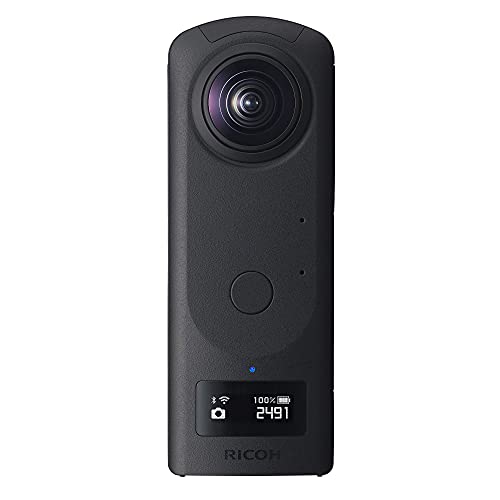
The answer hasn’t changed since the supervisor’s kit article, and that isn’t laziness. The Theta Z1 is still the camera VFX crews reach for: two 1-inch back-illuminated sensors, DNG raw output, and exposure bracketing that covers roughly 13 stops through its bracketing modes and the HDRI plug-in. Mine has earned its slot on set after set, and it has never been the thing that failed. Despite launching in 2019, it isn’t abandonware either: Ricoh confirms it has not been discontinued, and it got a firmware update in January 2026. Ricoh did launch a new pro 360 camera in June 2025, the THETA A1, but that one is aimed at inspection and documentation work, not at replacing the Z1.
Now the honest part. It’s nearly $1,000 for a seven-year-old camera. There’s no in-camera HDR merge, so the brackets still go through PTGui or the HDRI plug-in on a laptop. The battery is non-removable, storage is 51GB internal with no card slot, and the Amazon buybox rotates through third-party sellers, so check who you’re buying from before you click. If the price is the dealbreaker, the Insta360 X5 below is the first alternative I’d actually put in a kit.
The new Theta Z1 camera has a significantly larger capacity than the previous model and can capture high-quality 360 degree images and videos. It has advanced features such as suppression of ghosting, flare, and fringing, as well as dynamic range correction and automatic overexposure suppression. The camera also supports efficient transfer speeds via USB 3.0 and allows for RAW development and stitching with compatible software.
The value alternative: Insta360 X5
The X5 is the first consumer 360 camera VFX people can take seriously, and it took a firmware update to get there. Its predecessor, the X4, shipped without auto exposure bracketing, and working supervisors said flatly on Insta360’s own forum that this made it unusable for HDRI capture. The X5, launched April 2025 at $549.99, fixed that mid-2025: 72MP HDR bracketed stills with up to seven exposures, plus 8K 360 video. That last spec matters more than it looks, because the X5 doubles as a far better 360 witness and plate camera than the Z1 ever will, while the fixed-frame witness job still belongs to the GoPro HERO13 Black further down this list.
The trade-offs: its sensors are half-inch class, so brackets run noisier and clip earlier than the Z1’s 1-inch pair, and Insta360’s app-centric processing adds friction when you want untouched raw brackets. The workflow is also younger and less proven in VFX pipelines. Two buying notes. Insta360 sells a pile of bundle SKUs at $599 to $660; the link below is the standard bundle, which is the one you want. And a successor cleared the FCC on July 3, 2026, so if you’re reading this a few months from now, check what shipped in the meantime. The Z1 has held its job through several generations of consumer 360 cameras, so I don’t expect the argument to change, even if the model number does.

| HDRI camera | Sensors | Stills output | Bracketing | Price | The catch |
|---|---|---|---|---|---|
| Ricoh Theta Z1 | Dual 1-inch back-illuminated | DNG raw | Roughly 13 stops of coverage via bracketing modes + HDRI plug-in | $996.95 | 51GB internal only, fixed battery, no in-camera merge |
| Insta360 X5 | Half-inch class | 72MP HDR stills (via mid-2025 firmware) | Up to 7 exposures | $549.99 | Noisier brackets, app-centric workflow, successor cleared FCC July 2026 |
Reference spheres
This is where the kit saves you the most money. Chrome and gray spheres do a specific job: the chrome ball captures the reflections and light positions from the camera’s side of the set, and the gray ball shows light direction, intensity, and shadow roll-off. The parent post covers the theory. It also covers the pricing: the purpose-made VFX sphere kits on Amazon run about $760, from third-party sellers with single-digit stock counts. Meanwhile the original VFX chrome ball was always a garden gazing ball. It still is.
The chrome ball: a $50 garden gazing globe
Lily’s Home sells a 10-inch polished stainless gazing globe for $49.95. It’s hollow, light enough to rig on a C-stand, and a 10-inch sphere reads well on camera at typical reference distances. Buy two: leave one chrome, and hit the other with a rattle can of flat 18% gray primer. That’s the classic chrome-and-gray pair, the same hack VFX departments have been passing around for decades, for about $120 including the paint.
The compromises are real but livable. There’s a visible seam and a small mounting hole, so it isn’t optically perfect the way a machined ball is. There’s no 1/4-20 thread; you rig it with the built-in loop, a grip head, or something you improvise. The thin stainless wall dents if it hits concrete, and because this is technically garden decor, stock swings with planting season. None of that shows up in a lighting reference shot from ten feet away.

The pro set: matched chrome and gray with mounts
If a production is paying your kit fee, the matched sets earn their money in exactly one way: handling. Matched chrome and 18% gray spheres with 1/4-20 threaded mounts, telescoping handles, and a hard case mean an AC can hold the pair into frame in one move at every lighting change, instead of negotiating with a grip head. This 5-inch set was the only one in stock when I verified on July 11; the 25cm set the parent post links is currently unavailable, and the other sizes showed single-digit stock.
It is still $760 for two steel balls, from a no-name brand with no warranty story, through third-party listings that churn constantly. And 5-inch spheres are small, so they get held closer to the lens than a 10-inch ball. Treat this as the bill-it-to-production pick. If the money is coming out of your own pocket, buy the gazing balls and a can of primer, and put the difference toward literally anything else in this article.

Color charts and lens grids
Everything above captures light. This pair captures the two other things post can’t reverse-engineer after the fact: what the colors actually were, and what the lens actually did.
The color chart: Calibrite ColorChecker Passport Video 2
The supervisor’s kit carries the Passport Photo 2; for a data kit I’m switching the recommendation to its video-native sibling. The Passport Video 2 packs four targets into a 125 x 90 mm folding case: the 24-patch ColorChecker Classic for camera profiling, a white balance target, and two video targets built to be read on zebras, a vectorscope, and an RGB parade, which is what a DIT or data wrangler scopes against on set. Calibrite took the ColorChecker hardware line over from X-Rite in 2021, so the patch values match every plate-matching workflow your vendor already runs. It’s also the cheapest favor you can do for whoever ends up in the color grading suite six weeks later. List price is $139; street was $104.25 when I checked.
Limits: passport-size patches are small for a chart grab at any real distance. If your show wants a chart framed at the head of every locked-off plate, the flat ColorChecker Classic at $96.78 is the traditional answer. The plastic hinge is a known wear point, and patches fade, so Calibrite recommends replacing the chart every couple of years for critical work. One more pocket reference worth knowing about: Datacolor’s SpyderCube, a $65 gray/chrome/black-trap cube. Neat tool, but stock was down to one unit from a third-party seller on July 11, so it stays a mention rather than a pick.

The lens grid: DGK chart 3-pack, plus the free ones
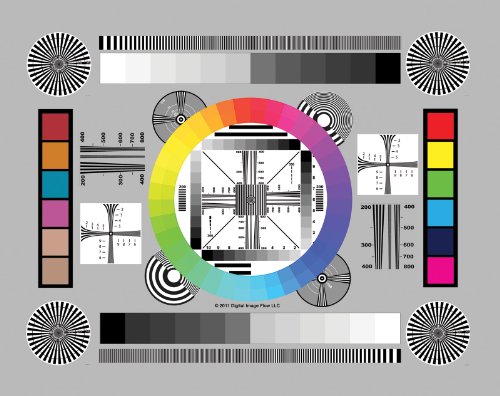
Same pick as the parent post, on purpose. The DGK lens test chart is $15.99 for three, and shooting a checkerboard through every lens on the show, ideally in prep, is how the matchmove department solves distortion instead of estimating it. At this price you tape one inside the Pelican’s lid and forget it exists until it saves you.
The limits: letter-size paper is too small for wide lenses at useful distances, glossy stock catches reflections, and a warped chart is worse than no chart, so mount it dead flat and matte-laminate it if you can. Also, know that free large-format grids exist before you spend real money here. CAVE Academy publishes a free wiki guide on shooting lens grids for VFX, and Eric Alba’s printable checkerboard grids go up to 48 x 96 inches as PDFs, meant to be printed matte, laminated, and mounted flat. A print-shop run costs less than a pro chart, and printed options like Duclos’ distortion chart are the step-up when a show demands one.
Measurement
Matchmove artists don’t ask for much: camera height, distance to subject, set width, greenscreen distance. The hardware to capture all of it costs about as much as a nice dinner.
The laser: Bosch Blaze Pro GLM165-40
A laser measure gets those numbers in seconds without dragging a tape through a hot set. The GLM165-40 measures to 165 feet at plus or minus 1/16 of an inch and costs $99. If your work lives on small stages and interiors, the honest budget call is Bosch’s GLM100-23 at $42.99: 100 feet of range in the same pocket form factor. That one superseded the GLM20 the parent post picked, so thoroughly that the GLM20’s old Amazon listing now serves the GLM100-23 instead.
Neither model has Bluetooth. That matters if you run Wrangler VFX, the iPad app for on-set VFX data management, which can auto-populate lens heights and camera-to-subject distances from a connected meter; for that you need Bosch’s connected C-suffix models or a Leica DISTO, starting around $107. And a red laser dot washes out in full sun at long range, which is one of two reasons the next item exists.

The tape measure: Stanley PowerLock 25 ft
The laser can’t hook onto a dolly track, and it can’t measure a curved prop. A $21 Stanley PowerLock can, works with dead batteries, and doubles as the thing you hand the art department when they ask. Every grip department on earth speaks PowerLock, which is reason enough to keep one in the case.
Its limits are what you’d expect: 25 feet, imperial-first markings, and Amazon carries half a dozen near-identical Stanley listings, some of them dead. The link below was the in-stock one on July 11.

Witness cams
A witness cam’s job is to see what the taking lens can’t: actor motion from a second angle for matchmove, the rig that needs removing, the stunt from the side. You want cameras cheap enough to clamp to a wall and forget, and mounts cheap enough to buy one per camera.
The witness cam: GoPro HERO13 Black
The HERO13 Black is still GoPro’s current flagship in mid-2026. A Hero 14 remained unannounced as of spring; GoPro showed its new GP3 processor in March 2026, with new cameras expected later in the year, so buy this one for the job in front of you, not for resale value. It has what the job needs: 5.3K at 60fps, GPS, the deepest mounting ecosystem in the business, and a price that makes owning two or three realistic. It launched at $399 in September 2024; the Amazon buybox has been sitting at $379 from a third-party seller, with GoPro’s own price still $399. Our action cameras guide has the full comparison if you want to shop around.
Witness duty exposes its weak spots. There’s no genlock or jam sync without extra hardware, so lining witness clips up with the A-camera is a manual job: a slate clap, a flash, a wave. Battery life runs about an hour of continuous high-res recording, so all-day witness rigs need USB power run to them. And a new model with a bigger sensor is rumored for late 2026, which is a refresh risk rather than a reason to wait. A witness cam gains less from a better sensor than from being on set in the first place.

The mount: SmallRig super clamp with ballhead arm
A witness cam is only as useful as the places you can put it. This SmallRig clamp-and-arm combo grabs anything from 14 to 60mm in diameter, which covers pipe, C-stands, dolly rail, and speedrail. It holds 3.5 kg, and it ships with both 1/4-20 and 3/8-16 threads plus a GoPro-mount adapter in the box. At $17.99, the correct quantity is one per witness cam, and after that you stop thinking about mounting.
Crank the ballhead down hard; a GoPro in a cage with a power cable will sag a loose one. It’s not a substitute for a real Manfrotto super clamp and arm when you rig anything heavier than an action cam. And the rubber pads can mark painted set pieces, which the art department will notice before you do.

The case
The parent post ends with a Lowepro backpack, and that’s still right for the supervisor’s day gear: laptop, reference camera, the things you touch every hour. The data kit is a different animal. Steel spheres, charts, a $1,000 360 camera, and a few GoPros want a hard case that flies as a carry-on and survives the camera truck.
The case: Pelican Air 1535
The Air 1535 has the same external size as Pelican’s classic 1510 carry-on but weighs about 3 pounds less, roughly 8.7 versus 12 pounds empty, with improved push-button latches. The weight matters here specifically because airlines weigh cabin bags and this particular case will be full of steel balls. The pick-and-pluck foam version was $314.95 on July 11 from CVPKG, a long-standing Pelican dealer; Pelican’s own no-foam version lists at $269.95 if you’d rather fit dividers. Cut a slot per sphere and a slot per camera, and the kit packs the same way every time.
Downsides: pick-and-pluck foam degrades over years of gigs, and the TrekPak divider version costs more. The Air series gives up a little crush resistance versus the classic 1510, which remains the tank option if the kit flies as cargo. And a loaded 1535 gets heavy fast, so weigh it before the airline does.

How the kit adds up
| Kit role | Budget build | Pro build |
|---|---|---|
| HDRI camera | Insta360 X5, $549.99 | Ricoh Theta Z1, $996.95 |
| Reference spheres | Two gazing balls + gray primer, about $110 | Matched sphere set, $760 |
| Color chart | ColorChecker Passport Video 2, $104.25 | |
| Lens grid | DGK 3-pack, $15.99 (free printables for wides) | |
| Laser measure | Bosch GLM100-23, $42.99 | Bosch GLM165-40, $99 |
| Tape measure | Stanley PowerLock 25 ft, $21.12 | |
| Witness cam | GoPro HERO13 Black, $379 to $399 (each) | |
| Mounting | SmallRig super clamp + arm, $17.99 (each) | |
| Case | Pelican Air 1535 no foam, $269.95 | Pelican Air 1535 with foam, $314.95 |
| Total | About $1,500 | About $2,700 |
The $1,200 between the builds buys a bigger HDRI sensor and nicer sphere handles. It does not buy better data. A wrangler with the budget build and good habits delivers more useful material than one with the pro build and sloppy ones, which is why the next section exists.
The habits that make the gear worth it
The log is half the kit. A folder of unlabeled brackets and mystery clips is barely better than nothing. Wrangler VFX, the iPad app mentioned above, is built for exactly this: slates, HDRI file naming with 3 or 4 angles and 3, 5, 7, or 9 bracket sets, reference photo sets, and witness clip logs, with Bluetooth laser meters feeding distances straight in. If you’d rather not add a subscription, VES Camera Reports at camerareports.org is a free industry-standard digital camera report for logging per-setup lens, filter, and camera data. Either way, the $760 sphere set with no log is worth less to your vendor than the $50 ball with a good one.
Capture on lighting changes, not on scenes. The set relights far more often than the call sheet suggests. A fresh HDRI, a sphere pass, and a chart grab at each turnover keeps the data current; a single set of captures from the morning tells post a story that stopped being true by lunch.
Buy the cheap version and bring it every day. The theme of this kit is that the modest version of each tool captures the same data as the expensive one. A gazing ball reflects the same set as a machined sphere, and a $16 chart shot in prep does more for the show than a $500 chart that stayed in the truck. Spend the savings on a second GoPro instead; a second angle helps matchmove more than a prettier ball helps lighting.
FAQ
What is a chrome ball actually for?
It’s a spherical mirror, so a single photo of it captures the position, size, and color of every light source and reflection around it from near the camera’s point of view. Artists use that to rebuild the set’s lighting around a CG object so it looks like it was photographed there. Its partner, the gray ball, shows light direction, relative intensity, and how shadows roll off a neutral surface, which the mirror finish can’t show cleanly. That’s why the pair travels together, and why this article tells you to buy two gazing balls and paint one.
How do you shoot an HDRI on set?
Put the 360 camera on a stand where the CG element will live, typically around subject height, get the crew clear of frame (it sees everything), and trigger a full bracket set: the Z1’s bracketing modes cover roughly 13 stops, and the X5 shoots up to seven exposures. Merge the brackets later in PTGui or the Theta’s HDRI plug-in. Then repeat at every lighting turnover, and name the files as you go; a convention like 3, 5, 7, or 9 brackets per position, logged per setup, is exactly what tools like Wrangler VFX exist to enforce.
Is the Ricoh Theta Z1 still worth it in 2026?
For HDRI work, yes. It has not been discontinued, it received a firmware update in January 2026, and nothing else combines 1-inch sensors, DNG raw, and deep bracketing in a body you can leave on a stand mid-set. The fair complaint is the price: $996.95 for a 2019 design. If that’s the sticking point, the Insta360 X5 at $549.99 covers the same job with noisier brackets and a less proven pipeline, and it’s the better 360 witness camera of the two.
What should a VFX data wrangler log on every setup?
Per setup: lens, filtration, and camera settings (the free VES Camera Reports covers this), camera height and distance to subject from the laser, chart and sphere passes for the current lighting, and an HDRI if the lighting changed. Witness clips get logged against the slate so post can find the angle that matches the take. It sounds like a lot; with the kit packed sensibly it’s a few minutes per setup, and it’s the difference between a vendor matching your set and a vendor guessing at it.
Pack it once, carry it forever
If this kit is your lane, the neighboring articles are worth the click: the VFX supervisor’s tool kit is the parent post with the reference camera, laptop, and gaff tape this article assumes you already have, and the DIT data-wrangler kit is this article’s cousin on the camera-media side of the truck. For where all this reference ends up, there’s the monitor calibration guide.
And that’s it. One case, somewhere between $1,500 and $2,700, and a VFX vendor who stops sending you questions that start with “do you happen to remember.” As always, this is what the research and the working supervisors I trust keep landing on; your show, your stages, and your kit fee get the final vote. Got a data kit trick I missed, or a pick you’d argue with? Leave a comment. The rest of our buyer’s guides live on the Gear Guides page.