Action cameras have gotten very good. The thumb-sized box you clip to a helmet or a chest mount now shoots stabilized 4K or better, shrugs off water and dirt that would kill a phone, and costs less than a decent lens. By 2026 there’s no longer a bad one from the big three. GoPro, DJI, and Insta360 all make cameras that will do the job, so the pick comes down to what you’re filming.
I rank them a little differently than the mountain-bike sites do, because my half of the job starts when the card comes out. A clip that looks great on the camera’s own screen can still be a pain on a timeline: a log profile that bands the moment you push it, a bitrate that falls apart in motion, gyro data the stabilizer plug-in can’t read. So the picks below weigh the things an editor feels: the log profile and its bit depth, the sensor behind it, internal storage, and whether Gyroflow can open the file. Stabilization, waterproofing, and mounts still count, and I’ll flag them where they decide something, but they’re no longer where these cameras differ much.
Here are the five I’d recommend, one for each kind of shooter. I haven’t owned any of these; what follows is a working editor’s read of the spec sheets and the files they hand you, which is the half of the purchase I care about. Prices are for the standard camera or combo, though most of these are worth the small step up to a bundle with a spare battery and a case.
Last updated: October 2026. Prices and specs were checked at Best Buy, Amazon, and the makers’ spec pages on October 17, 2026. Some links below are affiliate links. Buy through them and it helps keep the site running, at no extra cost to you. I only point at gear I’d be comfortable handing to a friend.
TLDR
If you just want the answer: the DJI Osmo Action 6 is the best action camera for most people and the one I’d hand an editor, at $436: 10-bit D-Log M, a 1/1.1-inch sensor behind a variable aperture, 50 GB of usable internal storage, and gyro data Gyroflow can read. If the image is all that matters and you’ll pay $699.99 for it, the GoPro Mission 1 Pro has the biggest sensor in the class, a true 1-inch chip, and the most flexible log profile. Want a flip screen for talking to the camera, or shoot a lot after dark on a budget? The Insta360 Ace Pro 2 at $389.99. For the toughest camera per dollar, the DJI Osmo Action 5 Pro has the same 20-meter rating and the same D-Log M as the Action 6 for $309. And if you want to capture everything and pick the shot later, the Insta360 X6 is the 360 camera to buy. The rest of this guide is who should pick what, and why.
Best overall: DJI Osmo Action 6
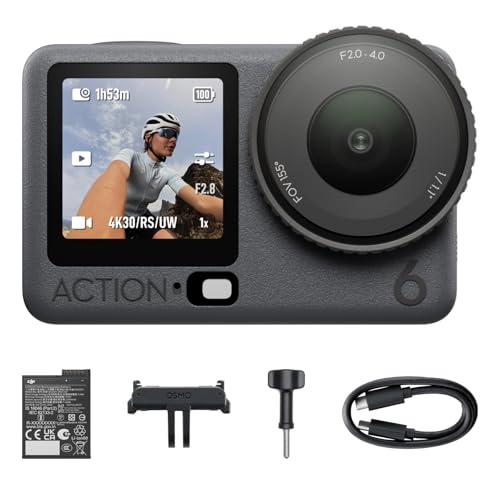
DJI keeps the overall slot, and the reason has moved from the spec sheet to the timeline. The Osmo Action 6 pairs the biggest sensor in any flat action camera, a 1/1.1-inch square chip, with the first variable aperture in the class, f/2.0 to f/4.0. Open it up and SuperNight mode runs the sensor to ISO 51200 (25600 in the normal modes). Stop it down and it focuses from 0.2 meters at f/4.0, close enough for a handlebar-mounted face or a product on a desk. The square sensor is the part I like most: shoot 4K Custom at 3840 by 3840 up to 60 fps, then cut a 16:9 master and a 9:16 vertical from the same clip with no resolution penalty. Regular 16:9 runs 8K at 30 or 4K up to 120, through a 155-degree lens.
On the file side, it records 10-bit D-Log M and DJI’s LUTs drop straight into Resolve or Premiere. D-Log M is capped at ISO 6400, so log is for lit scenes and SuperNight is its own mode; plan the shoot that way and the grade is easy. The container is MP4 HEVC at a maximum of 120 Mbps, and that’s the number I’d push back on. It’s fine for 4K. 8K at that rate is compressed hard, so I’d shoot 8K for reframing room and deliver from 4K. 64 GB is built in with about 50 GB usable, so a forgotten card doesn’t end the day. Gyroflow supports the Action 6 directly with EIS off, which gets you stabilization in post that keeps more of the frame than RockSteady does, and lets you decide how much to smooth per shot. It weighs 149 grams and is waterproof to 20 meters bare, 60 with the case. It’s $436 for the Standard Combo at Best Buy, $264 under the Mission 1 Pro, and that difference covers a lot of cards and batteries. The Action 6 is eleven months old, so a successor is plausible this winter; nothing is announced, and a newer model wouldn’t make these files any worse to cut.
Best image quality: GoPro Mission 1 Pro
GoPro skipped the Hero 14 and put its new GP3 processor into the Mission 1 line instead, and the GoPro Mission 1 Pro is the result: a 1-inch sensor, the biggest in any action camera, behind an f/2.8 lens that covers 15 to 27 mm equivalent. That sensor is the whole argument. More area means cleaner shadows and more room to grade, and GP-Log2, GoPro’s 10-bit log profile for the GP3 pipeline, is the most flexible log file in the class. It shoots 8K at 30, 4K at 120, and 1080p at 240. You’ll see 8K60 quoted around the web; GoPro’s own spec table says 30, so that’s the number I’ll stand behind.
The costs are real for an editor, and they start with storage. There’s none built in: it needs a V30 microSD, and at 8K you’ll want a few. GoPro doesn’t publish a bitrate, a waterproof depth, or a minimum focus distance on the Mission 1 spec page, so I won’t print numbers I can’t check. What I can say is that a fixed f/2.8 lens with no close-focus figure makes this a worse talking-to-camera tool than the Action 6. Gyroflow doesn’t list the Mission 1 yet, which means in-camera stabilization or nothing until the project adds it, and that’s the one line on the sheet that would make me pause if I cut a lot of mounted footage. It weighs 207 grams with the 2150 mAh Enduro 2 battery, almost 60 grams more than the Action 6. And it’s $699.99 at Best Buy and Amazon, with a Grip Edition at $779.99 and an ILS body with a Micro Four Thirds mount at the same $699.99. The plain Mission 1 starts at $599.99 on the same sensor and processor, and both weigh the same 207 grams. Buy the Pro if the grade is the point and you’re already paying for cards and a bag. If you own a drawer of GoPro mounts and want to stay in the family for less, the Hero 13 Black is the clearance buy, and only on a discount: Gyroflow reads it, it records GP-Log, and at its regular $429.99 at Best Buy the Action 6 is $6 more and the better camera.

Best for vlogging and low light: Insta360 Ace Pro 2
The Insta360 Ace Pro 2 holds the vlogging slot for the same two reasons it did last year: the screen flips up so you can frame yourself, which neither the GoPro nor the DJI will do, and the 1/1.3-inch 50-megapixel sensor behind the Leica-branded lens holds up after dark better than anything else near this price. The Action 6’s bigger chip and f/2.0 still win in the dark at $436; under $400, this is the low-light pick. It shoots 8K at 30, and the Octa edition at Best Buy is $389.99 with two batteries in the box, which is the bundle to get because talking-head work eats batteries.
In the edit, it’s the pick I’d hedge most. Insta360’s spec sheet doesn’t state a bit depth for I-Log, so plan the grade as if the file is 8-bit: shoot a flat profile, keep the pushes gentle, and don’t expect the latitude you’d get from D-Log M or GP-Log2. Gyroflow doesn’t list the Ace Pro 2 either, so FlowState in camera is your stabilizer. And a note with a date on it: as of October 17, 2026, an Ace Pro 3 is rumored and unannounced. If that firms up before you buy, wait; if you need the camera this month, $389.99 is a fair price for a 1/1.3-inch sensor and a flip screen.

Best value rugged: DJI Osmo Action 5 Pro
The previous DJI flagship is now the cheapest way to get serious depth and a usable log file. The Osmo Action 5 Pro carries the same 20-meter bare waterproof rating as the Action 6, RockSteady stabilization, and the same 10-bit D-Log M recording, for $309 in the Essential Combo at Amazon. Gyroflow supports it the same way it supports the Action 6, EIS off, so the post workflow is identical: same LUTs, same stabilizer, same HEVC files on the timeline. What you give up against the Action 6 is the bigger square sensor and the variable aperture, and those show up in low light and in vertical reframes. For daylight footage on a bike, a board, or in the surf, the files cut the same. The Essential combo is bare, the sensor is a generation behind, and it’s a DJI, so the supply note below applies. For $127 less than the Action 6, it’s the rugged camera I’d hand to someone who’s going to lose one.

Best 360 camera: Insta360 X6
A 360 camera is a different way of shooting: it captures everything around it and you choose the shot afterward in software, which is either magic or a chore depending on how you feel about editing. The Insta360 X6 launched in August and settled the category: dual 1/1.1-inch sensors, 360 video at 8K50, lens covers you can replace yourself so a scratch doesn’t total the camera, and the invisible-selfie-stick effect that makes it look like a drone is filming you. It’s $699.99 at Best Buy, which had three in stock when I checked on October 17.
Understand the workflow before you buy. Every clip is a full sphere, so you reframe in Insta360’s software, keyframe a virtual camera through the shot, and export a flat 16:9 or 9:16 render. Those exports are what land on your timeline, and the source files behind them are enormous, so budget drive space the way you would for a second camera. Gyroflow doesn’t do 360, so stabilization is FlowState in camera, which is good enough that you won’t miss it. If you’ll do that reframing work, nothing else here gives you one take and many angles. If you won’t, buy the Action 6 and keep the $264.

How they compare
| Camera | Sensor | Max video | Log profile | Gyroflow | ~Price (Oct 17, 2026) |
|---|---|---|---|---|---|
| DJI Osmo Action 6 | 1/1.1-inch square, f/2.0 to f/4.0 | 8K30, 4K120 | D-Log M, 10-bit | Supported (EIS off) | $436 |
| GoPro Mission 1 Pro | 1-inch, f/2.8 | 8K30, 4K120, 1080p240 | GP-Log2, 10-bit | Not listed | $699.99 |
| Insta360 Ace Pro 2 (Octa) | 1/1.3-inch, 50 MP | 8K30 | I-Log, bit depth not stated | Not listed | $389.99 |
| DJI Osmo Action 5 Pro | 1/1.3-inch | 4K120 | D-Log M, 10-bit | Supported (EIS off) | $309 |
| Insta360 X6 (360) | Dual 1/1.1-inch | 8K50 (360) | I-Log | No 360 support | $699.99 |
What to look for in an action camera
Match the camera to how you’ll mount and use it. A flat camera (the GoPro, the DJIs, the Ace Pro 2) clips to helmets and chest mounts and shoots a normal frame. A 360 camera (the X6) captures everything and reframes later. Decide which workflow you want before you start chasing specs.
If you grade, check the log profile and its bit depth, not the resolution. D-Log M on the DJI cameras and GP-Log2 on the GoPro are documented 10-bit formats, and 10-bit is what keeps a sky from banding when you pull the exposure around. Insta360 doesn’t state a bit depth for I-Log on the Ace Pro 2’s sheet, so treat it as 8-bit until they do. Bitrate matters almost as much and is harder to find: the Action 6 tops out at 120 Mbps HEVC, which is why its 8K is a reframing format more than a delivery one, and GoPro doesn’t publish a figure for the Mission 1 at all. None of these give you ProRes. Every file here is long-GOP HEVC, so plan on proxies or a fast machine for 8K.
Check Gyroflow before you count on stabilizing in post. Gyroflow reads the gyro track off the file and stabilizes with far less crop than the in-camera modes, and it lets you tune the smoothing shot by shot. Its supported list (read October 12) covers the DJI Action 4, 5, and 6 with EIS turned off, and the GoPro Hero 8 through 13. The Mission 1 and the Ace Pro 2 aren’t on it yet. If that workflow is part of how you cut, that list decides the purchase.
Internal storage is a real feature, and cards are a real cost. The Action 6 has about 50 GB usable built in. The Mission 1 Pro has none and requires a V30 microSD, so add cards to its price, and at 8K add several.
Stabilization is good everywhere now. HyperSmooth, RockSteady, and FlowState all produce footage that looked impossible a few years ago. This is no longer where these cameras differ, so don’t overpay chasing it; the Gyroflow question above is the one that still separates them.
Check the waterproof depth without a case. The Osmo Action 6 and Action 5 Pro are rated to 20 meters bare, and the Action 6 goes to 60 in its case. GoPro doesn’t print a depth on the Mission 1 spec page, so ask before you take one diving. For splashes and rain, any of these is fine as-is.
One heads-up on the DJI picks. DJI was added to the FCC Covered List in late 2025, and the effects are no longer theoretical: DJI’s Osmo 360 II launched in August without a US store page at all. That doesn’t affect a camera you already own, and both DJI cameras here were in stock at Best Buy and Amazon on October 17, so just don’t wait forever if a DJI is the one you want.
FAQ
Are action cameras good enough to replace a real camera?
For action, yes. For everything else, no. They’re built for tiny, tough, stabilized footage from mounts, and they give up shallow depth of field and interchangeable lenses to get there. The Mission 1 Pro‘s 1-inch sensor and 10-bit log close the image gap more than any action camera before it, and the files still hand you a fixed wide lens and long-GOP HEVC. If you want a proper camera, that’s a different guide, linked at the bottom.
Do I need a 360 camera?
Only if you’ll do the reframing work in software afterward. The payoff is flexibility: one take, many angles. The cost is editing time and storage, and no Gyroflow. If point-and-shoot is your style, a regular action cam is simpler and gives you a sharper image.
Is the most expensive one the best?
No. The two $699.99 cameras here are specialists: the X6 is for 360 capture and nothing else, and the Mission 1 Pro is for the best image when you’ll pay for cards and give up Gyroflow to get it. The $436 Osmo Action 6 is the right pick for most people, including most editors. You step up for a specific reason, like the 1-inch sensor, 360 capture, or a flip screen, not because a camera is newer.
GoPro, DJI, or Insta360?
All three make excellent cameras in 2026, so pick by the role you need. DJI has the best overall camera right now and the friendliest files for an editor: 10-bit log, internal storage, Gyroflow support, and 20 meters of waterproofing. GoPro has the best image, from the Mission 1 Pro’s 1-inch sensor, and the deepest mount ecosystem. Insta360 owns 360 capture and has the best flip-screen vlogging option.
Want a proper camera instead?
If you’re after interchangeable lenses, low-light performance, and shallow depth of field, an action cam isn’t the tool. Start with Best Cameras Under $1,000, or step up to Best Cameras Under $2,000.
Want the rest of our buyer’s guides in one place? They all live on the Gear Guides page.