Nobody buys a UPS because they want one. You buy it the week after the power blinked at 94% on a four-hour export, or the day your NAS came back up with a degraded array and a warning you didn’t like the look of. I’d rather you buy it the week before. A battery backup is the cheapest insurance in your whole rig: the workstation, the drives, the project file that was mid-write when the lights went out… all of it sits behind a box that costs less than one drive.
The problem is that UPS buying guides are written for people protecting a Wi-Fi router, and the advice that’s fine for a router will let an editing workstation crash at the exact moment the UPS was supposed to save it. There’s one spec that decides everything, most lists ignore it, and we’re covering it first.
Last updated: August 2026. Some links below are affiliate links; buying through them supports the site at no cost to you. Prices are early-August snapshots, verified on the live listings.
TLDR
If you just want the answer: the CyberPower CP1500PFCLCD ($239.95) is the workstation pick, because it’s a pure sine wave unit at a simulated sine price and the current revision delivers 1000W. Put the CyberPower CP1000PFCLCD ($179.95) on the NAS shelf and let the NAS tell everything else to shut down. If your machine room has a rack, the APC Smart-UPS line is where you graduate to.
The spec that decides everything: pure sine wave
Wall power is a smooth sine wave. A cheap UPS on battery produces a “simulated” sine wave instead: a stepped approximation with a brief flat spot at each zero crossing. Your router doesn’t care. Your workstation does, because every modern computer power supply (anything 80 Plus rated, and every Mac) uses active power factor correction, and active PFC circuits expect the smooth wave. Feed them the stepped version at the instant the UPS transfers to battery and the PSU can read it as unstable power and shut itself down to protect the hardware.
Read that failure mode again. The power blips, the UPS does its job, and your computer hard-crashes anyway… because of the UPS. This is why an editor can’t just buy the top result on a generic best-UPS list. The most recommended UPS on the internet right now is a simulated sine model, and it’s a fine product for the modem shelf it was reviewed for. For an edit rig, pure sine wave is the entry requirement, not a premium feature. Every pick below has it.
The picks
Best for the workstation: CyberPower CP1500PFCLCD
The CP1500PFCLCD has been the default recommendation in edit bays and homelabs for a decade, and the current revision made it better without changing the price class: 1500VA and a full 1000W of pure sine output (older units were rated 900W, and plenty of listings still quote it… the shipping version says 1000W on the box). You get automatic voltage regulation, which smooths brownouts and surges without ever touching the battery, twelve outlets, a display that shows load and runtime in plain numbers, and USB monitoring your Mac or PC reads natively. At $239.95 it’s the least money that does this job correctly.
Two downsides to plan around. The replacement battery costs $45 to $70 and you’ll want one every four years or so; budget for it, because a UPS with a tired battery is furniture. And at a sustained 400W editing-workstation load, this thing buys you minutes, not an evening. More on runtime math below, because it’s where every marketing page lies to you.
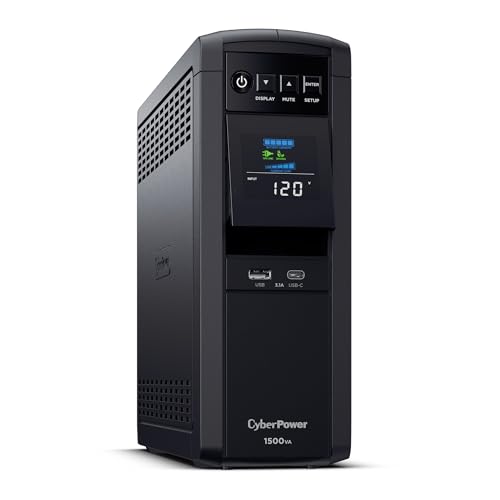
The APC BR1500MS2 is the same idea from the other big name: 1500VA/900W pure sine, ten outlets plus USB-A and USB-C charging ports on the front. APC hardware has lived on my DIT carts for years and I’d trust either brand with a client’s media. Buy whichever is cheaper the week you’re shopping; as I write this the APC is sitting at $299.99, so lately that’s been the CyberPower by a mile.

Best for the NAS: CyberPower CP1000PFCLCD
Your NAS needs its own UPS, and it’s the more important one. A workstation that loses power loses unsaved work; a NAS that loses power mid-write can corrupt the array that holds every project you’ve ever shot. The good news is that a NAS is a light load. A four-bay unit idles around 30W, which means the smaller CP1000PFCLCD (1000VA/600W pure sine, $179.95) will float it for well over an hour… far longer than the five minutes it needs.
Because the UPS isn’t there to keep the NAS running through an outage. It’s there to give it time to shut down like a gentleman. One USB cable from the UPS to the NAS, two minutes in settings, and Synology DSM or QNAP QTS will watch the battery and power itself down cleanly when an outage runs long. Set it to shut down after five minutes on battery. Done. Your array survives every outage you’re not even home for.

For the rack: APC Smart-UPS
If your storage lives in a rack (our shared-storage and SAN guides put you there eventually), move up to the APC Smart-UPS SMT1500RM2UC, the 2U rackmount workhorse, $700 to $800 street from IT suppliers. One buying note: the Amazon listings for this unit run hundreds over street through marketplace sellers, so this is the rare pick I’d buy from CDW or your usual IT reseller instead. It’s the line every IT department standardizes on, DSM and QTS both recognize it over USB or network, and the SmartConnect cloud portal emails you when the battery ages out instead of letting you find out during an outage. Eaton’s 5P1500R does the same job in 1U if rack space is tight. Overkill for a desk; correct for a machine closet billing clients.
The cheap shelf: APC BE600M1
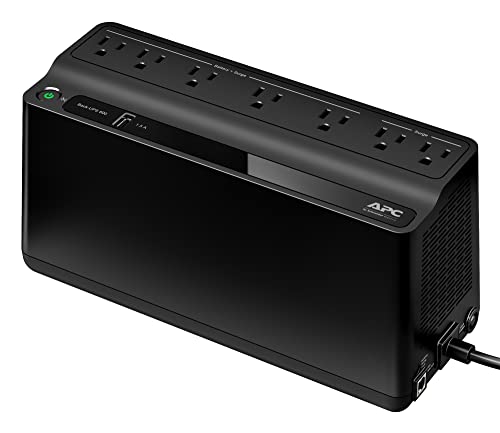
One more, because it’s the pick I recommend to everyone regardless of rig: a small 600-ish VA unit for the modem, router, and switch. It’s simulated sine, and that’s fine here, because network gear doesn’t have the picky PSU problem. The payoff: your internet stays up through the outage, your NAS can still email you that it shut down cleanly, and if you work remote, a blip doesn’t drop your client call. The APC BE600M1 is $83.99 with a handy USB charge port; CyberPower’s EC650LCD does the same job and lately costs more, so check both and take the cheaper one.
How the picks compare
| UPS | Output | Sine wave | The job | Price (Aug 2026) |
|---|---|---|---|---|
| CyberPower CP1500PFCLCD | 1500VA / 1000W | Pure | Editing workstation + displays | $239.95 |
| APC BR1500MS2 | 1500VA / 900W | Pure | Workstation (the APC version) | ~$300, fluctuates |
| CyberPower CP1000PFCLCD | 1000VA / 600W | Pure | NAS + graceful shutdown | $179.95 |
| APC SMT1500RM2UC | 1500VA, 2U rack | Pure (line-interactive) | Rack / machine closet | $700 to $800 street (skip Amazon) |
| APC BE600M1 | 600VA / 330W | Simulated (fine for network gear) | Modem, router, switch | $83.99 |
Sizing: watts, not VA, and the runtime lie
VA is the number on the front of the box; watts is the number that matters. Find your rig’s real draw, multiply by 1.25 to 1.5 for headroom, and never plan to run a UPS past about 80% of its watt rating. Two examples bracket most readers:
The Mac suite. Apple’s own spec sheet caps a maxed Mac Studio at 270W, and in real editing it sits under 100W. Add a display and some drives and you’re a 300 to 400W load at the absolute worst. A 1500VA/1000W unit is comfortable, and at sub-100W idle-ish loads the runtime math turns friendly: the CP1500PFCLCD’s published charts show roughly 70 minutes at 100W. You might, for once, watch an export finish on battery.
The RTX 5090 grading tower. The GPU alone can pull 450W and change; the whole system runs 400 to 600W at the wall under load, with transients spiking past 800W. On battery, that flattens a 1500VA unit in two to four minutes. That’s the runtime lie: “up to 120 minutes!” on the box is measured at 50W, a tenth of your render load. A UPS buys a graceful save-and-shutdown, not a finished render. If you need the render to survive the outage, that’s a generator conversation, not a battery one.
“So should I get double conversion? The data-center kind?” For a home suite… no. Double-conversion units rebuild the sine wave continuously with zero transfer time, and they cost two to four times as much, run fans, and turn 10% of your power bill into heat for a problem you don’t have. The line-interactive units above ride through the four-to-eight-millisecond transfer on their voltage regulators, and your PSU’s capacitors hold the machine up across the gap. Double conversion is for generator-fed buildings and rural power that browns out weekly.
The topology: one cable, whole-room protection
The setup I recommend for a one-editor suite with storage:
- Workstation, displays, and audio interface on the CP1500PFCLCD, USB cable to the workstation so it can save and sleep on battery.
- NAS (and its switch, if it has a dedicated one) on the CP1000PFCLCD, USB cable to the NAS, shutdown timer set to five minutes.
- Modem and router on the little 650VA unit so the network outlives the blip.
One refinement for the storage-heavy crowd: Synology, QNAP, TrueNAS, and Unraid can all act as a network UPS server. Plug the UPS’s USB into the NAS and every other machine on the LAN can subscribe to that one battery over the network and shut down in order. It’s the NUT protocol under the hood on all four platforms, it costs nothing, and it means one UPS coordinates the whole room. Our NAS hub covers which boxes make this easiest.
FAQ
Will a UPS protect against surges too?
Yes. Every pick here includes surge suppression and, on the line-interactive units, automatic voltage regulation, which also tames the brownouts and sags that never trip a plain surge strip. If your gear currently hangs off a power strip from the garage, this is the upgrade.
How often do batteries need replacing?
Every three to five years for the standard sealed lead-acid packs in everything above. The units chirp and the software warns you. Replacements run $45 to $70 for the desktop models and swap in minutes. Lithium versions (APC sells a Smart-UPS lithium line from about $1,000) last eight to ten years and weigh a third less, and the math works out for studios that would otherwise buy three battery cycles; for a home suite, lead-acid and a calendar reminder is the sane budget call.
Is a used or hand-me-down UPS worth it?
Check two things: the battery date, and the recall lists. APC has had real recalls over the years (a 2003 Back-UPS run and a big 2013 SurgeArrest batch, both fire risks), so run any secondhand unit’s serial through the CPSC site before you trust it overnight. With a fresh battery and a clean serial, sure.
What about the gaming UPS models?
APC’s “Gaming” BGM1500 is the same 1500VA sine-wave hardware as the BR1500MS2 wearing an RGB ring, usually at a markup. Your render does not care about the light show. Buy the plain one.
Set it up once, forget it exists
Power protection is the boring layer of the edit suite, which is exactly why it gets skipped and exactly why it shouldn’t be. It slots in underneath everything else we’ve covered: the editing-server build that doubles as our NAS hub, and the edit suite room guide that ties the whole space together. Do the two-UPS topology once and you’ll never think about it again, which is the point.
And that’s it! One spec (pure sine), one rule (watts, not VA), one workflow (let the NAS shut itself down). As always, this is what runs in my world and what I’d put under a client’s storage; your mileage and your utility company may vary. Questions about sizing a specific rig? Leave a comment.