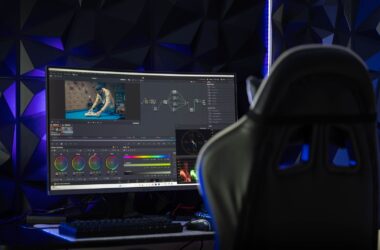
The client is in New York, the footage is on a drive in Los Angeles, and you are at a kitchen table in a town neither of them has heard of. Welcome to editing in 2026. I’ve run my post work remotely for years now, VFX included, and the thing nobody tells you when you go remote is that the gear list changes shape. Nobody is going to hand you a drive. Nobody is going to lend you the suite’s monitor. Your desk has to be the whole facility, and it has to survive a client call at 4pm and a 3am upload without anyone else in the building. Let’s build that desk.
This is a kit post, not a spec sheet. Every piece below is the one I’d buy for the job it does, most of them link back to the full guide where I argued the pick, and the two totals at the bottom are real numbers from September 2026 listings. If you already own a piece, skip it; the kit is modular on purpose.
Last updated: September 2026. Some links below are affiliate links. Buy through them and it helps keep the site running, at no extra cost to you. Prices read on the live Amazon listings on September 2, 2026; every pick had a buy box that day.
TLDR
If you just want the answer: a MacBook Pro 14 with the M5 Pro ($2,354) as the machine, a Plugable Thunderbolt 4 dock ($199.95) and a Dell U2725QE ($626.49) so it becomes a workstation with one cable, an OWC Envoy Ultra ($699.99) for the project that’s in front of you, a NAS at home with Tailscale on it for everything else, a Shure MV7+ ($299) so you sound like a professional on the call, and an APC UPS ($189.99) because the power will go out during the export. About $4,000 for the working set, before the server.
The remote kit, at a glance
| Job | The pick | Why it’s in the kit | Sept 2 price |
|---|---|---|---|
| The machine | MacBook Pro 14, M5 Pro | A real edit machine that also goes to the client’s office | $2,354 |
| The desk in one cable | Plugable TBT4-UD5 | Displays, drives, Ethernet, cards, charging, one plug | $199.95 |
| The monitor | Dell UltraSharp U2725QE | 4K, calibrated, and it’s a 140W Thunderbolt dock itself | $626.49 |
| The project drive | OWC Envoy Ultra 2TB | Thunderbolt 5, weatherproof, fast enough to cut raw off | $699.99 |
| The library | UGREEN DXP4800 Plus + Tailscale | Every past project, reachable from anywhere, without port forwarding | $656.99 + drives |
| The voice | Shure MV7+ | Client calls and scratch VO on one USB-C mic | $299 |
| The ears | Beyerdynamic DT 990 Pro | Honest open-backs for a room with no speakers | $179.99 |
| The power | APC BX1500M | Clean shutdown for the NAS, and the export finishes | $189.99 |
The machine
The pick: MacBook Pro 14 with the M5 Pro
A remote editor’s machine has one requirement a facility editor’s doesn’t: it leaves the house. The client wants you in the room for the final pass, the DP wants to look at selects on set, your co-writer has a couch. The 14-inch MacBook Pro with the M5 Pro is the machine that does both jobs without compromise on either: ProRes and H.265 engines in silicon, a display you can trust for a rough grade on the road, Thunderbolt 5 so the Envoy Ultra below runs at full speed, and a battery that gets through a flight of scrubbing. It was $2,354 at Amazon on September 2 with a buy box. If you’re a desk-only editor and travel is a myth, the Mac Studio M5 Max at $2,499 is the better machine per dollar, and the whole Mac ladder is in the best Mac for video editing. PC people, the laptop guide has your equivalent; everything else in this kit is platform-agnostic.

The desk, in one cable
The dock: Plugable TBT4-UD5
Sitting down should be one plug. The Plugable TBT4-UD5 is the right amount of dock for a laptop editor: thirteen ports, two 4K displays, 2.5GbE, SD and microSD slots, and 100W of charging, for $199.95. It’s Thunderbolt 4, which is the right choice for most of you; a Thunderbolt 5 dock only pays off if the laptop and the drives are both TB5, and on the M5 Pro they are, so if you want the faster tier the Kensington SD5000T5 EQ at $229.99 is the value TB5 dock with 140W charging. The full field, with the CalDigits at the top, is in the Thunderbolt dock guide.
The monitor: Dell UltraSharp U2725QE
Here’s a trick that saves a remote editor money: the U2725QE is a dock. It has a Thunderbolt 4 input with 140W of power delivery, Ethernet, a stack of USB ports, and a KVM, so a laptop-only editor can skip the Plugable entirely and plug the MacBook into the monitor. It’s also a 27-inch 4K IPS Black panel at 120Hz with 99% DCI-P3 and a calibration report in the box, which makes it the monitor I’d tell most editors to buy regardless, at $626.49. The monitor I run myself is an OLED, and the argument for and against that is in the best monitor for video editing. For a remote desk, the Dell’s dock trick wins.

Storage: the project in front of you, and everything else
The project drive: OWC Envoy Ultra 2TB
Remote editing runs on a two-tier storage rule: the active project lives on a fast drive next to the machine, and everything else lives on the server. The active drive is the OWC Envoy Ultra 2TB, $699.99: Thunderbolt 5 with the cable built in, over 6,000MB/s on a TB5 port, and an IP67 rating, so it survives the bag, the set, and the coffee. That’s fast enough to cut 6K raw straight off the drive, which is the whole point of buying TB5 in the laptop. The value alternative is the Kingston XS1000 1TB, a USB 3.2 pocket drive that’s plenty for proxies and 4K H.264. Fair warning on that one: NAND prices climbed hard this year and it was $189.95 on September 2, about double what it cost in the spring, so check the listing. The rest of the portable field is in the portable SSD guide.

The library: a NAS at home, reached over Tailscale
The server is what makes remote work sustainable instead of a pile of drives in a drawer. Every finished project, every client’s raw, every LUT and template you’ve ever built, on one box at home, and reachable from the hotel. My budget pick for a solo editor is the UGREEN DXP4800 Plus, four bays, 10GbE on board, $656.99 before drives; my own box is a QNAP TS-473A at $879 because I like QNAP’s software. Drives, RAID, and the network are the whole editing server guide, and the brand argument is QNAP vs Synology.
The remote part is the thing to get right, and it’s free. Do not put the NAS on the open internet. No port forwarding, no UPnP, and turn off the vendor’s own “quick connect” relay while you’re at it. Install Tailscale on the NAS and on the laptop instead. It builds an encrypted private network between your devices with nothing exposed to the outside, the NAS shows up on the laptop in the hotel exactly as it does at home, and it costs nothing for a personal setup. Then be realistic about what you pull over it: a hotel connection is not 10GbE. Sync the project you’re on to the Envoy before you leave, use the NAS remotely for the odd file and the archive, and let the big transfers run overnight. Which is the other reason the UPS is in this kit.

The call, and the ears
The mic: Shure MV7+
You will spend more hours on client calls than in most facility jobs, and a laptop mic makes you sound like you’re calling from the bottom of a well. The Shure MV7+ ($299) is a dynamic mic, which means it hears you and ignores the room, with USB-C and XLR on the same body, so it’s the call mic today and a real scratch-VO mic when the script needs a temp read. It’s the best-overall pick in our USB and XLR mic guide for the same reasons. Put it on a boom arm, not the desk stand; a mic on the desk picks up every keystroke.
The headphones: Beyerdynamic DT 990 Pro
A remote desk rarely has monitors and never has a treated room, so headphones are the mix reference. The DT 990 Pro at $179.99 has been the open-back answer on this site for years: comfortable for an eight-hour day, wide enough to hear a mix’s problems, and the 250-ohm version wants a small headphone amp to sing, which is in the headphone mixing article. Open-backs leak, so they’re the wrong pick for a shared apartment during a call; mute the mic, or keep a cheap closed pair for calls.

Power, review, and backup
The UPS: APC BX1500M
Power never cuts out at a convenient time. It drops in the middle of the export, or, worse, in the middle of the NAS writing a file while you’re 900 miles away. The APC BX1500M ($189.99) sits under the NAS and the router, tells the NAS to shut down cleanly when the battery gets low, and gives a laptop on the desk the minutes it needs to finish a render. I run an APC on every build I’ve ever done, and it’s the least glamorous purchase in this kit and the one you’ll thank yourself for.

Review and backup: the software half
Two pieces of the remote kit aren’t hardware. Client review needs a tool with frame-accurate comments and version stacking, not a Dropbox link and an email chain; Frame.io ships inside Creative Cloud if you’re already paying Adobe, and the alternatives are ranked in the video review and approval tools guide. And backup: the NAS is not a backup, it’s the library. The laptop and the Envoy back up to the NAS, the NAS backs up off-site, and the strategies for that last hop, from a second drive set to cloud storage to tape, are in archiving projects without losing your mind. A remote editor with one copy of the client’s raw is one dropped drive from a very bad phone call.
How the kit adds up
The working set, no server: MacBook Pro 14 M5 Pro $2,354 + Plugable dock $199.95 + Dell U2725QE $626.49 + Kingston XS1000 1TB $189.95 + Shure MV7+ $299 + DT 990 Pro $179.99 + APC BX1500M $189.99 = $4,039. Skip the Plugable and plug the laptop into the Dell, and it’s $3,839.
The full remote facility: the same machine, monitor, mic, headphones, and UPS, with the Kensington TB5 dock $229.99, the Envoy Ultra 2TB $699.99, and the QNAP TS-473A $879 = $5,458, plus drives for the NAS, which the server guide prices out. Add a Tailscale account at $0. Every number is the September 2 listing, and the storage lines are the ones most likely to have moved by the time you read this.
The habits that make the kit work
Sync before you travel, never during. The project you’re cutting this week lives on the Envoy, copied from the NAS before you leave the house; the hotel Wi-Fi is for email and the odd missing file. Name the drive and the NAS folder identically so relinking is a one-click job in Premiere or Resolve when you get home. Keep the NAS off the public internet, always, and let Tailscale be the door. Put a boom arm on the mic and mute by default. Back up the laptop to the NAS nightly and the NAS off-site weekly, and test a restore once a quarter, because a backup you’ve never restored is a rumor. And write the client’s review link into the delivery email template so the notes come back in one place instead of four.
FAQ
Can I edit directly off my NAS from another city?
Technically yes, practically no. A remote connection tops out at whatever the hotel or the coffee shop gives you, which is nowhere near a 4K timeline’s appetite. Pull the project to a local drive, cut there, and use the NAS remotely for the archive and the odd file.
Do I need a Thunderbolt 5 laptop for remote editing?
No. TB5 matters if you cut raw off an external drive and want the Envoy Ultra’s full speed; a TB4 machine with a fast USB or TB4 drive handles 4K comfortably. Buy TB5 if you’re buying a new Mac anyway, since it’s on the M5 Pro.
Is a NAS overkill for a solo remote editor?
Until you have more than two or three projects’ worth of media, a big external drive and an off-site backup do the job. The NAS pays for itself the first time a client asks for last year’s project and you can pull it from anywhere instead of digging through a drawer.
What about a second monitor on the road?
The laptop screen is your second monitor. Put the timeline on the Dell and the viewer or the bins on the laptop at home; on the road, the laptop’s own display is good enough for selects and a rough grade, and that’s what the 14-inch Pro’s panel is for.
In conclusion
What would I change if I were building my remote desk from scratch today? Nothing on this list, which is the point of writing it down. The MacBook Pro is the machine, the Dell is the desk, the Envoy is the project, the NAS is the library, and Tailscale is the door. Buy the UPS before you think you need it.
And that’s it! As always, what you see here is what works for me, my clients, and my crew. Remote work rewards boring reliability over clever gear, so if a piece of this kit feels unexciting, that’s the compliment. Got a remote setup that survived a bad hotel and a worse client? Comments are open. The rest of our kits and buyer’s guides live on the Gear Guides page.