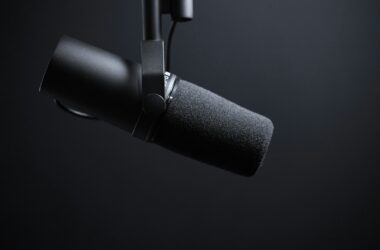
Three Shure microphones, one deciding number: how much clean gain sits between the capsule and the recording. The Shure SM7B puts out -59 dBV/Pa and needs about 60 dB of gain for speech at a normal level. The Shure SM7dB is the same microphone with a switchable preamp that adds 18 or 28 dB before the cable. The Shure MV7+ moves the preamp, the converter and the processing inside the body and sends the result over USB-C, with a passive XLR jack beside it. The interface already on the desk, or the absence of one, decides the pick before tone comes into it.
The measurements cited below are Podcastage’s, Sound On Sound’s, The Podcast Host’s and audioforgepro’s. Prices were read on the live Amazon listings on September 28, 2026: SM7B $439, SM7dB $549, MV7+ $299. All three were sold by Amazon itself that day.
Last updated: September 2026. Some links below are affiliate links. Buy through them and it helps keep the site running, at no extra cost to you.
TLDR
If you just want the answer: buy the SM7B ($439) when the interface offers +69 dB of gain or more. Any Focusrite Scarlett 4th Gen, the Focusrite Vocaster, the Elgato Wave XLR and the RODECaster Duo or Pro II all clear that bar. Buy the SM7dB ($549) when the interface stops near +55 or +56 dB, which covers the Scarlett Gen 1 through Gen 3 and the Universal Audio Volt, and the setup stays XLR for good; its +18 or +28 dB mode does the job an inline booster would. Buy the MV7+ ($299) when there is no interface and none is planned: USB-C, a headphone jack and Auto Level make it a complete chain on its own. The MV7i ($389) is the same idea with an XLR or instrument input on the back for a second source.
One capsule, three outputs
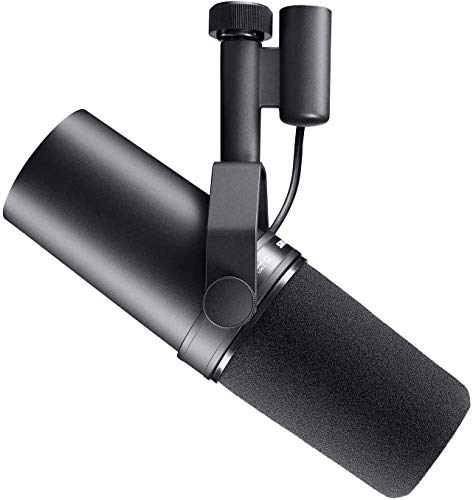
The SM7B is a cardioid dynamic on Shure’s RPM106 cartridge, rated 50 Hz to 20 kHz, with a bass roll-off switch and a presence boost switch on the back plate and a humbucking coil against monitor hum. Sensitivity is -59 dBV/Pa, which is low; the design assumes an outside preamp will make up the difference. It weighs 765 g. The mic has not changed since 2023; the 2025 price rise took it from $399 to $439.
The SM7dB carries the same transducer and the same two switches, plus a third: bypass, +18 dB, +28 dB. In bypass its output is -59 dBV/Pa and Sound On Sound found the recording indistinguishable from an SM7B. In +18 mode the output rises to -41 dBV/Pa and in +28 mode to -31 dBV/Pa. The preamp adds 72 g (837 g total) and a requirement for 48 V phantom power.
The MV7+ is a different, smaller dynamic capsule rated 50 Hz to 16 kHz. Over XLR it delivers -55 dBV/Pa, a little hotter than the SM7B and still a gain-hungry dynamic. Over USB the internal preamp and converter deliver -33 dBFS/Pa, and everything the mic can do to the signal happens on that side. It weighs 574 g and costs $140 less than the SM7B, and on a USB desk it is the only one of the three that needs nothing else.
What the SM7dB’s preamp does, and does not do
It adds output and does not lower the noise floor. Podcastage recorded the SM7dB against an SM7B on a Focusrite Scarlett 18i20 and found no quieter noise floor; the mic is an SM7B with more level. Sound On Sound called the stage a pad in reverse: a fixed lift of 18 or 28 dB applied before the cable, so the interface’s own gain knob can sit a third of the way up instead of at the top of its range.
On an interface with +56 dB of gain, an SM7B at a normal speaking distance runs the preamp at its limit, where budget preamps are noisiest. Moving 28 dB of the lift into the mic keeps a Scarlett Gen 3 or a Volt in the comfortable part of its range. On a 4th Gen Scarlett or a RODECaster, with +69 dB or more available, the built-in stage changes nothing audible. The preamp draws 48 V phantom; with phantom off the switch is inert and the mic behaves as a passive SM7B.
An SM7B at $439 plus a Cloudlifter CL-1 at $149 comes to $588, one more cable and one more box on the desk, against $549 for the SM7dB. If the interface is weak and the plan is XLR for the long run, the SM7dB is the cheaper way to solve the gain problem. If the interface already clears +69 dB, the SM7B saves $110 and records the same signal.

The MV7+ path: USB first, XLR as a spare
In The Podcast Host’s test, Auto Level on the MV7+ held the recording at -24 LUFS with peaks at -4 dBTP, which is a finished podcast level without a compressor in the edit. The rest of the on-device processing sits behind it: a denoiser, a digital popper stopper, tone presets, a compressor and a limiter, all set from the MOTIV Mix app and all applied before the signal reaches the computer. The 3.5 mm headphone jack carries the mic and the computer’s playback, so a solo recording or a remote call runs from one cable.
Over XLR the MV7+ is the weakest chain of the three. At -55 dBV/Pa it still wanted about 80 percent of the gain range on an SSL 2+ in Podcastage’s session, the DSP is off because it lives on the USB side, and the response stops at 16 kHz where the SM7B reaches 20 kHz. Podcastage also found the mic’s USB output hollower than its own XLR output. Buy the MV7+ for a USB desk; do not buy it as the XLR mic you plan to grow into. The MV7i ($389) puts an XLR and quarter-inch combo input on the back so a second mic or an instrument records through the same USB connection; the capsule and the USB path are unchanged from the MV7+.

Side by side
| Mic | Capsule and response | Sensitivity | Power | Outputs and processing | Weight | Price, Sept 28, 2026 |
|---|---|---|---|---|---|---|
| Shure SM7B | RPM106 dynamic, 50 Hz to 20 kHz | -59 dBV/Pa | None | XLR; bass roll-off and presence switches | 765 g | $439 |
| Shure SM7dB | Same transducer as the SM7B, with active preamp | -59 bypass, -41 at +18, -31 at +28 dBV/Pa | 48 V phantom for the preamp; passive in bypass | XLR; same two switches plus preamp switch | 837 g | $549 |
| Shure MV7+ | Smaller dynamic, 50 Hz to 16 kHz | -55 dBV/Pa XLR; -33 dBFS/Pa USB | USB-C bus; XLR passive | USB-C and XLR, 3.5 mm headphone out; Auto Level, denoiser, popper stopper, tone, compressor, limiter (USB only) | 574 g | $299 |
| Shure MV7i | MV7+ capsule | As MV7+ | USB-C bus | USB-C plus XLR/quarter-inch combo input for a second source | n/a | $389 |
Who buys which
Voiceover in an edit suite
An edit suite already has an interface for monitoring, and its gain figure picks the mic. A Scarlett 2i2 4th Gen or a MOTU M2 runs an SM7B without help. A Scarlett Gen 2 or Gen 3 left over from an older build makes the SM7dB the better buy, and cheaper than replacing the interface. The wider field of scratch-track and voiceover mics is in the USB and XLR mics for voiceover guide, and interface gain figures are in the recorders and interfaces guide.
Podcast
Two or more hosts in one room need an interface with a preamp per seat, and the RODECaster Duo and Pro II both have the gain, so an SM7B per chair is the pick and the $110 per seat stays in the budget. A solo host recording remote guests over a call needs one mic and no interface, and that is the MV7+. The full podcast mic field, including the sub-$200 options, is in the best podcast microphone guide; the interface half of a starter rig is in Alex’s start a podcast piece.
Zoom and client calls
Auto Level and the denoiser do the work a call needs, and the headphone jack removes the echo problem, so the MV7+ is the pick for a review session or a daily standup. An SM7B on a call is a $439 mic plus an interface doing a $299 mic’s job.
Amazon’s Prime Big Deal Days run October 6 and 7, 2026. All three mics were discounted for June’s Prime Day ($66 off the SM7B, $82 off the SM7dB, $45 off the MV7+); nothing is announced for October, and the prices on this page are the September 28 buy-box numbers.
FAQ
Does the SM7dB sound better than the SM7B?
No. It uses the same transducer, and in bypass Sound On Sound could not separate the two. The preamp modes add 18 or 28 dB of output level, not a different tone. Any difference in a finished recording comes from the interface running at a lower gain setting.
Does the SM7dB need phantom power?
Yes, for the preamp. The +18 and +28 dB modes draw 48 V from the interface; without it the switch does nothing and the mic works as a passive SM7B. Every interface named in this post supplies 48 V.
Can the MV7+ replace an SM7B over XLR later?
Partly. Over XLR the MV7+ is a -55 dBV/Pa dynamic that tops out at 16 kHz with no processing, and it still needs most of an interface’s gain range. The voice it records that way is usable, with less top end than the SM7B and none of the mic’s own processing. If XLR is the destination, buy the SM7B or the SM7dB now.
In conclusion
With +69 dB or more on hand, the SM7B at $439 is the same recording as the SM7dB for $110 less. With a +55 or +56 dB interface and an XLR future, the SM7dB at $549 costs less than the SM7B and a Cloudlifter and takes up less desk. With no interface at all, the MV7+ at $299 is the complete chain, and the MV7i covers the case where a second source has to ride along. Check the buy box before ordering: the SM7B and SM7dB both rose in price in 2025, and Prime Big Deal Days lands a week after this page went up.