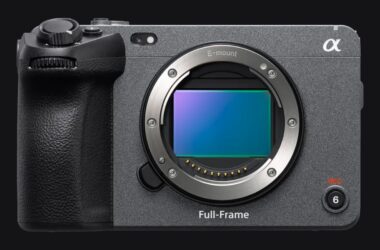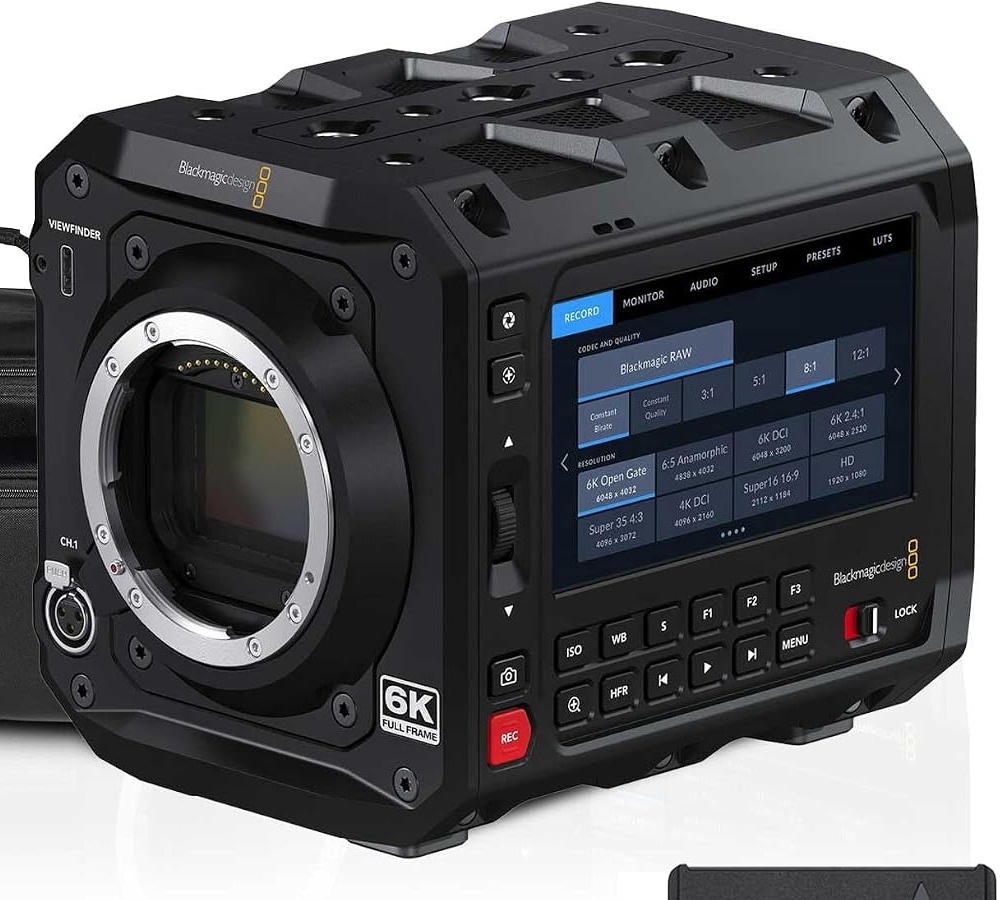

The Blackmagic PYXIS 6K records 12-bit Blackmagic RAW to a CFexpress card and writes a small H.264 proxy beside every clip. The Sony FX3 records 10-bit XAVC, and its RAW path runs out of the HDMI port into a recorder someone has to buy, mount and power. That is the difference an editor meets first, and it runs against the price: the camera that hands post the richer file costs $2,050 less.
The FX3 keeps its lead where the sensor decides the shot: two more stops of rated dynamic range, a second base ISO of 12,800 against 3,200, 4K at 120 fps, and stabilization and autofocus in a body that works handheld on its own. The PYXIS is a box, and a box needs a handle, a battery and a lens before it is a camera.
Last updated: October 2026. Some links below are affiliate links. Buy through them and it helps keep the site running, at no extra cost to you. Prices were read on the live Adorama and Amazon listings on October 12, 2026.
TLDR
Buy the PYXIS 6K at $2,245 if the footage is graded in DaVinci Resolve and the shoot is controlled: interviews, narrative, product, anything on sticks or a gimbal with time to set up. Internal 12-bit BRAW with proxies, a Resolve Studio key in the box, 12G-SDI and a timecode BNC make it the better camera to receive files from, and the price leaves $2,050 for glass. Buy the FX3 at $4,298 if the shooter works alone, works after dark or works at 120 fps. Its 15+ stops, its 12,800 second base and its 4K120 are numbers the PYXIS does not reach, and XAVC S-I opens in every NLE without a plugin.
The FX3 on Amazon is the FX3A body, Sony’s 2025 refresh that changed the rear screen and nothing about the files, so FX3 means FX3A for the rest of this page. Our FX3 vs FX30 comparison covers the cheaper Sony.
12-bit BRAW on a card against 10-bit XAVC
The PYXIS 6K records 12-bit Blackmagic RAW internally at the full 6048 x 4032 of its sensor, to two CFexpress Type B slots or to an external SSD over USB-C. Every clip gets a small H.264 proxy written at the same time, and the proxies upload to Blackmagic Cloud over 10Gb Ethernet or a tethered phone. An editor can be cutting proxies before the cards leave the camera, and the BRAW relinks when the originals arrive.
The FX3 records 10-bit 4:2:2 XAVC in three flavors: long-GOP S, All-Intra S-I and H.265 HS. S-I at 4K24 is 240 Mbps and 108 GB per hour, and it cuts without transcoding on any machine from the last five years. The FX3 writes proxies too. Its RAW is 16-bit over HDMI at 4264 x 2408, as ProRes RAW on an Atomos Ninja or as BRAW on a Blackmagic Video Assist since firmware v7.00: the path exists, as a second device with its own media and battery.
Storage is where the PYXIS costs more. A 6K 12-bit RAW frame carries more data than a 4K 10-bit compressed one at any sensible BRAW setting, and a card that holds a morning of S-I on the FX3 holds less of the PYXIS. Type B is the cheaper card format per gigabyte, and the USB-C port lets an SSD stand in for cards on a long interview day. The CFexpress vs SD guide covers Type B against the FX3’s Type A.
BRAW in Resolve, BRAW in Premiere, and the $295 in the box
The PYXIS 6K ships with a DaVinci Resolve Studio activation key. Resolve Studio is $295 on its own, so $295 of the $2,050 gap is software the buyer would otherwise pay for, and temporal noise reduction, the pass the low-light section below depends on, is a Studio feature. Resolve Studio vs the free version lists what the key unlocks.
BRAW in Resolve is the native case. ISO, white balance, gamma and highlight recovery sit in the Camera RAW panel and change per clip without a render. BRAW in Premiere Pro and Final Cut Pro goes through Blackmagic’s free plugin, which decodes the files and exposes the main RAW controls; the full set and the fastest decode live in Resolve, and a Premiere shop that never round-trips gives up part of what it paid for.
The FX3‘s XAVC opens everywhere with no plugin, which is its strongest post argument. Its RAW path is the complication: ProRes RAW from a Ninja does not open in Resolve, so an FX3 shooter feeding a Resolve grade records BRAW to a Video Assist and arrives at a smaller version of the PYXIS file after buying a second device. For a Resolve house the PYXIS is the shorter path and the cheaper one.

13 stops at 400 and 3,200 against 15+ at 800 and 12,800
Blackmagic rates the PYXIS 6K at 13 stops with dual native ISO at 400 and 3,200 and sensitivity to 25,600. Sony rates the FX3 at 15+ stops in S-Log3 with dual base ISO at 800 and 12,800. Two stops of range and two stops of base sensitivity, both to the Sony, whose 12.1MP pixels have about twice the area of the PYXIS’s 24.6MP ones.
In the grade, 13 stops means exposure is set on set. A window the FX3 holds with a soft clip is one the PYXIS blows or the face goes under; 12-bit RAW recovers the shoulder, not what the sensor never read. After dark the gap is wider: the FX3 at 12,800 grades like the PYXIS at 3,200, and 12,800 on the PYXIS is two stops into gain and a temporal noise reduction pass that pulls a 6K timeline well below real time.
Under a key light the ranking flips on bit depth. The PYXIS‘s 12-bit file carries four times the code values per stop of the FX3’s 10-bit log, and a lit interview at ISO 400 shows it in how far a secondary can be pushed before it bands. For lit work the Sony’s two extra stops go unused, and the cheaper file is the better one to grade.

6K open gate at 36 fps against 4K at 120
The PYXIS 6K records its full 3:2 sensor, 6048 x 4032, at up to 36 fps. A 6:5 anamorphic window runs to 60 fps, Super 35 4K, Super 16 and other windowed modes sit below that, and Full HD runs to 120 fps. The FX3 reads 4K from a 4.2K full-width readout up to 60p and crops about 1.1x for 4K at 100 and 120p, with a rolling shutter of about 8.8 ms at 4K24.
For post the open gate frame is reframing room. A 9:16 vertical cut from a 4032-pixel-tall master is still taller than 4K, and a 25 percent punch-in stays above UHD, so one PYXIS take covers a broadcast master, a social cutdown and a reframe. The FX3’s 12MP sensor has no spare pixels: 4K is the frame, and every punch-in is a scale.
Slow motion goes the other way. The FX3 delivers 4K at 120p at a crop the editor barely sees. The PYXIS reaches 120 fps only at Full HD, so a 120 fps insert on a 4K PYXIS timeline is a 2x upscale. A job built on slow-motion inserts is an FX3 job. A job built on one master that feeds several frame shapes is a PYXIS job, and the cheaper one.
Box body, SDI and timecode against a camera that leaves the bag ready
The PYXIS 6K is a box with a 1/4-20 and 3/8-16 mounting plate, an SSD plate and a 4-inch 1500-nit HDR touchscreen with LUT monitoring. The connector side is the case for it in a multicam room: 12G-SDI out, a BNC timecode input, 10Gb Ethernet, a mini-XLR with 48V and four channels of 24-bit audio, on Sony BP-U batteries, with SRT and RTMP streaming from the body. Three PYXIS bodies jammed to one timecode source arrive in Resolve as a multicam clip that syncs on the first try, and the SDI feeds a switcher or a client monitor with no HDMI converter in the chain.
The FX3 is a 715 g handheld body with in-body stabilization, autofocus and the XLR-H1 top handle in the box, which adds two full-size XLR inputs and four audio channels to the clip. It runs about 95 minutes of 4K on an NP-FZ100. Its video out is HDMI, and timecode comes in through an adapter cable on the USB port rather than a BNC. For a one-person documentary shoot that is the whole argument: the FX3 is a camera the moment it leaves the bag, and the run-and-gun documentary kit is built around a Sony body for that reason.
Price the PYXIS with its rig. A handle, two BP-U batteries and a charger are not in the box, and they come well inside the $2,050 difference, so the rigged PYXIS still undercuts the bare FX3. What the money does not buy back is stabilization and autofocus on a moving shot, and a shooter who relies on either stays with the Sony.
Three mounts and the price in October 2026
The PYXIS 6K comes in L-mount at $2,245, EF at $2,245 and PL at $2,475. Blackmagic announced a cut to $1,995 before tax for the L and EF bodies on September 4, 2026, and the US shelf price settled at $2,245 once duties and sales tax were added. On October 12, Adorama listed the L-mount as shipping from the manufacturer, the EF as temporarily on backorder and the PL with a slight delay. Amazon has only third-party bundles at $3,599 to $3,699 and Best Buy’s EF is a marketplace seller at $3,089 (its L-mount listing is gone), so our link goes to Adorama. The box includes a 60W power supply, the Resolve Studio key and a 12-month warranty.
L-mount opens the Sigma, Leica and Panasonic lines and adapts to most other glass; EF is where a decade of Canon lenses already sits; PL is for the rental house. The FX3 is E-mount only, and it is $4,298 at Amazon, sold by Amazon, with the XLR-H1 handle in the box.
Spec table
| Spec | Blackmagic PYXIS 6K | Sony FX3 (FX3A) |
|---|---|---|
| Sensor | 24.6MP full-frame 36 x 24 mm, OLPF | 12.1MP full-frame BSI |
| Max resolution | 6048 x 4032 open gate | 3840 x 2160 from 4.2K readout |
| Dynamic range (maker) | 13 stops | 15+ stops |
| Dual native / base ISO | 400 / 3,200, to 25,600 | 800 / 12,800 |
| Internal codec | 12-bit Blackmagic RAW | XAVC S / S-I / HS, 10-bit 4:2:2 |
| Proxies | H.264, simultaneous, cloud upload | Yes, in camera |
| RAW path | Internal | 16-bit over HDMI to a recorder |
| Top frame rates | 6K 3:2 36 fps, 6:5 anamorphic 60 fps, FHD 120 fps | 4K 60p full width, 4K 120p at ~1.1x |
| Rolling shutter, 4K24 | Not published on the listing we read | ~8.8 ms |
| Media | 2x CFexpress Type B, USB-C SSD | 2x CFexpress Type A / SD UHS-II |
| Monitor | 4-inch 1500-nit HDR touchscreen | 2.36M-dot rear screen |
| Video out | 12G-SDI | HDMI |
| Timecode in | BNC | Adapter cable on USB |
| Network | 10Gb Ethernet, SRT/RTMP streaming | None |
| Audio | Mini-XLR 48V, 3.5 mm in/out, 4 ch 24-bit | 2x XLR on the included handle, 4 ch |
| Battery | Sony BP-U, locking 2-pin DC | NP-FZ100, ~95 min 4K |
| Body | Box, 1/4-20 and 3/8-16 plates | Handheld, ~715 g, IBIS, AF |
| Lens mount | L, EF or PL | E |
| Software in box | DaVinci Resolve Studio key ($295) | None |
| Price | $2,245 L/EF, $2,475 PL | $4,298 |
Who pays the gap
$2,050 separates the L-mount PYXIS from the FX3, and $295 of it comes straight back as the Resolve Studio key. The rest pays for three things on the Sony: two stops of low light, 4K at 120 fps, and a stabilized, autofocusing body one person can run. A solo shooter with night exteriors, events or slow-motion inserts on the job pays it and should.
A studio that shoots lit interviews, narrative or product on sticks, grades in Resolve and sometimes runs two or three cameras to one timecode needs none of those three, and the PYXIS gives that studio 12-bit RAW, SDI and a timecode BNC for less than the body that lacks them.
Two cheaper paths sit under both. The Blackmagic Cinema Camera 6K at $1,755 is the smaller body on the same sensor family, with the same BRAW and Resolve Studio key and without the SDI, timecode BNC and 10Gb Ethernet; price it first when multicam is not on the list. On the Sony side a used 2021 FX3 records the same files as the FX3A, so the low-light and 120p case can be had for less than the new body.
Where this fits in your setup
Both cameras sit inside the best cameras under $5,000. The PYXIS lands just above the ceiling of the best cameras under $2,000. An editor receiving PYXIS files for the first time needs Resolve Studio (the key is in the camera box), a CFexpress Type B reader from the card guide, and more drive space per shoot day than XAVC needed.
An editor receiving FX3 files needs nothing new, and that is part of what the FX3’s price buys. The PYXIS asks the pipeline to run through Resolve, and for the shops that already do, it is the better camera to receive and the cheaper one to own.