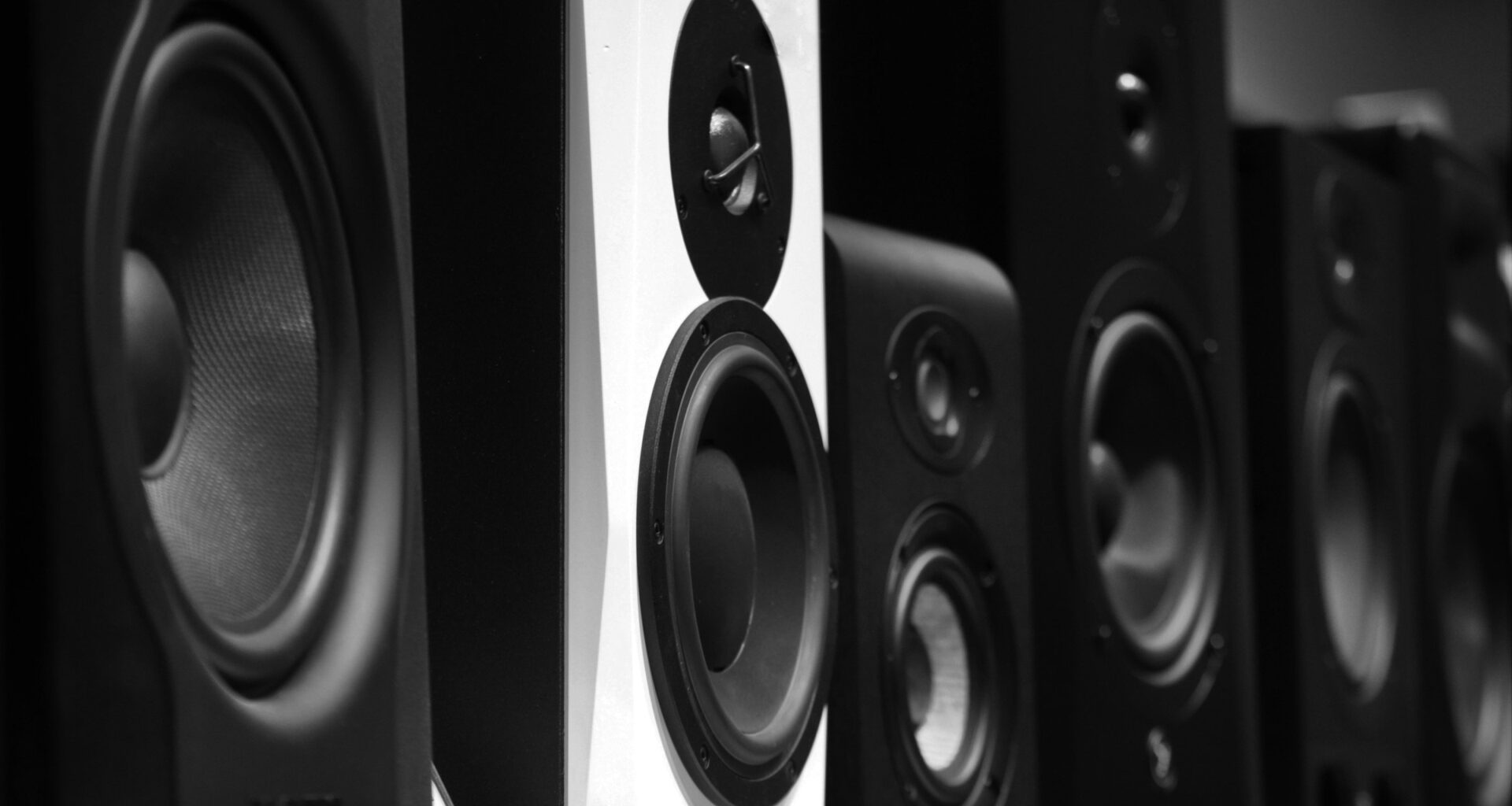

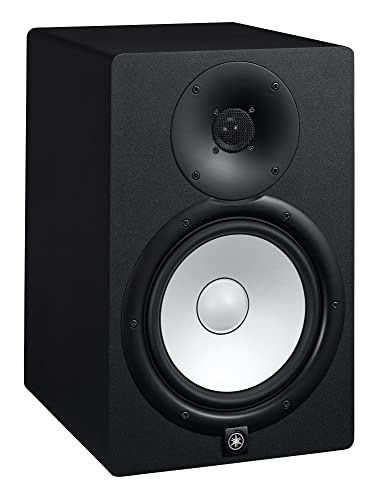
The room decides this one. The Yamaha HS5 has a 5-inch woofer, a rated response of 54 Hz to 30 kHz and 70 watts of bi-amped power, and it is built to sit 1 to 1.5 m from your ears on a desk. The Yamaha HS8 has an 8-inch woofer, reaches 38 Hz, carries 120 watts and wants a room with space behind the chair. Same tweeter, same tuning, same switches on the back panel. Measure the room and the listening distance; the pick follows.
Prices were read on the live Amazon listings on October 17, 2026, all sold by Amazon itself: HS5 $199.99 each or $399.98 a pair, HS8 $398.99 each or $797.98 a pair, HS8S $499.99, HS4 pair $249.99. We did not read a single-unit HS7 price that day.
Last updated: October 2026. Some links below are affiliate links. Buy through them and it helps keep the site running, at no extra cost to you.
TLDR
If you just want the answer: buy the HS5 pair ($399.98) for a desk in a room under about 12 square meters, or anywhere you sit less than 1.2 m from the speakers. Buy the HS8 pair ($797.98) for a dedicated room with the chair 1.5 m or more from the speakers, or if you mix music and sound-effects beds and need to hear below 50 Hz. Add the HS8S to an HS5 pair only when the room has bass treatment. The cheaper buy for an untreated room is the Kali LP-6 V2, covered at the end.

Room size decides it
The spec-sheet difference is 16 Hz of bass extension. The HS5 is rated to 54 Hz at the -10 dB point and is about 3 dB down near 74 Hz, so the bottom octave of a music bed plays quieter than the mix intends. The HS8 is rated to 38 Hz and holds level through the 50s. In a large or treated room that extension is the reason to pay double.
In a small room it works against you. A 3 by 4 m room (12 square meters) has its first axial modes near 57 Hz and 43 Hz, and a speaker with real output there produces peaks and nulls of 10 dB or more across the desk. The HS5 has little level left by 57 Hz, so the room contributes less. The HS8 drives both modes at full output, and a dialogue mix balanced on it in that room comes out thin on every other system.
Listening distance is the second gate. At 1 to 1.5 m the HS5‘s woofer and tweeter have fused into one source. The HS8’s drivers sit further apart in a 390 mm cabinet, and under about 1.2 m you hear two drivers. If the chair cannot move back, the HS5 is the better monitor, and the $398 saved covers the first-reflection panels.
ROOM CONTROL and HIGH TRIM for a desk against a wall
Both monitors are rear-ported and both carry the same two switches for it. ROOM CONTROL cuts the response below 500 Hz by 0, 2 or 4 dB to offset the bass a wall adds; HIGH TRIM shifts everything above 2 kHz by +2, 0 or -2 dB. With the cabinet within 30 cm of the wall behind it, set ROOM CONTROL on the HS5 to -4 dB; between 30 cm and about 1 m, -2 dB. Set both speakers identically, set the rear LEVEL knobs to the same mark, and use the interface output as the only volume control. HIGH TRIM gets set once: -2 dB for hard walls and a window behind the desk, 0 or +2 dB for carpet, curtains and panels. After that leave it, because the point of the HS tuning is a reference that does not move.
The HS8 needs more room behind it. The cabinet is 334 mm deep, so on a 60 cm desk it sits almost flush with the wall, and -4 dB of ROOM CONTROL removes the boundary gain without touching the mode problem above. On a desk that shallow the HS8 goes on stands behind the desk. The HS5 is 222 mm deep and fits most desks with the clearance the port wants.
The bright top end
The HS series measures close to flat, and flat sounds bright next to consumer speakers. The 1-inch dome tweeter on the HS5 and the HS8 crosses over at 2 kHz and runs to 30 kHz with no lift in the presence region. Sibilance, mouth clicks and lav hiss sit where you can hear them. An hour of loud listening on that tuning is tiring, and the fix is level: dialogue work happens at a conversational 76 to 79 dB SPL, well under what a music mixer runs.
Neither speaker corrects for the room. There is no measurement mic and no DSP; both hand you a repeatable picture of the signal and leave the room for you to learn. The studio monitors guide ranks the calibrated speakers that do.
Dialogue mixing on either pair
Set the monitor level once and keep it. Play pink noise at -20 dBFS from the timeline, hold an SPL meter (a phone app is accurate enough) at the listening position, and raise the interface output until one speaker reads 76 to 79 dB SPL, C-weighted, slow. Mark the knob. A mix that sounds right at that mark lands close to the -23 LUFS integrated target of EBU R128 and the -24 LKFS of a US broadcast spec; a true-peak meter in the NLE checks the rest. The HS5‘s 70 watts has headroom to spare at 1 m for that level. The HS8’s extra power is loudness a dialogue room never uses.
Neither Yamaha has a mono switch, and the mono check is where a stereo room lies to you. A phase problem between a boom and a lav, or a music bed with wide stereo processing, can sound full in stereo and thin out when a phone or a TV soundbar sums it. In Resolve, the Fairlight monitoring panel has a mono button; Premiere has none, so a mono-summing effect on the master or a monitor controller does the job. Check every cut in mono before delivery, then do the headphone pass.
The HS8S subwoofer question
An HS5 pair plus an HS8S costs $899.97, $102 more than an HS8 pair at $797.98. The HS8S is an 8-inch, 150-watt powered subwoofer rated to 22 Hz, with a variable high cut from 80 to 120 Hz, a matching low-cut switch for the satellites and a phase switch. Crossed at 80 Hz it takes the bottom two octaves off the HS5s and reaches lower than the HS8 pair, and the small speakers keep their near-field imaging.
In a treated room that is the better system. In a bare room it is the worse one: a subwoofer has one placement in a small room that gives a smooth response at the chair, finding it takes a measurement mic and an afternoon, and without bass traps the sub’s output lands on the same 43 and 57 Hz modes as the HS8, from a cabinet that is harder to position. Our rule: HS5 pair alone in an untreated room; add the HS8S once the room has traps and the work includes music or effects beds; HS8 pair in a room large enough that the modes fall below its reach.

The HS7 between them and the HS4 below
The Yamaha HS7 is the 6.5-inch cabinet, rated to 43 Hz with 95 watts, sized for a 12 to 20 square meter room where the HS5 runs out of low end and the HS8 overloads the room. We did not read a single-unit price in October; the HS7 pair bundled with an HS8S was $849.98 from Amazon itself.
Below the HS5, the Yamaha HS4 pair at $249.99 is a 4.5-inch system with the amplifier in one cabinet driving both. It keeps the HS tweeter and the tuning and gives up another slice of low end. For a laptop desk with the speakers 60 to 80 cm away and dialogue-only work, it is enough. For anything with a music bed, the $150 step to the HS5 pair buys the bottom octave back.
Side by side
| Monitor | Woofer | Rated response | Power | Size (W × H × D) and weight | Inputs and switches | Price, October 2026 |
|---|---|---|---|---|---|---|
| Yamaha HS5 | 5 in, 1 in dome tweeter, 2 kHz crossover | 54 Hz to 30 kHz | 70 W bi-amp (45 + 25) | 170 × 285 × 222 mm, 5.3 kg | XLR and TRS; ROOM CONTROL, HIGH TRIM, LEVEL | $199.99 each, $399.98 pair |
| Yamaha HS8 | 8 in, 1 in dome tweeter, 2 kHz crossover | 38 Hz to 30 kHz | 120 W bi-amp (75 + 45) | 250 × 390 × 334 mm, 10.2 kg | XLR and TRS; ROOM CONTROL, HIGH TRIM, LEVEL | $398.99 each, $797.98 pair |
| Yamaha HS7 | 6.5 in, 1 in dome tweeter | 43 Hz to 30 kHz | 95 W bi-amp | Between the two | Same as HS5 and HS8 | Pair with HS8S $849.98; single not read |
| Yamaha HS8S | 8 in subwoofer | 22 Hz to 160 Hz | 150 W | Floor cabinet | XLR and TRS in and through; high cut 80 to 120 Hz, low cut, phase | $499.99 |
| Yamaha HS4 | 4.5 in, pair with one powered cabinet | Narrower than the HS5 | Shared amp | Desktop | TRS, RCA, 3.5 mm | $249.99 pair |
| Kali LP-6 V2 | 6.5 in, 1 in tweeter, front port | 47 Hz to 21 kHz | 80 W bi-amp, 115 dB max SPL | Between the HS5 and HS7 | XLR, TRS, RCA; boundary-EQ dip switches | See the monitors guide |
Yamaha rates response at the -10 dB points; the -3 dB figure sits roughly 15 to 20 Hz higher on each cabinet, which is why the HS5 reads as thin under 74 Hz.
Which one for your room
A desk in a bedroom or spare room, under 12 square meters
The HS5 pair, ROOM CONTROL at -2 or -4 dB, on isolation pads, tweeters at ear height, speakers and head in a 1 to 1.2 m triangle.
A dedicated edit room, 15 to 25 square meters
The HS8 pair on stands, 1.5 to 2 m from the chair, at least 40 cm off the wall behind them. The room modes fall low enough that the 38 Hz extension reports the mix, and the bigger cabinet fills a room the HS5 sounds small in.
Music or sound-effects beds are part of the job
You need to hear below 50 Hz, so the HS5 pair alone is out. In a treated room of any size, the HS5 pair plus HS8S at $899.97 reaches lowest. In a larger untreated room, the HS8 pair at $797.98 is the simpler buy with one fewer cabinet to place.
The cheaper option: Kali LP-6 V2
A 6.5-inch woofer rated to 47 Hz, 80 watts, 115 dB of maximum output, a front port, and boundary-EQ dip switches on the back for a desk against a wall. The Kali LP-6 V2 reaches lower than the HS5, places more easily than the HS8 because the port faces you, and at list price a pair costs about what the HS5 pair does. It is the budget pick in the studio monitors guide for those reasons. It gives up the HS cabinet’s build and resale value, and Kali’s stock and marketplace pricing have been less steady than Yamaha’s, so read the listing before deciding. For an untreated room it solves more of the problem per dollar than either Yamaha.

FAQ
Is the HS8 too big for a bedroom edit suite?
Under about 12 square meters and untreated, yes. Its 38 Hz extension lands on the room’s first modes and the bass at the chair swings by 10 dB or more. The HS5 pair plus two bass traps gives a more consistent low end in that room than the HS8 pair alone.
Are the HS5 and HS8 sold as pairs?
Both are sold singly, and Amazon lists a two-unit pair at double the single price: $399.98 for two HS5s and $797.98 for two HS8s at our October 2026 check. Only the HS4 is sold as a pair by design.
Do these speakers have a mono button or room correction?
No to both. The back panel has LEVEL, ROOM CONTROL and HIGH TRIM. Mono summing happens in the NLE or on a monitor controller, and room correction means a different speaker; the studio monitors guide ranks the ones that include it.
In conclusion
Under 12 square meters or under 1.2 m from the speakers, the HS5 pair at $399.98 is the better monitor and the remaining $398 goes into treatment. In a dedicated room with 1.5 m or more between chair and speaker, or when music and effects beds need the bottom octave, the HS8 pair at $797.98 reports what the smaller cabinet cannot. The HS8S joins the HS5 pair only once the room is treated. If the room will stay untreated, the Kali LP-6 V2 pair is the cheaper answer. Check the buy box before ordering; the prices here are from October 17, 2026.